Get Full Government Meeting Transcripts, Videos, & Alerts Forever!
Get email alerts on the Alaska Aerospace topic
No spam. Unsubscribe anytime.
Alaska Aerospace details Kodiak operations, hypersonic range plans and economic gains
Summary
John Oberst, president and CEO of Alaska Aerospace, told a legislative "lunch and learn" that the Pacific Spaceport Complex–Alaska on Kodiak Island is expanding services, pursuing new licenses (including at Poker Flat), supporting hypersonic testing, and has grown its revenues and workforce in recent years.
John Oberst, president and CEO of Alaska Aerospace, told a legislative “lunch and learn” that the state-owned company is expanding launch services from the Pacific Spaceport Complex–Alaska in Kodiak and pursuing additional facilities and ranges across the state.
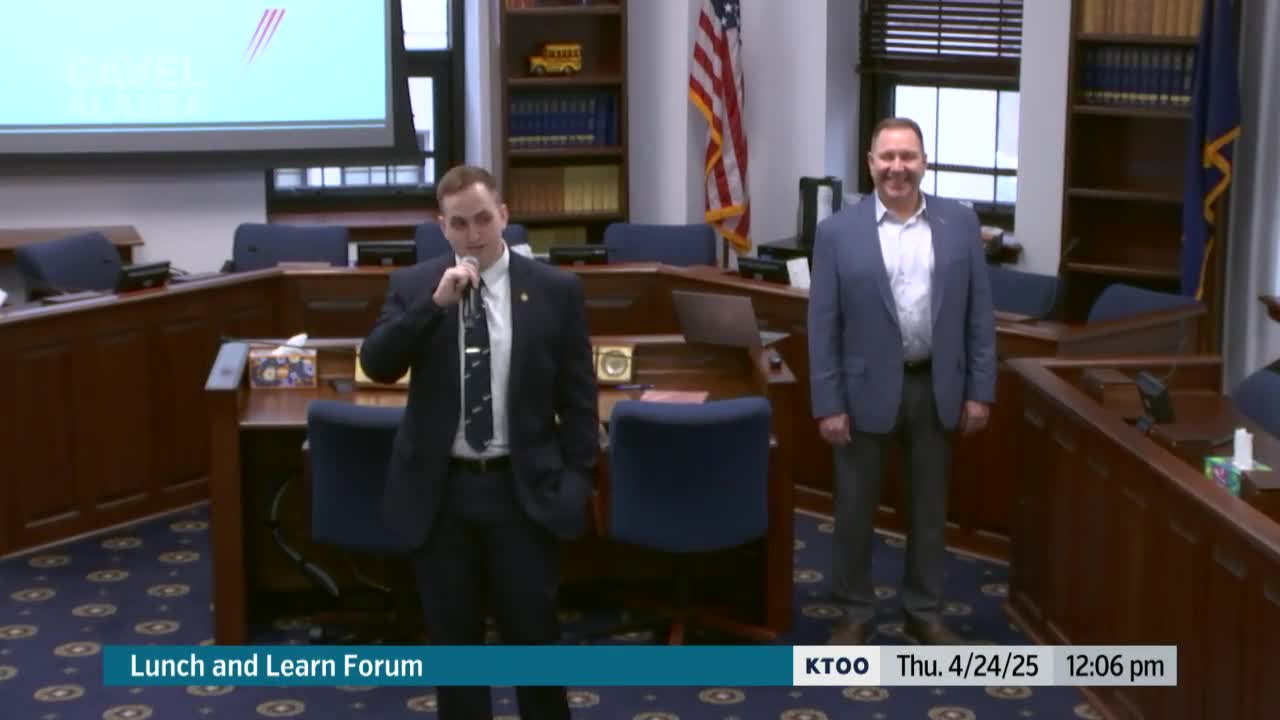
Oberst said Kodiak’s spaceport supports launches into polar and sun-synchronous low Earth orbits and provides government-range services internally rather than relying on federally subsidized range infrastructure. “I’m president, CEO of Alaska Aerospace. I’ve been in the job for about a year,” Oberst said as he opened his presentation and outlined operations, workforce and growth plans.
The company reported a recent increase in business and an expansion in staff and contracts. Oberst said Alaska Aerospace brought about $16,000,000 a year into the state economy in recent years, that Kodiak employs “about 40 people,” and that the organization has 10 staff at its Anchorage headquarters. He said the company signed $24,000,000 in contracts since Jan. 1 and expected additional contract awards by the July 1 fiscal year start. “We have turned the corner economically, and that’s 1 spaceport,” Oberst said.
Why it matters: Oberst framed the expansion as both an economic opportunity for Kodiak and a strategic asset for U.S. testing needs. He told legislators the company is pursuing new licensing and range work — including a licensing process at Poker Flat Research Range — and hopes to develop hypersonic test ranges along the Aleutian Chain and from Fairbanks north to the Arctic Ocean.
Details of operations and capacity: Oberst described Kodiak as a vertically integrated commercial range that provides security, flight-safety range control, tracking and telemetry with containerized instrumentation that can be deployed internationally. He said Kodiak’s land footprint is roughly 3,700 acres under an interagency land management agreement (ILMA) and that the site has a variety of pads (concrete and one gravel pad) and supporting payload facilities. He described Kodiak as better than many U.S. coastal sites for weather-related reliability, saying lightning and hurricanes are rare there.
Launch cadence and licensing: Oberst said Kodiak holds a federal launch license and historically launches one to three rockets per year, with an existing license for nine launches and a submitted request seeking licensing for 25 launches per year at Kodiak. He said a typical practical throughput historically is about one-third of a license’s maximum. He said the FAA regulates launches and that hypersonic activity can include aircraft-, ship- or air-drop-launched vehicles that do not count against Kodiak’s rocket-launch license.
Hypersonics and test ranges: Oberst said the U.S. lacks the capacity to test hypersonic vehicles at the rate some federal and private actors want. He described plans for a multi-node hypersonic test capability along the Aleutians using remote tracking and destruct systems (RSTS) that can issue a destruct command to onboard charges if a vehicle violates flight-safety parameters. He also described a proposed northern range from Fairbanks into the Arctic Ocean so test vehicles could be recovered for post-flight inspection.
Workforce, education and community engagement: Oberst described internships (four last year, eight planned this year), outreach to the University of Alaska Geophysical Institute to license Poker Flat for orbital launches and plans to increase engagement with STEM programs. He said the spaceport is a multi-generational employer on Kodiak and highlighted local hires who perform multiple operational roles. Oberst said Alaska Aerospace coordinates with local Kodiak media (KMXT and KDM) and participates in community events such as ComFish.
Funding and independence: Oberst said the spaceport has had “zero state funding since 2014” after an on-site explosion in February 2014 that required rebuilding. He said federal funding has been available as periodic "plus-up" contributions, but that most operating revenue now comes from commercial contracts and services the organization exports internationally.
Open questions and limits of authority: Oberst said some ambitions — for example, attracting heavy or super-heavy launch customers or broad private equity investment — will require structural and financing changes. He said Alaska Aerospace can pursue joint ventures now but that state-corporation structure may need review for larger-scale private investment. He also cautioned that specific counts and future contracts are in flux and provided projected contract figures rather than fixed appropriations.
Ending: Oberst took questions from legislators about distance to the Kodiak site, how destruct systems work, licensing and launch rates. He closed by saying the company has started the licensing process at Poker Flat and is pursuing multiple statewide initiatives to grow Alaska’s aerospace footprint.