Get Full Government Meeting Transcripts, Videos, & Alerts Forever!
Get email alerts on the Hb199 Cfab Funding topic
No spam. Unsubscribe anytime.
Committee considers bill to inject about $3.7 million into CFAB to preserve low-rate loans; members ask for appropriation clarity
Summary
House Bill 199 would provide a one-time, temporary investment of roughly $3.7 million to the Alaska Commercial Fishing and Agriculture Bank (CFAB) so the bank can refinance or issue low-interest loans at a 5.25% rate. Committee members questioned the fiscal mechanics and appropriation pathway; the bill was set aside pending clarification.
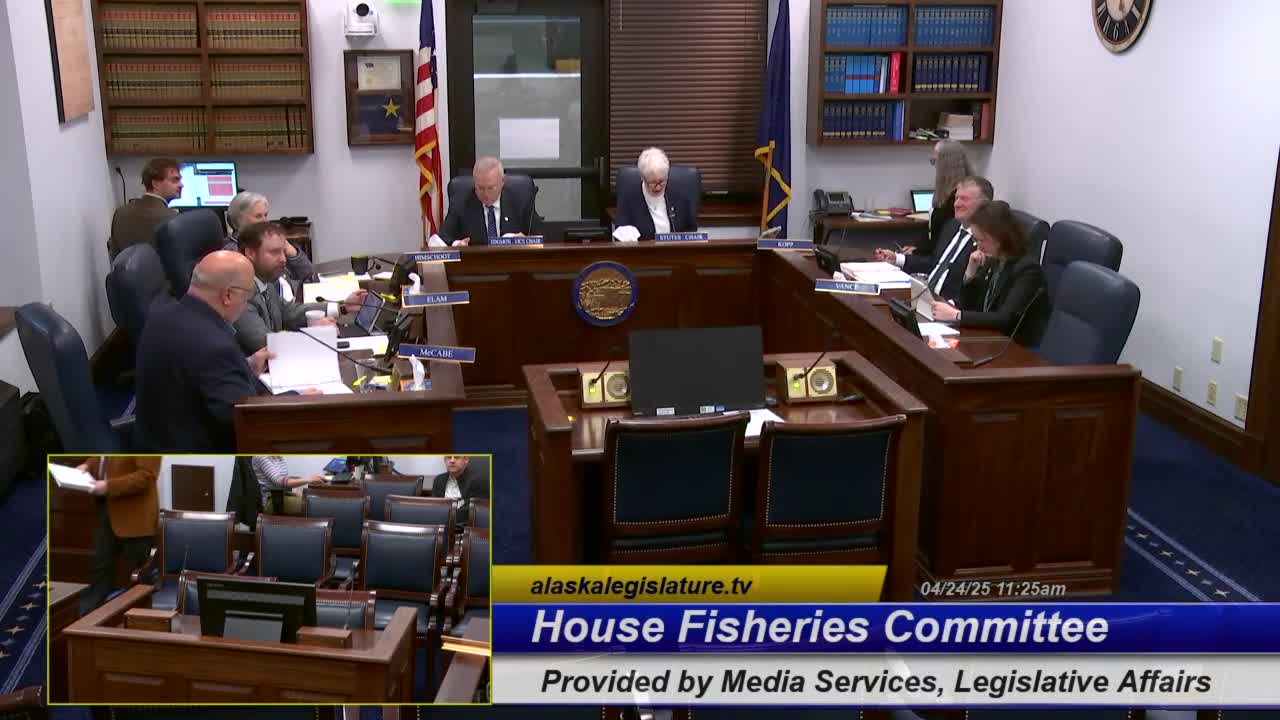
House Bill 199, presented April 24 to the House Special Committee on Fisheries by committee staff, would provide a one-time temporary investment of roughly $3.7 million in state funds to the Alaska Commercial Fishing and Agriculture Bank (CFAB) so the bank can refinance existing loans or issue new low-interest loans at a 5.25% rate.
Kyle Newman, staff to the committee, told members HB 199 is a response to CFAB losing loan volume because the state’s Commercial Fishing Revolving Loan Fund temporarily set interest at a fixed 5.25% under 2024 legislation (HB 273). "This would allow CFAB to refinance existing loans and potentially issue new loans at a reduced interest rate of 5.25%, the same rate currently offered by the Commercial Fishing Revolving Loan Fund," Newman said. He said the $3.7 million would come from an existing, defunct Capstone Avionics revolving loan fund currently holding about $3.7 million; the bill would require a purchase of Class C non-voting shares in CFAB, subject to appropriation.
Sharon Lechner, president of CFAB, testified in support, describing CFAB’s cooperative, public-purpose mission and its willingness to work with borrowers rather than foreclose. "Right now, about 90% of our loans are commercial fishing loans," Lechner said, and CFAB had introduced seasonal bullet loans to provide working capital as processors reduced working-capital lending. She told the committee the infusion would extend a financial lifeline to several hundred fishermen and their communities.
Committee members focused on fiscal mechanics. Representative Vance asked why there was no fiscal note showing the transfer; staff replied the bill itself does not move funds but, as written, authorizes the department—subject to appropriation—to buy CFAB shares. Vance and Representative McCabe pressed for a clear appropriation mechanism and a fiscal note so the committee could trace where the money would come from and how the transfer would appear in the operating or capital budget.
Members also asked about the history and status of the Capstone Avionics Revolving Loan Fund; Newman said the program had sunset and the funds remained in place after a prior reallocation effort was vetoed. Newman and Lechner described CFAB’s statutory authority under AS 44.81, noting the bank was created by statute in 1978 and that the state provided start-up capital via share purchases in 1979 (roughly $32 million) that CFAB repurchased by 1998.
Why it matters: CFAB provides financing tailored to commercial fishing and other rural industries. Committee staff said low ex-vessel returns and high operating costs have strained borrowers; CFAB contends it is losing new loan business because it cannot match the temporarily low rate available from the state revolving loan fund. The $3.7 million pulse would be used only for low-interest loans for a two-year period, with the state repaid over time by CFAB under the bill’s terms.
No formal committee vote was taken on HB 199; members agreed to set the bill aside while staff obtains clarifications on appropriation language and a fiscal note. Committee staff and legal counsel were asked to return with precise budget language and any necessary fiscal documentation before the committee considers the bill further.
Meeting context: Presenters included committee staff and CFAB leadership; Division of Banking and Securities staff were noted as available online but did not provide extended testimony during the hearing. The committee adjourned at 11:40 a.m.