Get Full Government Meeting Transcripts, Videos, & Alerts Forever!
Get email alerts on the Office Of Entrepreneurship topic
No spam. Unsubscribe anytime.
Committee hears bill to create Office of Entrepreneurship; fiscal notes estimate $661,000 annually and a one‑time disparity study
Summary
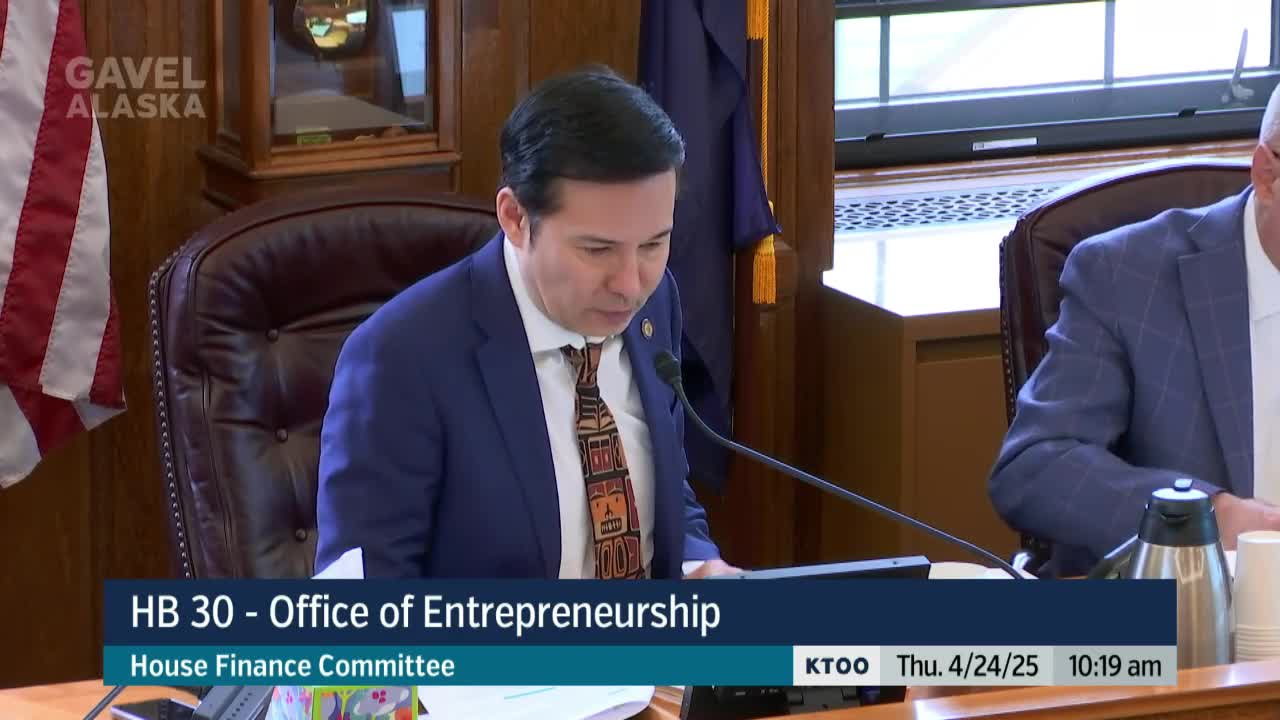
The Alaska House Finance Committee on April 24 held an introductory hearing for House Bill 30, which would create an Office of Entrepreneurship inside the Department of Commerce to coordinate startup supports and review how state policy affects new businesses.
The Alaska House Finance Committee held an introductory hearing on House Bill 30 on April 24, 2025, a measure sponsored by Representative Kai Holland to establish an Office of Entrepreneurship inside the Department of Commerce, Community and Economic Development (DCCED). Proponents said the office would coordinate statewide startup supports, promote scaling of high‑growth firms and produce regular analysis of how state policy affects new businesses.
Representative Kai Holland, sponsor, said the office would help retain and grow Alaskan firms and suggested a baseline funding concept directing 5% of the state’s economic development budget toward programs supporting startups. “100% of net new job creation in this country comes from entrepreneurs and new, scalable businesses. In Alaska, it's 89%,” Holland told the committee, arguing the office would strengthen the pipeline for emerging sectors including mariculture, aerospace and energy technology.
University of Alaska Center for Economic Development Director Jared Reynolds, invited to testify, summarized the Center’s research: “Alaska is a state of entrepreneurs. We rank eighteenth in the nation in start up density ... Over the past decade, those young companies generated 41,000 net new jobs,” he said, adding that the state struggles with scaling firms, particularly outside Anchorage, and that a more coordinated ecosystem could help.
Fiscal notes and staffing: Department fiscal testimony identified an estimated ongoing cost of $661,000 from the general fund in each fiscal year to support three positions — one division director, one program coordinator and one research analyst — and travel and operating expenses. Administrative Services Director Hannah Lager said positions were planned to be located in Juneau for recruitment and coordination. Chief Procurement Officer Tom Mayer said a one‑time disparity study to assess how state spending reaches newer businesses could cost in the range of prior disparity studies and cited roughly $500,000 as a comparable figure; the fiscal note listed a control code and a one‑time services cost for that study.
Key points of committee discussion: members questioned the bill’s emphasis on procurement as a measure of success for entrepreneurs, discussed how the office would work for rural communities and asked about the scope and cost of the disparity study. Representative Tomczewski asked whether the study would look at regulatory barriers; Holland said the ongoing review function of the office (described in the bill) is intended to monitor how policy changes affect new businesses, while the one‑time study is a snapshot of procurement access for young firms. Several members urged a tighter, lower‑cost scope for the study.
The committee did not take a committee vote on HB 30 during the morning session. Representative Holland and invited witnesses said further discussion and testimony would continue in the afternoon; the committee scheduled follow‑up consideration and noted that HB 34 (Alaska Innovation Council) may connect to the same policy aims.
The bill remains at the introductory/hearing stage; no motion to advance or refer HB 30 was recorded in the transcript.