Get Full Government Meeting Transcripts, Videos, & Alerts Forever!
Get email alerts on the Permanent Fund Pomv topic
No spam. Unsubscribe anytime.
Senate Finance hears modeling of SJR 14 POMV amendment; analysts show short‑term tradeoffs and long‑term crossover
Summary
Legislative Finance Division analysts presented probabilistic and linear modeling of proposed SJR 14 changes to the Permanent Fund’s percent of market value (POMV) payout. Models show higher near‑term payouts at higher draw rates but a crossover in ~25 years when lower draws can yield larger nominal payouts as the fund grows.
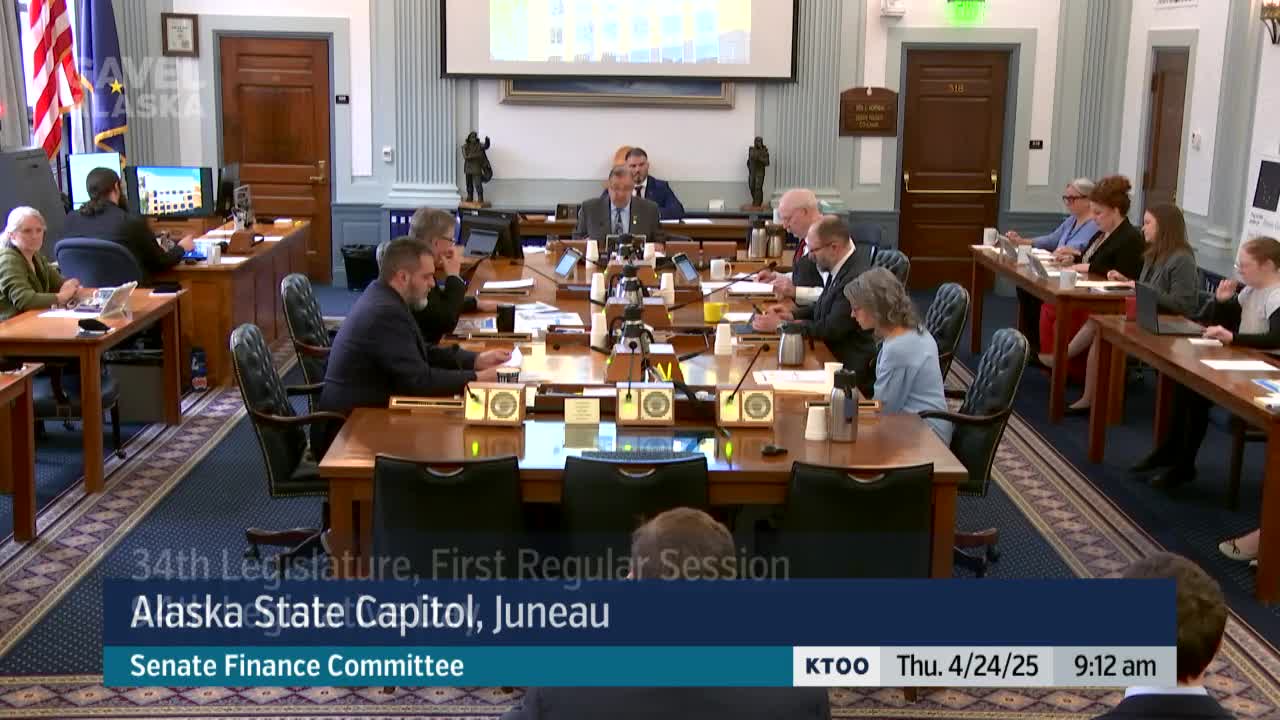
Juneau — Legislative Finance Division analysts Alexi Painter and Connor Bell presented modeling on SJR 14, a proposed constitutional amendment that would change how the Permanent Fund’s percent of market value (POMV) payout is calculated.
Painter described two modeling approaches used for the committee: a linear model that follows the Department of Revenue forecast and a probabilistic model that incorporates volatility in oil receipts and Permanent Fund investment returns. “The median cases that use these models are typically slightly lower than the linear model,” Painter said, noting the probabilistic runs use Callan’s ranges for investment returns.
The analysts tested multiple permutations the committee requested: varying the POMV draw percentage between 4.5% and 5.5%, changing the averaging period in the formula between three and seven years, and several hybrid or step‑down provisions that would change the draw rate over time. Many scenarios assume an effective date in FY 2028, when the amendment would take effect under the draft language.
Connor Bell walked the committee through the numeric results, explaining the range of uncertainty the probabilistic model produces. Bell noted the presentation shows nominal dollars only: “These are all nominal dollars. None of the figures in this presentation will be adjusted for inflation.” He illustrated that, for example, a 4.5% draw (five‑year average) produces an approximate median POMV payout of $3,600,000,000 in early years, while a 5.5% payout produces roughly $4,400,000,000 in the same year, and that a three‑year average generally increases near‑term payouts compared with a seven‑year average.
Analysts emphasized volatility and predictability tradeoffs. Adding more years to the averaging period tends to lower the effective draw rate and reduce year‑to‑year volatility, while shorter averaging increases both near‑term payouts and uncertainty. Bell said the probabilistic model runs thousands of iterations and reports percentiles of outcomes; he also stressed a simplifying assumption the analysts used: returns from year to year were treated as uncorrelated. “We’re assuming that returns from year to year are uncorrelated,” Bell said, noting that correlation or persistence in returns would change tail risks in the simulations.
Committee members asked about interpretation and limits of the modeling. Senator Kaufman raised concerns about sequence‑of‑returns risk and whether adverse returns early in the horizon were modeled differently; Painter and Bell said the trials distribute returns randomly and that correlated sequences were not modeled. Senator Stedman emphasized market‑return uncertainty and portfolio changes the Permanent Fund Corporation might undertake if draw policy changed.
Analysts also extended illustrative scenarios to FY 2052 using long‑term royalty extrapolations; under those assumptions lower draw rates can produce a larger nominal payout after roughly 25 years because the fund balance grows faster under lower withdrawals.
The committee did not take action on SJR 14 at the hearing and set the item aside for further consideration and possible follow‑up requests for additional modeling, including alternate assumptions or longer probabilistic horizons.