Get Full Government Meeting Transcripts, Videos, & Alerts Forever!
Get email alerts on the Workforce Housing Finance topic
No spam. Unsubscribe anytime.
House committee hears bill to let AIDEA finance workforce multifamily housing
Summary
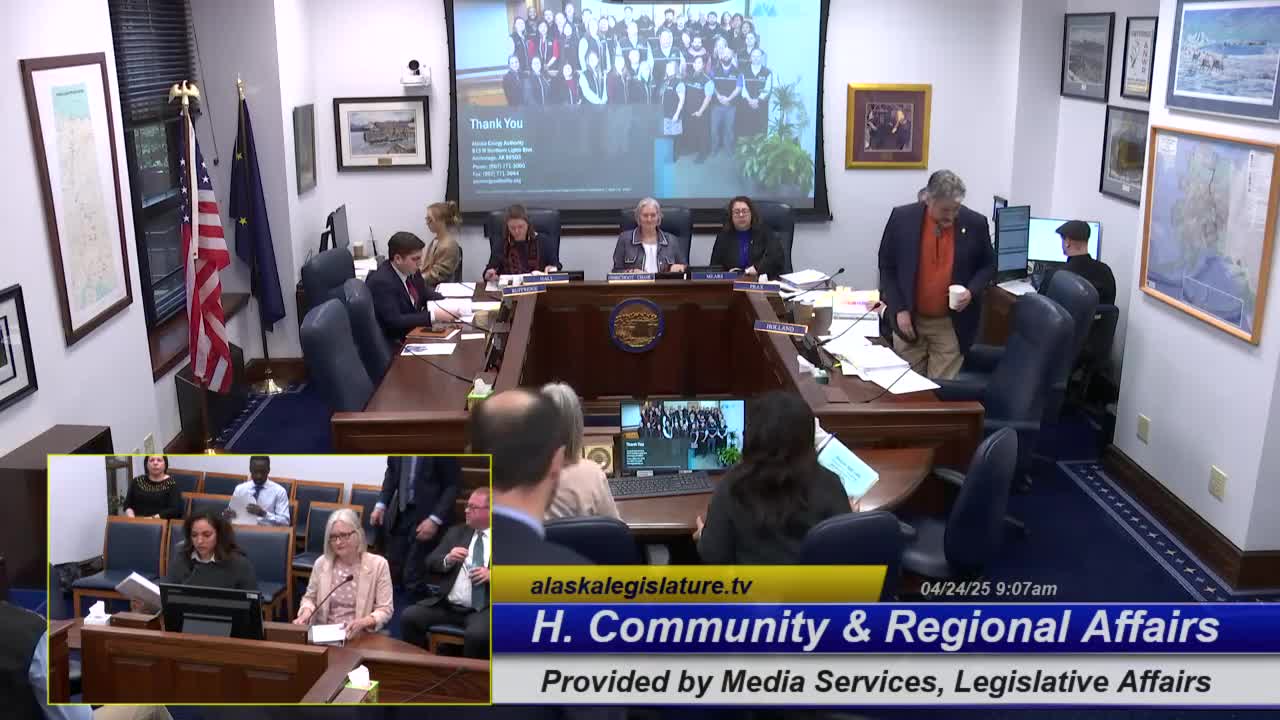
Representative Andy Story, sponsor of House Bill 184, told the House Community and Regional Affairs Committee on April 24 that many Alaska communities face acute shortages of multi‑family and affordable workforce housing and that the Alaska Industrial Development and Export Authority could expand financing tools to address that gap.
Representative Andy Story, sponsor of House Bill 184, told the House Community and Regional Affairs Committee on April 24 that many Alaska communities face acute shortages of multi‑family and affordable workforce housing and that the Alaska Industrial Development and Export Authority (AIDEA) could expand financing tools to address that gap.
The bill would amend AIDEA’s statutory loan-participation and development authorities to explicitly allow financing for workforce housing developments with five or more dwelling units. “Workforce housing” in the draft is defined using U.S. Department of Housing and Urban Development area median income (AMI) standards: residential housing that costs occupants less than 30% of the income of a household at 120% of AMI.
Why it matters: Committee members and invited testimony framed the bill as a practical step to expand capital sources for developments that “pencil” with tighter margins. Testimony emphasized that many developers have not built mid‑price multifamily housing because available financing and incentives favor higher‑end single‑family or condo construction.
Invited testimony and questions: Honor Miller Austin, staff to Representative Story, walked committee members through sectional changes. Brandon Reshinsky (AIDEA deputy director) said AIDEA already has statutory authority and internal programs that could support commercial housing projects but that the bill adds clarity and statutory direction; he said AIDEA had not yet received formal commercial multifamily applications through banks for such projects but had had preliminary discussions with municipalities.
Stacy Barnes, director of government relations and public affairs for Alaska Housing Finance Corporation (AHFC), told the committee AHFC offers single‑family and multifamily lending programs but that AIDEA involvement could be complementary — AIDEA can engage in early-stage construction or gap financing while AHFC can provide longer-term housing finance.
Christine Wall, a Juneau assembly member testifying in support, said Juneau’s municipal incentives (tax abatements, reduced parking requirements and limited city financing) have helped but were not sufficient to make many multifamily projects financially viable without additional investor-friendly capital. Rochelle Johnson of the University of Alaska Center for Economic Development presented statewide data showing multifamily construction has fallen and rental vacancy rates remain low, arguing additional financing tools can help spur construction.
Concerns and clarifications: Representative Reffridge and others asked whether the bill’s HUD‑based definition — AMI at 120% and 30% income share — could permit units that remain expensive in higher‑cost communities (for example, a $3,000 monthly cost in Juneau under the formula). AIDEA and AHFC staff said AMI is a HUD standard updated annually and that statutory language could be tracked against community AMI tables; AIDEA noted it typically would consider projects under existing commercial loan and loan‑participation mechanisms and that the lack of explicit income limitations could provide flexibility.
Outcome: The committee held a first hearing. Members requested follow-up materials, including AMI tables across communities and AHFC data on current multifamily loan demand. No committee vote was taken; the bill was set aside for further consideration.
Ending: Sponsors said the measure is one of several steps — zoning changes, local incentives and financing — needed to address statewide workforce housing shortages.