Lifetime Citizen Portal Access — AI Briefings, Alerts & Unlimited Follows
Alaska Energy Authority details strain on rural power systems, urges funding to stabilize Power Cost Equalization
Loading...
Summary
The Alaska Energy Authority told the House Community and Regional Affairs Committee that the Power Cost Equalization endowment and rural energy infrastructure face funding and maintenance shortfalls, and described programs — including circuit riders and bulk fuel upgrades — used to support 82 utilities and roughly 82,000 Alaskans.
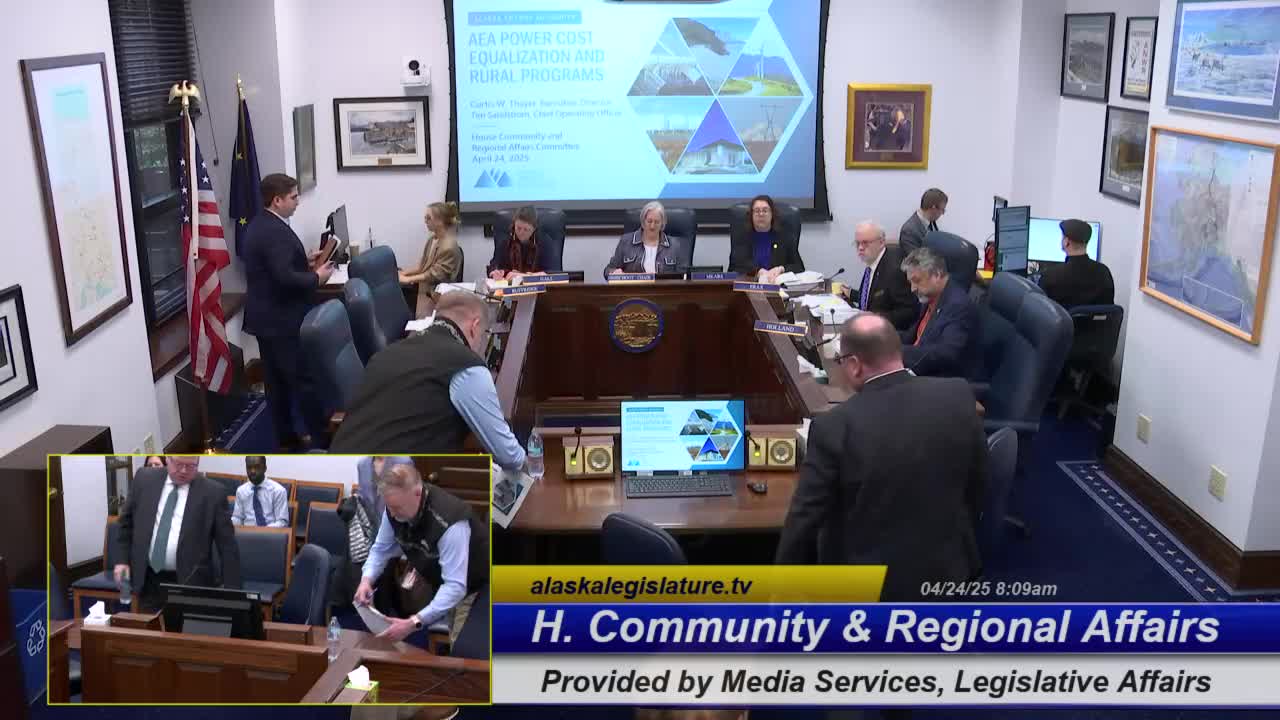
For the record, Curtis Thayer, executive director of the Alaska Energy Authority, told the Alaska House Community and Regional Affairs Committee on April 24 that the agency’s work focuses on reducing Alaska’s energy costs and diversifying the state’s energy mix.
The presentation centered on the Power Cost Equalization (PCE) program, a long-standing state effort to lower electricity costs in rural communities. Tim Sandstrom, AEA chief operating officer, described the program’s legislative evolution and current structure and said the PCE endowment provides the primary funding flow for payments to eligible customers and related community assistance.
Why it matters: PCE credits and related AEA projects support remote communities where diesel generation and bulk fuel storage remain essential. Committee members pressed AEA officials about whether current funding and program rules — including eligibility, the program’s 3‑year market-value “waterfall” and the endowment’s investment management — will sustain payments and infrastructure work going forward.
Thayer and Sandstrom said the PCE endowment is currently just under $1 billion in principle and that the program budgeted roughly $48 million for PCE disbursements in recent years. They said investments and legislative changes — most notably the 2022 increase in the residential PCE threshold from 500 to 750 kilowatt‑hours — substantially increased program outlays and reduced the funding available for other capital projects that previously benefited from endowment earnings.
AEA described several rural programs that rely on state or partner dollars: bulk fuel upgrades (AEA estimates a replacement bulk fuel facility now averages roughly $11 million), rural power system upgrades (typical new powerhouses cost about $6 million), a circuit rider program that provides emergency technical response and training, and a renewable energy fund that has supported more than 100 projects statewide.
On eligibility and community facilities: Sandstrom said the Regulatory Commission of Alaska (RCA) sets PCE eligibility and rates and that community facilities can be eligible for a PCE credit (currently described as up to 70 kWh per person, per month) if they do not receive federal or state funding for the same energy costs. AEA said it is working to identify community facilities so they can receive credits, and that RCA makes final eligibility determinations.
On capacity and maintenance: AEA staff told the committee that typical powerhouse equipment life has shortened in many communities from about 20 years to closer to 10 years because of deferred maintenance and limited local capacity to keep pace with repairs. AEA highlighted workforce challenges: it has trained roughly 84 Alaskans through bulk fuel and powerplant operations coursework but sees high turnover as trained technicians leave for other opportunities.
Circuit riders and funding risk: AEA said its circuit rider program — three to four specialized technicians who travel to remote systems — is one of the highest-return investments to avert costly emergencies. AEA requested $710,000 in legislative funding to sustain the program as federal grants (including from the Denali Commission) decline. Thayer said some of the circuit rider costs were proposed to be funded from PCE endowment earnings in the governor’s budget.
Environmental and logistical constraints: Committee members asked whether renewable projects reduce the need for bulk fuel storage; AEA responded that storage remains necessary because wind and solar are intermittent and communities require spinning reserve. AEA also said Congress and the Environmental Protection Agency have granted rural Alaska limited exemptions from some emissions rules for standby diesel engines, in recognition of operational constraints and maintenance realities.
Committee next steps: Members requested follow-up information on workforce training numbers, the circuit rider funding request, and how municipal and school facility eligibility for PCE is determined. The committee did not take action on PCE itself; the briefing closed before the meeting moved to the next agenda item.
Ending: AEA staff reiterated that long-term capital needs — bulk fuel facility backlogs, aging powerhouses and distribution systems — exceed current funding and that decisions about adjusting PCE eligibility or benefit levels would be a legislative policy decision with trade-offs for other designated endowment-funded programs.