Get Full Government Meeting Transcripts, Videos, & Alerts Forever!
Get email alerts on the School Performance topic
No spam. Unsubscribe anytime.
District review: Washington School Improvement Framework shows mixed results across Orting schools
Summary
Director Brush presented the Washington School Improvement Framework results and identified schools requiring varying levels of district support; board members asked for more disaggregated data where numbers are small or sequestered.
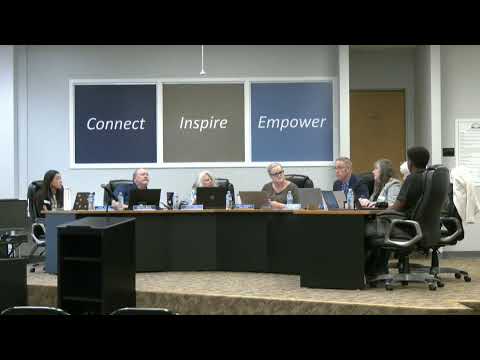
Director Brush presented the Washington School Improvement Framework to the Orting School District board and walked directors through how indicator scores and composite ratings determine levels of support for each school.
Brush explained the framework’s components, including assessment indicators (ELA and math achievement and growth), high-school graduation metrics and attendance, and how the state divides results into deciles across all schools. ‘‘They take the entire state scores and they divide them into 10 categories,’’ Brush said, and the district’s schools receive a 1–10 score that feeds a composite identification.
Why it matters: The framework determines whether a school must submit a school improvement plan and whether the district must provide targeted supports. Brush reviewed each school’s trajectory and noted that some student-group identifications are close to thresholds while others have improved sufficiently to move out of higher-support tiers.
Key points from the presentation: Ptarmigan Ridge moved out of a compound support designation into a lower support tier after progress in several indicators. One middle school—identified in the presentation as Ordean Middle School—has shown growth in English-language learner and students-with-disabilities indicators but remains close to thresholds in some groups. Horrying High School (presented as the district high school in the packet) performed ‘‘above the all-school threshold by quite a distance,’’ Brush said.
Board members asked why certain demographic groups did not appear in the high-school disaggregation. Brush and other staff explained that when subgroup counts fall below state privacy thresholds the data are sequestered or the group’s results are combined with others; staff said the threshold can be roughly 20 students for a subgroup to be reported.
Brush closed by saying the district will continue to monitor the framework annually and that principals and assistant principals will spend half a day before summer break to lay out intervention and instructional plans for next year. Director Brush characterized the district’s outlook as ‘‘careful conservative optimism’’ given recent investments in core instruction, intervention cycles and new diagnostic and curricular tools.
Ending: Board members asked for continued access to disaggregated data where available; staff said much of the underlying grade-level data are already published on the district website and on the state Office of Superintendent of Public Instruction (OSPI) portals and that more detail will be shared at upcoming reviews.