Get Full Government Meeting Transcripts, Videos, & Alerts Forever!
Get email alerts on the Water Sewer Budget topic
No spam. Unsubscribe anytime.
Salisbury officials seek new wastewater staff, vehicles and a 6% rate increase to cover PFAS, chemicals and maintenance costs
Summary
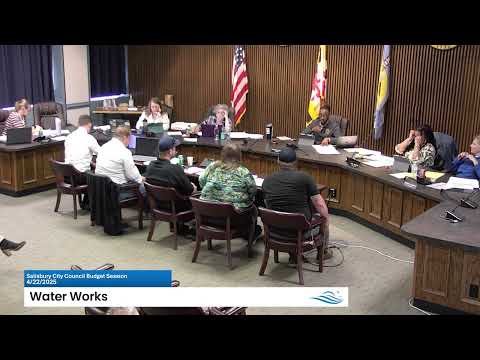
City water officials told the Salisbury City Council the water/sewer fund budget includes two new wastewater positions, vehicle replacements, and contingency for PFAS treatment and higher chemical costs; the proposal is funded in part by a proposed 6% rate increase and past grants that may not continue.
Salisbury water officials told the City Council during a budget presentation that the water and sewer enterprise fund will request funding for two new wastewater positions, several vehicle replacements and added operating money to cover rising chemical and maintenance costs and prepare for forthcoming PFAS requirements.
The request matters because city staff said some funding currently relied on — about $400,000 a year from a state B and R grant — may shrink, and state and federal changes on PFAS monitoring and treatment could require substantial future investment. Council members were told the budget package as presented assumes a 6% water‑sewer rate increase to support the plan.
Corey Cameron, director of Water Works, presented the wastewater side of the budget. He said the department expects chemical costs to rise and is planning a roughly $200,000 increase in chemicals and about a $200,000 increase in repairs and maintenance to cover aging equipment. "We're pretty dependent on our B and R grant now," Cameron said, adding the plant has received about $400,000 in recent years and staff cannot assume that level will continue.
Cameron told the council the department is asking to add two positions at the wastewater treatment plant: another maintenance supervisor and an assistant superintendent, the latter a post eliminated roughly seven years ago. He said the operations chief and maintenance chief may retire within a year, creating a loss of institutional knowledge. "Connie handles the sampling over there now for PFAS because it's so difficult to do," Cameron said, arguing management backup is needed. If approved, the positions would be budgeted for a full fiscal year and the city would begin recruiting immediately; Cameron and staff said hires are typically completed 30–90 days after budget adoption.
Staff also requested vehicle replacements tied to plant operations: one new dump truck for biosolids, two F‑350 utility‑body trucks for maintenance crews and two compact transit vans for meter readers. Troy Glaiver White, superintendent of utilities, said the fleet is "antiquated" and some vehicles have structural and mechanical problems; one older truck would need an estimated $15,000 in repairs to return to service.
On metering, White described the city's move from radio‑read meters to an automated meter infrastructure (AMI) system that will enable remote reads and customer alerts. "This technology, we can read them remotely... People can get alerts that we don't have to go put door hangers out for anymore," he said. Staff said AMI is a multiyear project with an estimated total cost of about $5 million and the city is phasing purchases at roughly $300,000 a year.
Council discussion also covered the West Side water tower and a separate tank at Edgemoor. Cameron said the Edgemoor tank is being taken down and that repainting would be costly because of lead paint; he described the structure as an "eyesore" and said removal and replacing capacity on the West Side will be planned after a water‑modeling study currently being restarted by the department.
On PFAS specifically, staff told the council the Maryland Department of the Environment (MDE) is overhauling its pretreatment program and that Environmental Protection Agency action on PFAS is driving potential new requirements. Council member Warren Stewart said the proposed spending is funded under the 6% rate increase as presented and noted the city originally considered a larger increase. "Originally, we were looking at about a 12% increase and we were able to tighten the belt and defer some of these vehicles and some of the other things for future years to try to keep it ... manageable," Stewart said. Staff also said the draft budget includes some revenue assumptions tied to PFAS settlement proceeds but that larger treatment costs remain a future risk.
Council members asked staff to emphasize the reasons for any rate increase when communicating with residents — aging pipes, chemicals and PFAS treatment — and to explore programs used by other utilities to assist customers who cannot pay. Cameron and other staff referenced the Washington Suburban Sanitary Commission (WSSC) as an example of a utility with programs to help customers address leaks and manage bills.
No formal vote on the budget items was recorded during the discussion; staff said the positions and purchases would proceed through the normal budget adoption process and hiring timetable if the council approves the budget.
Looking ahead, staff said they will continue work on the West Side tower siting, advance the AMI rollout, and evaluate capital planning for PFAS treatment needs. Council members requested that staff include clear public explanations of the drivers behind any rate change when the budget is presented for adoption.