Get Full Government Meeting Transcripts, Videos, & Alerts Forever!
Get email alerts on the Infrastructure Budget topic
No spam. Unsubscribe anytime.
Salisbury staff keep Infrastructure budget largely unchanged, seek training funds and finalize Naylor Mill Bridge match
Summary
Salisbury's Infrastructure and Development Department proposed no major operating increases, emphasized staff training and a capital plan that includes a $3.5 million Naylor Mill Bridge project with a 20% local match target.
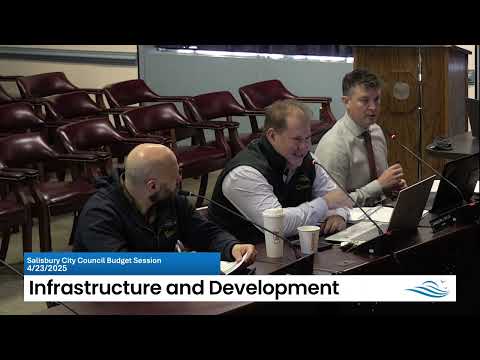
Nick Forteica, Infrastructure Development Director, told the Salisbury City Council on Oct. 12 that his department is proposing no major changes to operating expenses for the coming year while prioritizing staff training and moving forward on several long-delayed capital projects.
Forteica said the department is "still kind of in the stage of assessing what's going on, making sure we fill existing positions" and that training for younger staff is a continuing priority: "a little bit of jogging around some of the expense numbers in terms of more of a focus on training for the staff, because we have some younger staff and make sure that that gets done."
The department's capital improvement plan remains focused on several high-dollar items the council has discussed for years. Forteica identified the Naylor Mill Bridge as a top priority and described the current funding picture: the council heard that the project is estimated at about $3.5 million, with the city expected to provide roughly a 20% local match (about $700,000) while the state would cover the remaining roughly $2.8 million. Forteica said final design work will continue and that the city is proceeding toward bidding and construction if the match and estimates hold.
Council members pressed staff on budget line items and account structure. Finance and infrastructure staff explained the Infrastructure and Development Department's costs are paid from multiple accounts: roughly one-third from a general engineering account, one-third from the water account and one-third from sewer. Staff also noted a separate BPI account that supports building-permit and inspection work, and a small planning account (cited in the meeting as $19,000) used to fund the city planner.
On street maintenance, council members cited differences between budgeted amounts and year-to-date actuals. Staff said timing and contract cycles account for much of the variance: a street-maintenance contract was rebid late in the fiscal year, delaying expenditures into the current reporting period, and some encumbered funds are not reflected in the report that covered through April.
Forteica described an internal effort begun about six months earlier to catalog infrastructure and private-development projects by stage (designed, funded, or both) and to create a clickable dashboard that council members and staff can use to track projects. He said the department hopes to scope projects carefully and bid them so budgets remain under control and any residual funds can be recycled to other priorities.
Council members also asked about committee budgets. The Green Team and the Bicycle and Pedestrian Advisory Committee (BPAC) were cited in the budget with roughly $2,000 each; staff said other city advisory groups do not automatically receive recurring funds but could be considered for allocations if the council wishes. Mayor Taylor asked staff to compile a list of committees and potential funding amounts for future council discussion.
No formal votes or ordinances were taken during this portion of the meeting. Staff described next steps as continuing design and budgeting work for the larger capital projects, refining the project-tracking dashboard, and returning to the council with options for committee funding and any contract awards tied to rebid street-maintenance work.
The discussion included repeated clarifications about the department's multi-account funding structure and the timing of encumbrances; staff warned that consolidating accounts could simplify reporting but would lose historical detail tied to prior organizational structures.