Get Full Government Meeting Transcripts, Videos, & Alerts Forever!
Get email alerts on the Procurement Budget topic
No spam. Unsubscribe anytime.
Salisbury procurement requests $13,000 in small increases for energy reporting, staffing cushion and contract software
Summary
City procurement director asked the council to add $5,000 for energy-reporting consulting tied to Maryland’s building rules, $3,000 to cover recurring salary shortfalls and $5,000 for document-automation software; department remains four staff strong.
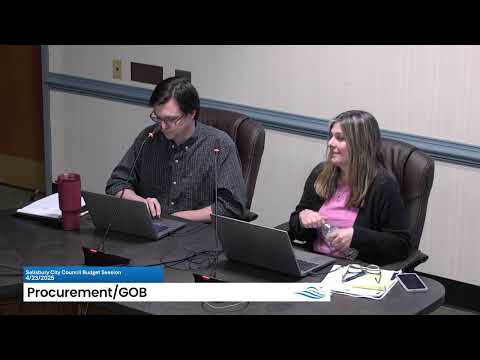
Jennifer Miller, director of procurement for the City of Salisbury, told the council on Oct. 12, 2025, she requested three modest increases totaling $13,000 in the procurement department’s draft fiscal-year budget to pay for energy-reporting consulting, cover operating shortfalls and purchase document-automation software.
Miller said the Department of Procurement has remained a four-person office since she joined in 2013 and requested near-level funding overall but flagged three line-item increases. "I did ask for an extra $5,000 in this account," she said of the consulting line, explaining the money would pay an energy consultant to perform required state reporting. "We're asking that our energy consultant do that reporting for the city. It's quite complex."
The consulting request is tied to Maryland’s building energy performance rules under the Climate Solutions Now Act of 2022, Miller said. Under those requirements, covered buildings — she said buildings 35,000 square feet or larger, excluding parking garages — must report annual energy use and direct greenhouse-gas emissions. Miller said owners of covered buildings, including city-owned facilities such as the police department building, must submit that reporting; the city is seeking consultant help to prepare those filings.
Miller also asked for a $3,000 increase to the department’s operating account to cover recurring salary and benefit shortfalls. She provided three years of shortfall figures: about $7,600 in fiscal 2023, $4,400 in fiscal 2024 and a projected near-$5,000 shortfall in fiscal 2025. "For a small department like mine, when I have a $7,000 or $5,000 shortfall, it's almost impossible for me to pull it out of another line item," she said.
The third request is $5,000 for computer software to automate and template contract documents. Miller described the product as an interview-style document automation tool that converts standard contract language into templates and prefilled documents to reduce staff time assembling contracts.
Council members asked clarifying questions during the presentation; Miller said the requested increases are intended as cushions and tools rather than program expansions. No formal vote or decision on the line-item requests was recorded during the session.
Miller and contract specialist Michael Lyle remained available to answer follow-up questions and to provide additional line-item detail later in the budget process.