Get Full Government Meeting Transcripts, Videos, & Alerts Forever!
Get email alerts on the Transportation Infrastructure topic
No spam. Unsubscribe anytime.
Council hears plan to rehabilitate 40 First Avenue, add separated bikeway and new wayfinding for Highway 1
Summary
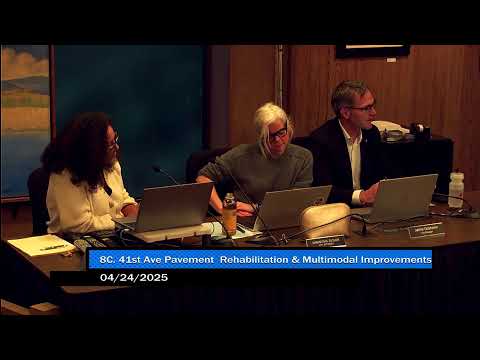
Capitola City Council received a presentation April 24 on a $1 million‑plus rehabilitation and multimodal safety upgrade for 40 First Avenue from Clare Street north to the city boundary, including pavement recycling, bicycle buffers with delineators and new lane‑selection signage to clarify access to State Route 1.
Capitola City Council received a presentation April 24 on a $1 million-plus rehabilitation and multimodal safety upgrade for 40 First Avenue from Clare Street north to the city boundary, including pavement recycling, bicycle buffers with delineators and new lane‑selection signage to clarify access to State Route 1.
The project team — city staff and traffic consultant Chris Brackhaus of Kimley‑Horn & Associates — described an approach that would use partial‑depth recycling to reuse existing pavement, install refreshed striping and targeted green bike pavement, and place physical delineators where Caltrans permits to separate cyclists from general‑purpose traffic through the SR‑1 interchange. Jessica (city staff) said the Regional Transportation Commission (RTC) awarded a grant that helped move the project into design; roughly $700,000 in RTC construction funds remain and the city expects to use SB 1 and Measure D funds to cover the balance.
Why it matters: the corridor shows extensive pavement distress and recurring queueing and safety problems where motorists choose lanes to access the SR‑1 north and south ramps. The design team said rear‑end crashes and speed differentials are a primary collision type in the corridor; clearer lane wayfinding and tighter posted speeds through the interchange are intended to reduce those conflicts.
Key details of the proposal include full roadway surface rehabilitation using partial‑depth recycling, refreshed high‑visibility crosswalks, upgraded signal and pole work at Gross Road/Auto Plaza, new pavement wayfinding markings that show which lanes access SR‑1 north and south, and a separated bikeway through constrained locations with delineators where Caltrans will permit them. The consultant said Caltrans has the final approval for elements located in state right of way and the design team is coordinating on allowable delineator types and placement.
Timing and construction window: staff and the consultant said they expect to complete remaining Caltrans reviews by late summer 2025, release construction bids in winter 2025, and begin construction in spring 2026. The consultant estimated construction duration of three to four months once materials and signal equipment are on hand; including lead times for long‑lead items such as signal poles, the overall field work could span about six months.
Funding and scope constraints: the presentation said the RTC grant provided roughly $1 million in earlier phases and about $700,000 remains for construction; SB 1 and Measure D revenue are projected to cover the rest. The team cautioned that adding larger hardscape changes (raised bikeways, reconstructed medians or removing turn pockets) would significantly increase costs and are not included in this contract. Several councilmembers pressed for as many physical delineators or raised elements as Caltrans will accept, citing cyclist safety concerns; the consultant said lane widths and truck clearance (10‑foot traffic lanes in most places) limit how much of the roadway cross‑section can be reallocated without substantial additional concrete work.
Public outreach and next steps: the council was told the project will go to the county bicycle advisory and elderly/disabled advisory committees and that staff will notify adjacent property owners and the public before construction. The city also noted a separate 40 First Avenue corridor study has just started; that planning effort will look at longer‑term options for streetscape and public space, while the pavement rehabilitation focuses on near‑term safety, pavement life and wayfinding improvements.
Council response: members expressed support for advancing the project, urged the strongest practical delineation for the bicycle buffer, and emphasized coordination with Caltrans to minimize construction impacts. No formal council action was required tonight; staff will return with final Caltrans approvals and an updated construction cost estimate in the 2025–26 budget.
Ending: the council thanked staff and the consultant for the presentation and encouraged outreach that emphasizes wayfinding and safety at the SR‑1 ramps.