Get Full Government Meeting Transcripts, Videos, & Alerts Forever!
Get email alerts on the Environmental Attorney Hiring topic
No spam. Unsubscribe anytime.
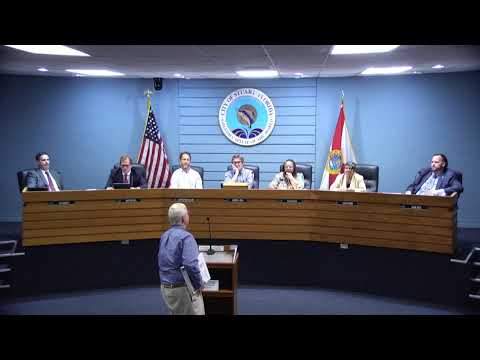
Stuart commissioners deliberate hiring environmental attorney to address St. Lucie River and Indian River Lagoon
Summary
City of Stuart commissioners discussed finalists for an environmental attorney position created to address discharges into the St. Lucie River and Indian River Lagoon, debated the job’s scope and whether litigation and data collection would be required, and scheduled follow-up interviews and a selection date.
City of Stuart commissioners held an extended deliberation on finalists for a newly created environmental attorney position, focusing on whether the role should be narrowly tasked with challenging discharges into the St. Lucie River and Indian River Lagoon or given broader responsibilities that could overlap with the city attorney. Commissioners discussed candidate strengths, the need for expert scientific data if litigation is pursued, and scheduling for remaining interviews and a formal selection.
Commissioner Clark said the interview process went well and thanked candidates for participating, adding, “I was pleased with the interview process today, and I appreciate those who came in.” The commission agreed to continue the process: one remaining candidate who could not attend will be interviewed on May 1, and the commission expects to place the selection on the May 12 agenda.
Why it matters: commissioners tied the hire to ongoing water-quality concerns that affect the city’s economy and environment. The position was created under a previous city resolution authorizing a second charter position to report directly to the commission for matters related to discharges from Lake Okeechobee; commissioners said that resolution frames the job’s current focus but that the commission must clarify the attorney’s precise duties and budget before finalizing an offer.
Commissioners reviewed several finalists by name and experience. Candidates discussed in the meeting included Allison Kelly, Harvey (last name not specified), Ruth (last name not specified), Keith (last name not specified), Sheldon (last name not specified), Williams (last name not specified), Holmes (last name not specified) and Diana Khalil (who had not yet interviewed because of travel). Commissioners described different strengths: some candidates brought strong federal- and agency-level experience, others had local Indian River Lagoon knowledge, and at least one candidate said they preferred a part-time arrangement.
Commissioners repeatedly returned to two issues: scope and resources. On scope, staff advised that the city’s existing resolution limits the job to challenging pollution discharges that affect the St. Lucie River — for example, operations related to Lake Okeechobee and estuarial conveyances such as C-40, C-23 and C-44 — and that assigning the attorney duties that overlap with the city attorney would require a redefinition of positions and responsibilities. Several commissioners said that clarifying that scope and resolving who handles what must occur before any hire is finalized and before the budget is set.
On resources, multiple commissioners and candidates raised the likely need for independent scientific data and expert witnesses if the city pursues enforcement or litigation. Commissioners discussed whether experts should be retained as outside consultants or hired on staff, with several warning that in-county experts can be “hired guns” and that trial-tested expert witnesses are expensive. Commissioner Reed said experts the candidates suggested “would need to be hired” and noted that the city would have to weigh costs and potential bias if experts were made employees rather than outside consultants.
Attorney Stuckey, who assisted the selection effort, urged commissioners to focus on the primary drivers of river harm, saying that fresh water, turbidity and changes in salinity from large discharges remain the most damaging factors. “Fresh water is the most damaging pollutant that comes into it,” Stuckey said, noting prior litigation and a court finding discussed in the River Coalition case materials he distributed to the commission.
Commissioners emphasized process safeguards discussed during interviews: reference checks, follow-up conversations, and restraint from making a final hire before checking references and hearing the final candidate. Commissioner Gioby and others said the commission would not make a final hiring decision at the deliberation meeting and that references would be called before any offer. Commissioners also noted timeline constraints: the remaining candidate cannot be interviewed the same day because of travel/time-zone differences, so the commission scheduled that interview for May 1 with a plan to act on May 12.
Votes and formal actions taken during the meeting were procedural and limited. The commission approved the meeting agenda by motion of Vice Mayor Collins, seconded by Commissioner Gio (Gioby), with a unanimous vote in favor. No hiring motion or offer was made during the deliberation; commissioners said such a motion would follow reference checks and clarification of scope and budget.
What’s next: the commission will interview Diana Khalil (the remaining candidate) on May 1, collect references, clarify the attorney’s scope relative to the city attorney’s duties before the budget process, and consider a hiring item at the May 12 commission meeting. Commissioners repeatedly said that if litigation is proposed, the commission would require a later, explicit vote to authorize litigation and any associated expenditures.
Ending: Commissioners praised the candidate pool’s quality and urged caution in defining the role and the city’s strategy. They asked staff to provide clearer scope language and cost estimates for potential litigation or data-collection efforts prior to any final hiring action.