Get Full Government Meeting Transcripts, Videos, & Alerts Forever!
Get email alerts on the Sound Noise topic
No spam. Unsubscribe anytime.
City of Stuart hears hours of testimony on sound ordinance; commission takes no action
Summary
The City of Stuart Commission reviewed its sound/noise ordinance, heard technical explanation from staff and more than a half-dozen public speakers for and against louder outdoor music at a downtown venue, and decided not to change the code at this meeting.
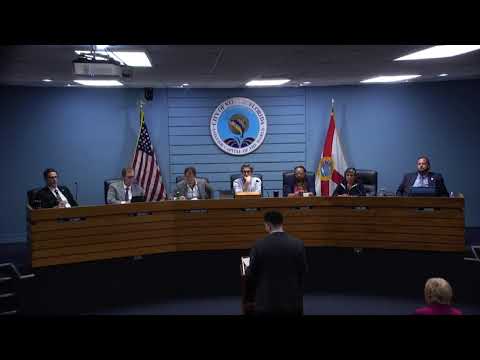
Mayor Campbell Rich and the City Commission of the City of Stuart on Tuesday reviewed the city’s noise (sound) ordinance and heard multiple public speakers on whether outdoor live music at a downtown venue — variously referred to during the meeting as Terraformada — should face new restrictions. After staff reviewed the code and commissioners discussed enforcement challenges, the commission declined to alter the ordinance and instead allowed extended public comment on the issue.
The city attorney’s office staff member who presented the ordinance review summarized where the rules stand and how the city measures sound. “For all noise except vehicle noise, the maximum permissible sound levels coming from the property line from which the sound originates shall be 80 decibels or lower from 8 A.M. until 10 P.M. It lowers from 80 decibels to 60 decibels when you get from 10 P.M. until 8 A.M.,” the presenter said. He added that the code requires sound from private property to be measured at the property line and that the city’s code includes multiple exemptions for emergency operations, permitted special events and certain equipment.
Why it matters: downtown Stuart’s arts-and-entertainment identity relies in part on outdoor music, but nearby residents and some commissioners pressed the city over consistency of enforcement, capacity and whether some downtown venues operate more like concert sites than neighborhood restaurants. The meeting made clear the technical difficulty of enforcing a numeric decibel standard in a busy downtown, and commissioners flagged limits on local authority for specific regulated items such as vehicle noise.
Most important facts first: Staff review, enforcement limits, and public testimony
- Staff summarized the ordinance language, measurement points and exemptions. The presenter said the code is in “Chapter 20, Article 6, titled Noise” and walked the commission through the ordinance’s sections, including 20‑151 (vehicles excluded), measurement rules and an exemptions list that covers emergency services, certain permitted events, sanitation operations and specified equipment. “When measuring ... for nonvehicular noise originating from private property, the sound will be measured at the property line of the property where the noise originates,” he said.
- Commissioners and staff repeatedly emphasized practical enforcement problems: ambient downtown noise levels, the speed of on‑scene measurement, and the difficulty of attributing sound to a specific source in a street with multiple venues and passing cars. “If somebody wasn't making noise, the sound measure was gonna come up at 50 decibels,” the presenter said, noting how ambient sound can mask a violation.
- The commission decided not to change the ordinance during this meeting. After discussion, Mayor Rich stated, “At this time, this commission has decided to take no action with regard to this ordinance.” Following that decision, the commission allowed public comment.
Public testimony and the main points raised
Robert Steinberg, a resident who said he wrote a letter to the commission raising the issue, told the commission the concern is not small local bands but larger, ticketed concerts. “It's the concerts that they're having that are pumped into a monstrous PA system ... This is a major concert level system,” Steinberg said, arguing Terraformada operates in practice as an outdoor concert venue while holding a business tax classification and a 2‑COP liquor license that suggest a small bar footprint.
Other speakers defended outdoor live music and downtown vibrancy. John Callaghan, speaking for local music fans, urged the commission to treat live music as exempt under the ordinance’s exemptions, saying, in part, “Change the noise ordinance by adding four words ... Live music is exempt.” Several residents and business supporters told the commission that Terraformada and similar venues draw visitors and are well managed. One speaker said the venue’s sound technician had committed to “paying closer attention.”
What staff and commissioners said about regulatory options
Staff stressed that the city has limited tools and that the ordinance already contains progressive penalties for repeat violations (warnings followed by escalating fines up to mandatory magistrate hearings and potential daily fines). The presenter noted that the code allows the magistrate to restrict business operations or the use of amplified sound equipment after repeated violations. He also explained the city’s historical path: the current numeric thresholds date to a 2015 process intended to produce enforceable standards after repeated debates about “plainly audible” enforcement.
Commissioner comments reflected a balance between support for downtown music and concern for neighbors. Some commissioners said they are not inclined to reduce allowable decibel levels, noting enforcement difficulty and the downtown character, while others encouraged the commission to provide avenues for neighbors to be heard. Vice Mayor Collins explicitly said he had “no intention of changing the sound ordinance” during this meeting but supported hearing complaints.
Outcome and next steps
The commission took no action to amend the code at this meeting; Mayor Rich announced the commission’s decision and the panel proceeded to allow public testimony. Staff said it will continue to enforce the current code and to respond to complaints under existing procedures; the commission did not direct a specific code rewrite at this time.
Clarifying details from the meeting
- Daytime/nighttime numeric limits: staff cited an 80 dB limit from 8 A.M.–10 P.M. and a 60 dB limit from 10 P.M.–8 A.M. for nonvehicular sound measured at the property line (presenter). - Measurement point: property line for private property sources; 50 feet from the source when on public property or right of way (presenter). - Common exemptions named in the code: emergency responders, permitted special events, certain portable equipment (generators, compressors) up to 85 dB, sanitation operations with restricted hours, landscape activities and construction hour limits (presenter). - Penalties: first offense written warning, escalating fines ($250 second offense, $500 third, $1,000 fourth) and $2,500–$5,000 and mandatory magistrate hearing for fifth or subsequent offenses (presenter).
Ending: what residents can expect
The commission did not adopt any changes this session. For residents and businesses with concerns about noise, the existing enforcement route remains: report incidents to city code enforcement or police so staff can document complaints and, when necessary, pursue progressive enforcement steps or a magistrate hearing. The commission emphasized that it hears complaints and will revisit the issue if new information or a formal proposal emerges.