
California adds seven C-130 airtankers to state firefighting fleet
Get AI-powered insights, summaries, and transcripts
Sign Up Free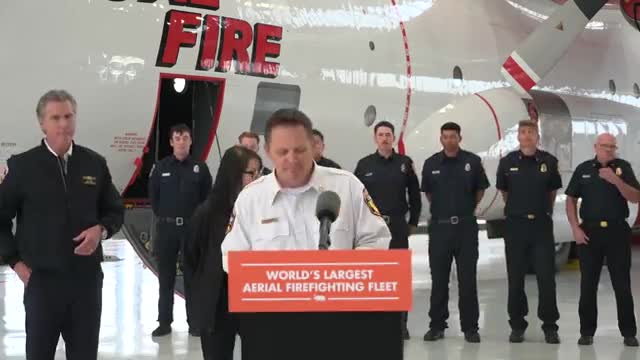
Summary
State officials announced that seven C-130 Hercules aircraft transferred from the federal government will expand CAL FIRE’s aerial firefighting capacity, with the first tanker already in service and additional aircraft staged across the state for mutual-aid response.
California officials on stage at McClellan Park announced that the state has taken possession of seven C-130 Hercules aircraft transferred from the federal government and is expanding its aerial firefighting fleet, with the first aircraft, Tanker 122, already in service.
The move, CAL FIRE Director and Fire Chief Joe Tyler said, follows federal-to-state transfers authorized in the 2019 and 2024 National Defense Authorization Acts and a multi‑year effort to retrofit the aircraft for fire retardant delivery. "It is an honor to be here today to talk about the expansion of CAL FIRE's aviation firefighting fleet," Tyler said, adding that the state retrofitted several aircraft and placed Tanker 122 into service last year.
The expansion matters because California faces year‑round wildfire risk, state officials said. Tina Curry, chief deputy director of operations at the California Governor's Office of Emergency Services (Cal OES), described new detection and forecasting tools that work with the expanded air fleet. "The fire integrated real time intelligence system, what we call FIRIS, is sensor based aircraft that's available at all times 24/7," Curry said. She added that a joint wildfire forecast threat integration center with CAL FIRE provides "actionable information to first responders."
Tyler described the program’s federal and operational background: earlier federal efforts to acquire similar aircraft stalled, and Congress provided authority to transition the C-130s to states. He said the state began retrofitting the airframes after they were transferred and that Tanker 122 has been deployed on missions across California. "We plan to have the third air tanker available in the middle of the fire year, late summer this year," Tyler said, and listed planned initial basing for the aircraft: McClellan (Sacramento), Fresno, San Diego/Ramona (initially), Paso Robles, Chico, and one designated for surge/spare operations.
Private contractors and federal partners provided equipment and technical support, Tyler said, naming the U.S. Coast Guard, U.S. Air Force and U.S. Forest Service among collaborators. Amentum pilot Brian Baker, who flew Tanker 122’s first mission, said the platform increases the state’s capability. "Is the state doing everything it can to provide us with the best capability to protect the people and resources of the state of California from wildfire? And the answer to that question is emphatically yes," Baker said.
Officials emphasized the fleet is one component of a broader wildfire strategy that also includes prevention, forest management and new detection tools. Governor Gavin Newsom highlighted investments in technology, night‑vision capacity and a network of cameras and said the state has "10x'd the investments" in recent years and treated roughly 1.9 million acres between 2021 and 2023, including about 730,000 acres in 2023. Newsom also urged residents to prepare defensible space and heed evacuation orders: "Property can be replaced, but lives cannot. Listen. Listen to the experts," he said.
Speakers said the state will continue to rely on mutual aid—locally positioned fire resources that can surge when needed—and on federal partnership and funding. Newsom noted that 57% of California forest land is federally managed and said the state needs stronger federal support while warning of budget uncertainty at the federal level. "We're not here to focus on who's to blame. We're focused on what to do," he said.
Officials gave quantities and performance details: the C-130 airtankers carry about 4,000 gallons of retardant, can reach most points in the state quickly, and Tanker 122 completed many missions in a short time after entering service. Cal OES described a statewide surge posture that keeps engines and equipment positioned to respond and noted investments in predictive tools and an intelligence fusion center to guide resource placement.
The announcement does not change local evacuation rules or other operational directives; officials said residents should follow local emergency instructions. Several speakers thanked federal and state lawmakers, private contractors and agency staff who participated in acquisition and retrofit work. The event did not include any formal votes or policy adoptions.
(Additional details from the briefing: the aircraft transfer and retrofit timeline was discussed in relation to the 2019 and 2024 National Defense Authorization Acts; CAL FIRE and Cal OES described the role of mutual aid, pre‑positioning and new surveillance technologies.)