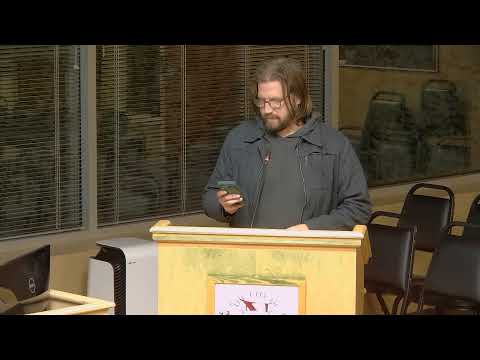
Newcastle planning commission holds public hearing on state-mandated middle-housing and ADU code changes
Loading...
Summary
The Newcastle Planning Commission held a public hearing to collect public comment and commissioner feedback on a package of proposed code changes that would implement recent Washington state middle‑housing and accessory dwelling unit laws and a related affordable‑housing policy on fees or on‑site units. Staff emphasized the state deadline of July 1 for several new provisions and said the commission would not vote at the hearing.
The Newcastle Planning Commission held a public hearing to collect public comment and commissioner feedback on a package of proposed code changes that would implement recent Washington state middle‑housing and accessory dwelling unit (ADU) laws and a related affordable‑housing policy on fees or on‑site units. Staff emphasized the state deadline of July 1 for several new provisions and said the commission would not vote at the hearing.
The hearing centered on state laws staff identified by bill numbers and on several sections of the draft city code. Associate Planner Tyler Coyle said the laws “require duplexes in all single family zones” and that the city must allow up to two sellable ADUs on lots in single‑family zones and remove owner‑occupancy requirements for ADUs. Coyle warned that “if we cannot get it passed” by July 1, “the state laws will override our current code” and a state model ordinance could apply in the interim.
Why it matters: The package would change which housing types are permitted across much of the city and set design, setback and parking rules that affect feasibility for homeowners and small developers. Staff stressed that most changes are to comply with state law but highlighted several areas where the city could go beyond the state — and sought commissioner direction on those points.
Key proposals and discussion
- State laws cited and timing: Staff referenced several state bills by number and the Department of Commerce interpretation that duplexes and the two‑ADU allowance are an either/or choice on a given lot rather than cumulative. Staff repeated that several provisions take effect July 1 and, until local code is adopted, state rules would apply directly. Mike Stenger of ARCH, the regional housing partner, told the commission that “the city of Newcastle City Council as the ultimate, decision making authority about where your ARCH Trust Fund contributions are spent.”
- ADUs and duplexes: The draft would allow either a duplex footprint or a single family home with up to two ADUs on qualifying lots, but not both at once on the same lot. Staff proposed keeping a 35% building‑coverage cap, allowing reduced side setbacks to 5 feet (rather than the current paired setbacks totaling 15 feet) and reducing rear setbacks from 20 feet to potentially 15 or 10 feet (commissioners expressed support for a 10‑foot rear setback for ADUs while reserving the option to require additional privacy measures where ADUs sit closer to neighboring yards).
- Height and size limits: Staff proposed lowering the ADU height limit to about 24 feet (a “one‑and‑a‑half‑story” form) from the current 30 feet to better match older neighborhoods, and retaining a 1,000‑square‑foot per‑unit cap for ADUs.
- Lot subdivision and ownership: The code would add a unit‑lot subdivision process required by state law to allow ownership of individual units (for example splitting a duplex into separate fee‑simple unit lots) while measuring setbacks and dimensional standards on the parent lot, a technique staff described with example diagrams.
- Parking and lot‑coverage rules: Staff said the proposal would keep the existing layered limits: building coverage at 35% of a lot, impervious surface at 40%, and a total hard‑surface cap at 45%. For middle housing outside a half‑mile of major transit stops, the draft would generally require up to two off‑street parking spaces per unit and one additional space per ADU; state law limits the city’s ability to require more parking in certain locations.
- STEP and co‑living housing: Staff explained that shelters, transitional housing, emergency housing and permanent supportive housing (collectively referred to as STEP) must be allowed in more residential areas without conditional use permits under the state law; staff said they were not proposing to go beyond the state minimums. Co‑living (shared units with private sleeping rooms occupying multifamily or mixed‑use districts) would be allowed only in multifamily/mixed‑use zones, in line with state direction.
- Affordable‑housing options: Staff presented two optional approaches the city could adopt as part of new capacity rules: (1) a 10% on‑site or in‑lieu requirement for proposed developments of four or more units, with in‑lieu fees set at $13 per square foot of the development’s total new square footage; or (2) an arterial/collector trade allowing up to three townhouses on an arterial lot in exchange for one townhouse being restricted to households at 80% of area median income (AMI). Staff and ARCH provided modeling showing the fee approach would place a sample $42,900 per‑unit cost on buyers in a hypothetical 4‑unit development and could raise a mortgage payment by roughly $216 per month in the presented example; modeling also showed the townhouse trade would be financially viable only on parcels with lower land values in some places. Staff noted exemptions for small projects (less than four units) and for dwelling units under 1,600 square feet.
What the commission asked staff to do
Commissioners and public commenters asked for clarifications and directed staff to return with edits and diagrams. Among specific directions recorded in the discussion: clarify and re‑insert conditional‑use pathways for certain multifamily forms to preserve existing CUP options; prepare diagrams and objective design/privacy options for reduced rear‑setback ADUs (including possible window‑treatment or clerestory provisions if rear setbacks drop to 10 or 5 feet); confirm whether exemption thresholds (unit count and unit size) and cottage‑housing sizing interact with the affordable‑housing exemptions; and revise the draft to make clear that in‑lieu ARCH funds can be prioritized to projects within Newcastle if the commission and eventual council so direct.
Public comment highlights
Residents and stakeholders who spoke at the hearing expressed a range of views. Carol Simpson, a resident and former architect, urged more review and flagged code inconsistencies and potential grandfathering issues for existing multifamily properties; Allison Sweeney, a restaurant owner, supported ADUs and middle housing as a way to provide local workforce housing and increase foot traffic for businesses; and Steven Vimes urged greater overall housing production across the city to address affordability.
Outcome and next steps
No formal action or vote was taken at the hearing. Staff said they will revise the draft code to reflect the committee’s direction and return with a consolidated draft and diagrams for further commission review and a future recommendation to City Council. Staff emphasized that timing is constrained by the state’s July 1 effective date for several requirements, and cautioned the commission that if the city’s updated code is not in place by then, state provisions and a model ordinance could apply temporarily.