Get Full Government Meeting Transcripts, Videos, & Alerts Forever!
Get email alerts on the Student Technology Policy topic
No spam. Unsubscribe anytime.
Board reviews expanded personal-technology policy for pre-K–8; community asks for clearer enforcement language
Summary
The board held a first reading of a revised student personal-technology policy that would extend the existing elementary phone/watch rules to middle school, tighten smartwatch limits and rely on teacher discretion for enforcement; public commenters asked for clearer language about storage, before/after-school use and teacher protections.
The Glen Ellyn SD 41 Board of Education held a first reading of a revised student personal-technology policy that would expand the district’s pre-K–5 device rules up through eighth grade and remove prior language that permitted teacher-managed classroom use of personal devices for instruction.
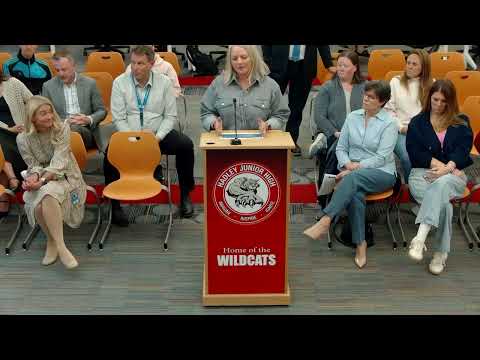
Multiple public commenters urged clearer details before the board adopts the policy. Rebecca Coleman Taylor, a Hadley and Churchill parent, asked the board to clarify where devices must be stored during the school day (backpack, cubby, locker or pocket) and to define expectations for before- and after-school use if students remain inside the building. Erin Lindgren of Glen Ellyn Unplugged urged clearer administrative procedures around enforcement—specifically whether the initial teacher warning is required and how progressive consequences would follow.
Administration said the revised policy aims to be consistent across elementary and middle schools and to address smartwatches, which administrators and students identified as a frequent classroom distraction. District staff described the chosen approach as “off and out of sight”; the policy explicitly bars watches from being worn on the wrist during school hours while allowing flexibility on where phones are stored, in part to respect student safety concerns expressed by students at advisory meetings.
Board members and student representatives discussed how to ensure consistent enforcement so teachers have cover and students and parents know expectations. The administration said it will work with principals and staff to clarify procedures and to provide training so that the policy is applied uniformly, rather than leaving enforcement to widely varying individual teacher practices. The board did not vote on the policy at the meeting; a second reading and vote was scheduled for the May board meeting.
The board also clarified that a separate administrative waiver process would remain available for medical or learning needs.