Get Full Government Meeting Transcripts, Videos, & Alerts Forever!
Get email alerts on the Community Engagement topic
No spam. Unsubscribe anytime.
Metro Arts outlines FY26 engagement plan, timeline and proposed standing meeting date
Summary
Staff summarized community engagement events and online survey for FY26 guidelines, presented a tentative timeline for the FY26 grant cycle, and proposed a standing Grants Committee meeting time (third Monday afternoons) beginning in July.
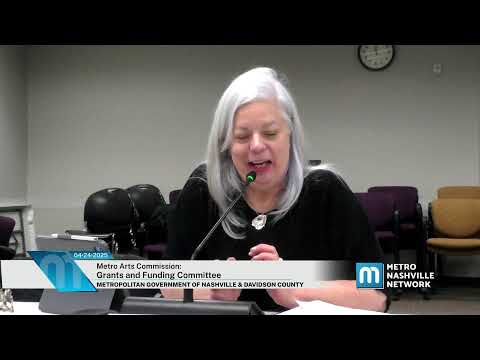
Metro Arts staff outlined plans for fiscal-year-2026 public engagement, shared takeaways from outreach events, and presented a tentative timeline for FY26 grant guidelines and awards to the Grants & Funding Committee on April 24.
Ashley (staff member) described three public-engagement channels: an online survey (bit.ly link shown in the meeting materials), five in-person/virtual events, and weekly drop-in sessions. She reported attendance counts from the in-person sessions: 13 attendees at Studio 615, 9 at Trinity Community Commons (Thrive-focused), 15 at a Centennial Arts Center morning session (operating-focused, highest attended), and 15 at a Monday afternoon session at 100 Taylor Events. A virtual session was scheduled for that evening at 5 p.m.
Staff said survey responses have been substantive but limited in number and that they will send a follow-up email after the evening event with a suggested soft deadline (staff proposed the following Tuesday) for survey responses to be included in early reporting. Ashley said she will send committee members a summary of takeaways early next week after the final engagement session.
The committee reviewed a slide deck that staff have used in engagement meetings to explain the operating and Thrive funding models and award distributions. Staff reiterated how the operating formula scales award percentages to organizational budget tiers (micro through large) and noted an example anomaly in the data: one large organization with a roughly $3.1 million budget received a comparatively small award because of where it landed in the budget-tier calculation. Staff discussed possible policy adjustments that could address the sensitivity at revenue cutoffs—for example, using multi-year revenue measures—but said larger policy changes would likely need to be part of the next cycle to avoid delaying payment timelines for FY25.
Staff presented a tentative FY26 timeline: May for commission guideline approvals; June for Metro Council review; July for application intake and scoring; August for commission approvals; September for award acceptance and contracting; and funds out by the end of the calendar year if the schedule holds. Ashley emphasized that missing monthly meetings could push items back two to three weeks because the commission meets monthly and Metro Council meets twice monthly.
Committee members discussed meeting scheduling. Staff proposed meeting materials would be provided by May 15 to support a tentatively scheduled Grants Committee meeting on Monday, May 19, 1–3 p.m., with the full commission meeting tentatively scheduled for Thursday, May 22. Commissioners expressed a preference for a standing Grants Committee time beginning in July on the third Monday of each month in the afternoon (after 1 p.m.) to facilitate planning and to return the grant cycle to an earlier, regular schedule.
Staff said they will prepare a written summary of engagement takeaways and a short list of smaller, feasible guideline tweaks for the committee to consider at the May meeting. Commissioners and staff agreed the priority for this cycle is to get awards and payments out by the end of the year rather than attempt large-scale changes now.
No formal votes were taken on FY26 guidelines at this meeting; staff will bring recommendations and proposed guideline language to the Grants Committee in May for consideration and, if approved, to the commission and then Metro Council per the schedule.