Get Full Government Meeting Transcripts, Videos, & Alerts Forever!
Get email alerts on the Transportation Impact Fees topic
No spam. Unsubscribe anytime.
Commission delays adoption of Panama City transportation impact-fee ordinance to allow more stakeholder work and new commissioners' input
Summary
After public comment from builders and residents, the Panama City Commission voted to delay final adoption of a transportation impact-fee ordinance and set a new target adoption date of July 8, 2025, with a commission workshop beforehand to allow additional stakeholder meetings and for the incoming commission members to review the proposal.
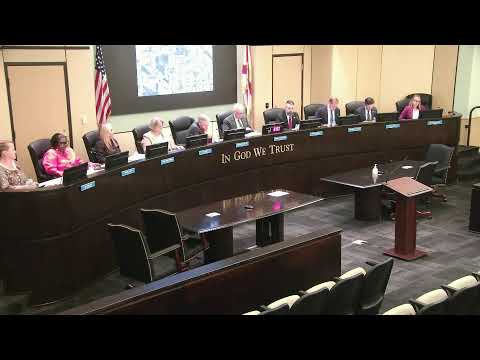
The Panama City Commission on April 24 agreed to postpone final action on a transportation impact‑fee ordinance and to return for adoption on July 8, 2025, following further workshops and stakeholder engagement.
City staff presented a report summarizing outreach held since February — community workshops and stakeholder roundtables — and proposed several adjustments to the draft ordinance. Those adjustments included: delaying implementation until Oct. 1, 2025; a 10‑year sunset (to Sept. 30, 2035); a phased implementation with 50% reduction for years one and two and full implementation by Oct. 1, 2027; exemptions for residential homes under 2,400 sq. ft. and accessory dwelling units under 1,200 sq. ft.; a statutory definition–based affordable-housing exemption; credits for previously paid fees when a building is demolished and rebuilt; credits for developer-funded improvements; and a right for owners to request alternate fee calculations.
Speakers and concerns: Kurt Hartshaug of the Bay Building Industry Association (BBIA) told the commission the association appreciated outreach but urged clearer implementation plans and an exemption or relief for small houses and day‑care construction, arguing high impact fees would increase costs for day care and medical offices in growth areas. Resident speakers, including builders and parents, said high fees could make housing and child care unaffordable; one commenter asked that the reading be delayed until after the June commission election so the incoming member would weigh in.
Commission discussion focused on balancing infrastructure needs — particularly projected capacity work in Panama City North and on roads such as Star Avenue and John Pitts Road — with not discouraging development. Commissioner Granger noted preliminary engineering estimates for widening Star Avenue (planning and engineering alone) could be roughly $2.5–3 million and that some level of local funding will be required to obtain state matching funds. Staff clarified that impact-fee revenues must be held and used for capacity projects in the area where the fees are collected.
Action taken: The commission voted 4–0 to set the ordinance adoption for July 8, 2025, and asked staff to schedule a workshop in June that will include newly elected commissioners. Staff emphasized the draft study is complete but that additional community discussion and limited edits are reasonable given the ordinance’s regulated nature and the commission’s authority to adopt incentive or exemption policies.
Why it matters: The fees are intended to align growth with transportation capacity. Staff and the commission said funds collected in a particular part of the city must be spent in that part of the city, a point intended to reassure residents who fear a transfer of costs across wards. The ordinance carries legal limits: state law constrains increases within certain periods and requires a supermajority for increases beyond statutory limits.
Clarifying details: Staff recommended delaying implementation to Oct. 1, 2025, with a phased rollout: 50% credit years 1–2 and full fees by Oct. 1, 2027; a 10‑year sunset to 2035; exemptions for small homes and accessory units; affordable-housing exemptions following Florida Statute Chapter 420 definitions; and developer credit provisions. Staff also cautioned against publishing a fixed project map prior to implementation because naming projects in advance can legally limit the city’s ability to use collected fees for other eligible capacity projects.