Get Full Government Meeting Transcripts, Videos, & Alerts Forever!
Get email alerts on the Historic Preservation topic
No spam. Unsubscribe anytime.
Planning commission approves Marlin Meadows neighborhood conservation overlay after mixed testimony
Summary
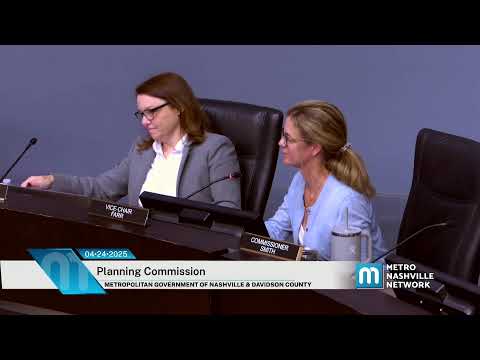
The Metropolitan Planning Commission voted 7–1 on April 24 to recommend approval of a neighborhood conservation zoning overlay for the Marlin Meadows area after hearing supporters who cited architectural and historical significance and opponents who warned of exclusionary uses and inconsistent process.
The Metropolitan Planning Commission voted 7–1 on April 24 to recommend approval of a neighborhood conservation overlay (NCO) applying additional review for demolition, additions and new construction in Marlin Meadows, a mid‑century subdivision north of the river.
The overlay would apply conservation‑oriented review in addition to the existing RS‑20 zoning; it does not automatically change base zoning. The Metro Historic Zoning Commission had earlier found the area eligible under criteria for mid‑century architectural significance and recommended adoption of guidelines tailored to Marlin Meadows. Planning staff recommended approval, noting the request aligned with the Historic Zoning Commission findings and that the department relied on that commission’s expertise in evaluating significance.
Councilmember (applicant) told commissioners the overlay was the result of several community meetings dating back to 2019 and subsequent public discussion. Supporters — including a local preservation planner who sought a State Historic Preservation Office review — said the majority of houses would be contributing resources and that the overlay was intended to be a lighter tool than full historic zoning. “We feel like that it's without doubt the neighborhood's architecturally historic significance,” said Robbie Jones, a resident and preservation planner who asked commissioners to adopt the overlay.
Opponents said the proposal risked being used to restrict housing supply and to insulate the neighborhood from citywide housing reforms. Mannen Hall, speaking as a renter and housing advocate, said the overlay risked being “weaponized” to exclude additional housing and described the proposal as a tool that could be used to entrench existing owners. Other residents said the petition and outreach were not representative of the full neighborhood and that additional community work was needed.
Commissioners questioned the appropriate standard for an NCO versus a historic overlay and noted the proposal had already proceeded through several public processes. Melissa Sajid, staff to the Metro Historic Zoning Commission, told the planning commission that the NCO would review new infill, additions and demolitions but would not cover routine maintenance such as replacing windows or roofs.
After deliberation commissioners voted to approve the conservation overlay application and the associated design guidelines. The roll call showed seven votes in favor and one opposed. The measure now goes to Metro Council as an advisory recommendation; the council has the authority to accept, amend or reject the overlay ordinance.
Votes at a glance
- Case 11 (Marlin Meadows Neighborhood Conservation Overlay): Motion — recommend approval. Outcome — planning commission recommended approval; tally recorded in open meeting: yes 7, no 1.
Ending: Supporters framed the overlay as a neighborhood‑led preservation effort; opponents asked for broader community engagement and raised concerns about consequences for housing supply. Council will consider the ordinance, following the advisory action by the commission.