Get Full Government Meeting Transcripts, Videos, & Alerts Forever!
Get email alerts on the Land Use Rezoning topic
No spam. Unsubscribe anytime.
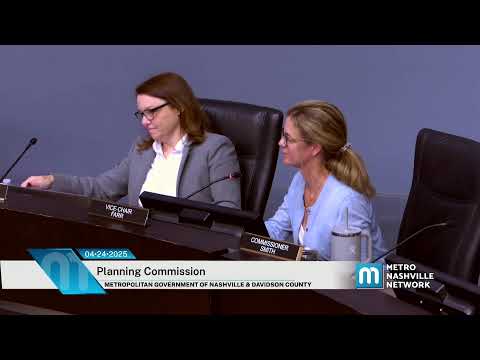
Planning commission recommends disapproval of Councilmember Welsh’s District 16 rezoning and South Nashville UDO after large public hearing
Summary
At its April 24 meeting the Metropolitan Planning Commission voted to recommend disapproval of a councilmember-filed rezoning of roughly 620 acres in District 16 and a companion South Nashville urban design overlay, after a multi-hour public hearing with dozens of speakers raising infrastructure and process concerns.
The Metropolitan Planning Commission voted 6–1 on April 24 to recommend disapproval of a councilmember-filed rezoning map for parts of District 16 and a companion South Nashville urban design overlay (UDO), after a lengthy public hearing that drew hundreds of residents and dozens of speakers.
The proposal, filed by Councilmember Ginny Welsh, sought to rezone roughly 620.23 acres south of I‑440 and south of Thompson Lane to allow RM20 A NS and RM40 A NS zoning in many blocks near Nolensville Pike and to apply a UDO with alternative design standards. The commission considered a staff substitute that would have reduced the rezoning footprint and limited the UDO area; staff recommended disapproval as filed and approval of a smaller substitute in part.
Councilmember Ginny Welsh told commissioners she filed the proposal to “right size” zoning in a district that she said has seen piecemeal rezonings and to encourage “middle‑scale housing” near transit and services. “Zoning is not a technical issue; it’s a personal issue,” she said during the public hearing, arguing the UDO and rezoning were designed to give long‑time homeowners options and to produce housing oriented to nurses, teachers and other middle‑income residents.
Supporters — including homeowners, builders and housing advocates — said the changes would create more modest, walkable housing types and increase options for local workers and first‑time buyers. “Density is our only path to affordable housing in Nashville,” said a local builder who spoke in favor.
Opponents countered that the application was rushed and poorly noticed, and they raised site‑specific infrastructure concerns: absent sidewalks and alleys on many interior blocks, inconsistent stormwater systems, and sewer upgrades staff estimated in the millions. Alexa Little, president of the Glencliff Neighborhood Group, told commissioners the proposal “was created without any involvement” of many residents and called for a planning‑led neighborhood process. Multiple speakers urged the commission to delay any recommendation until the city’s housing and infrastructure study is finalized in June and more local engagement occurs.
Planning staff’s technical review flagged three broad constraints: (1) where proposed upzones were within the T3 neighborhood maintenance policy, RM20 was not typically supported by Nashville Next policy; (2) stormwater and sidewalk networks in several interior areas are inconsistent and would need upgrades; and (3) RM40 density exceeds what staff judged appropriate in some T4 neighborhood maintenance locations without targeted infrastructure investment. Staff proposed a narrowed map focused on parcels within about a quarter‑mile of Nolensville Pike and areas already built with alleys and sidewalks.
After debate, a motion to disapprove the rezoning as filed and to disapprove staff’s substitute carried. The commission then took the same action on the companion UDO. By rule, the planning commission’s recommendation will be transmitted to Metro Council; because the bill had already been introduced and more than 30 days had passed between introduction and the council public hearing date, the council may hold its public hearing regardless of the commission’s recommendation. Staff noted the difference in council vote thresholds: a planning commission approval recommendation would require fewer council votes to pass than a recommendation of disapproval.
Next steps: the council will consider the bill at public hearing on May 6. The planning commission’s disapproval is an advisory recommendation and does not prevent the council from advancing the measure.
Votes at a glance
- Case 28a (rezoning of various parcels in District 16): Motion — “disapprove as submitted and disapprove staff’s suggested amendment.” Outcome — planning commission recommended disapproval; tally recorded in open meeting: yes 6, no 1. - Case 28b (South Nashville UDO): Motion — “disapprove as submitted and disapprove staff’s proposed amendment.” Outcome — planning commission recommended disapproval; tally recorded in open meeting: yes 6, no 1.
Ending: The commission’s action is advisory; Councilmember Welsh said she will carry any commission recommendation to council and continue community meetings. Planning staff and councilmembers referenced a forthcoming citywide housing and infrastructure study expected to publish final recommendations in June that planners and councilmembers said should shape any district‑scale rezoning.