Get Full Government Meeting Transcripts, Videos, & Alerts Forever!
Get email alerts on the School Levy Renewal topic
No spam. Unsubscribe anytime.
Kennewick School District begins preliminary planning for 2026 levy renewals
Summary
District staff outlined early options for renewing the Educational Programs & Operations (EP&O) and technology levies set to expire in 2026, warned of shrinking state Local Effort Assistance as assessed valuation rises, and asked the board for data and direction on timing, length and amount of any future ballot measures.
Dr. Pierce, district staff, told the Kennewick School District Board of Directors at a study session that the district is beginning preliminary planning for two levy renewals — the Educational Programs & Operations (EP&O) levy and the technology levy — that expire in 2026. "Tonight is a very early preliminary discussion, just to kind of plant some seeds," she said.
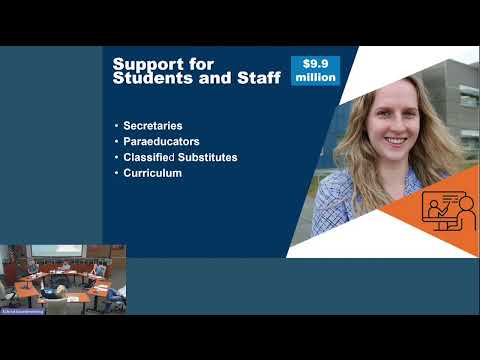
The presentation reviewed why the district relies on levies, what the 2023 EP&O and technology levies currently fund, and options for the next levy cycle. Dr. Pierce said the district asked voters in February 2023 for a three-year EP&O levy that collects $23 million in year one, $23.85 million in year two and $24.7 million in collection year 2026. Combined with Local Effort Assistance (LEA), she said the district told voters it would use about $38.2 million to fund safety, students and staff, operations and extracurriculars.
Dr. Pierce outlined how assessed valuation affects both tax rates and LEA: a higher total assessed valuation lowers a district—s tax rate but also reduces state LEA payments. She said the district—s actual tax rate for the current cycle is $1.52 per $1,000 of assessed value and projected to be $1.49 next year based on current AV; she contrasted that with neighboring districts reporting rates near $1.90 and $2.09 per $1,000. "At some point in time, we're going to get to a point' . . . when we get to, like, $26 billion, we'll only get about $40,000 of LEA," she said.
District staff reviewed how the district carried through the dual levy failures in 2022 and the eventual 2023 passage: Dr. Pierce said the district lost roughly $34 million in revenue for the 2021—22 and 2022—23 school years after earlier levies failed, used about $10 million in federal ESSER funds, made approximately $5 million in staffing and non-staff reductions, and dipped into roughly $15 million of fund balance to bridge the gap. She said those decisions allowed the district to avoid layoffs.
Looking forward, Dr. Pierce presented a scenario that would increase the district's total levy needs to roughly $45 million to $50 million over a new levy cycle to maintain current staffing and programs as LEA declines, though she emphasized the figures are preliminary and not final. She said the district typically manages about a $5 million difference between funding and expenditures and is considering a measured use of fund balance to limit tax-rate increases in an initial collection year. If the district used no fund balance, she warned, the tax rate would rise further.
Dr. Pierce said the board must decide levy amounts, collection years and lengths (two, three or four years), and noted tradeoffs: longer levies reduce the frequency of voter asks but risk mismatch with future state funding and enrollment changes; shorter levies require more frequent campaigns. She said her early preference is toward a three-year levy, but stressed the board had not reached a decision.
Staff asked the board what additional data it wanted. Dr. Pierce said staff will provide historical assessed valuation data for the past 10 years, comparisons with neighboring districts, cost estimates for any new or restored programs (she cited an estimate of approximately $180,000 to add more high-school security), and projections for LEA under current AV assumptions. She also said Tom and Brandon (district staff) will meet with the county assessor the following week to get updated assessed-valuation intel.
Dr. Pierce explained procedural steps if the board moves forward: the district prepares levy amounts and collection years; OSPI reviews and approves the levy expenditure plan; the board must adopt a formal resolution and file the ballot proposition with the county auditor; pro/con statements are solicited for the voters' pamphlet; and the district must follow public disclosure rules for any informational campaign. She described common February special-election timing and said a February measure allows a possible April rerun if needed.
No formal levy proposition, resolution or vote occurred at the study session. The board asked staff for the historical AV trend, statewide comparisons, and specific costs for potential restorations or additions to programs; staff says it will return with those data and planning options in the summer and fall.
This article is based on staff remarks during the Kennewick School District study session about preliminary levy planning.