Get Full Government Meeting Transcripts, Videos, & Alerts Forever!
Get email alerts on the Housing Development topic
No spam. Unsubscribe anytime.
Corte Madera planning commission approves 99‑unit affordable housing project at 240 Tamal Vista Boulevard amid traffic and scale concerns
Summary
The Corte Madera Planning Commission on April 22 approved a proposal to demolish a vacant office building and build a six‑story, 99‑unit, 100‑percent affordable housing development at 240 Tamal Vista Boulevard, granting multiple waivers allowed under California’s density‑bonus and housing laws.
The Corte Madera Planning Commission on April 22 approved a design‑review application to demolish an existing two‑story office building at 240 Tamal Vista Boulevard and build a six‑story, 99‑unit multifamily residential project with 100 percent affordable units.
The commission adopted staff draft Resolution No. 25,004 by a 3‑2 roll call (Commissioners Kenny, Bashoyer and Chair Chase voting yes; Commissioners Bridal and Rizzo voting no). The resolution approves the project and finds that a subsequent environmental impact report is not required, the staff report said.
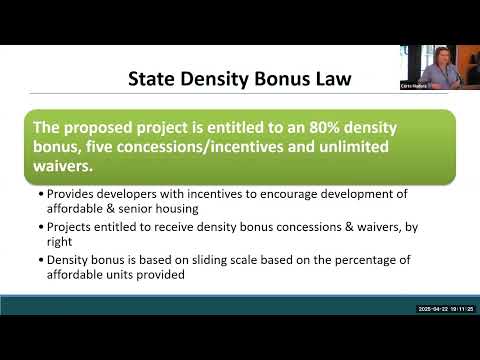
The project, presented by the applicant’s design team, proposes a 72‑foot‑tall building with 99 units (86 three‑bedroom units and 13 four‑bedroom units), two levels of structured parking totaling 63 parking stalls, a ground‑floor leasing office and amenities, and a podium landscape courtyard. Senior planner Martha (Martha’s last name not given in the record) told the commission the project totals about 226,000 square feet and that the developer is invoking California’s density‑bonus law to achieve an 80 percent increase in density over the site’s base zoning. Community development director Amy Lyle told the commission “this project has been controversial from the beginning.”
Why it matters: the proposal sits on one of 10 sites identified in Corte Madera’s housing element and implements state housing‑streamlining laws the town says limit local discretion. Staff repeatedly told the commission the project qualifies for protections under state laws including SB 330 (streamlining), the state density‑bonus law, the Housing Accountability Act and consequences tied to unmet RHNA (Regional Housing Needs Allocation) obligations. Amy Lyle said the town had “little discretion” over elements that the density‑bonus law protects.
Key project facts and standards - Address: 240 Tamal Vista Boulevard (southwest corner of Tamal Vista and Pfeiffer Avenue). - Units: 99 total (86 three‑bedroom, 13 four‑bedroom) as presented by staff and the applicant. - Building: six stories, 72 feet tall (town height limit in the rezoning district is 50 feet; applicant requests a height waiver). - Parking: project proposes 63 vehicle spaces; staff’s slide noted a parking requirement under state density‑bonus parking rules of about 162 spaces based on bedroom counts. - Bicycle parking: municipal code requires 99 secured bicycle spaces (one per unit); the design currently shows 36–37 secured spaces and requests a waiver. - Trees: applicant proposes removal of 42 trees on site; the mitigation/landscape plan would plant 101 trees (88 on‑site, 13 off‑site street trees) as replacement. - Flooding/sea level rise: site is in the mapped floodplain; applicant proposes to elevate livable floors at least 2 feet above the base flood elevation (staff and the civil engineer said the project team intends to comply with FEMA and NPDES stormwater requirements).
Waivers and concessions Staff and the applicant detailed multiple development‑standard waivers requested under the state density‑bonus rules: increased height (72 ft vs. 50 ft), reduced stepbacks above the third floor, encroachments for stairs/ramps into setbacks, higher allowable share of compact parking stalls, and a reduction in required secured bicycle parking. Staff’s presentation said some waivers would be mandatory if the project meets density‑bonus eligibility; staff recommended approval and judged that denying those waivers could expose the town to legal risk under state housing law.
Public comment and objections More than two dozen speakers addressed the commission during the public‑comment segment. Supporters described local workforce and family needs: Omar Carrera said the project would provide homes for “multi‑generational households, essential workers, and families with children” who otherwise face long commutes or overcrowding. Joseph Shoemake, director of HomeMatch Marin, and Jenny Silva, executive director of Marin Environmental Housing Collaborative, also urged approval, citing family‑sized units and transit access.
Opponents, many of them neighbors on Lucky Drive and nearby streets, cited traffic congestion at school drop‑off and pickup times, off‑site parking spillover, public‑safety and emergency‑access concerns, and flood and liquefaction risks. Several speakers said the proposal felt oversized for the immediate neighborhood and asked whether the project mix should include smaller units (one‑ and two‑bedroom) rather than predominantly three‑ and four‑bedroom family units. Joe Murray and multiple Lucky Drive residents urged the commission to consider cumulative impacts from other Tamal Vista projects and emergency egress in a major incident.
Staff responses and technical notes - CEQA: staff and EMC Planning Group consultants prepared an initial study and an addendum to the 2023 Housing Element SEIR; staff recommended the commission find a subsequent EIR unnecessary and adopt mitigation and monitoring measures included with the addendum. - Schools: EMC planner Shoshana Lutz reported available capacity in local schools (the report cited roughly 3,243 excess capacity for the Tamalpais Union High School District and several hundred seats at the elementary/middle level for the Larkspur‑Corte Madera district, as summarized in the staff presentation). - Flooding and grading: public‑works staff said a final grading plan and FEMA guidance would be required during building permit review to show the project would not increase off‑site flood depth or velocity; the civil engineer for the applicant said the site elevation decision accounts for projected sea‑level rise guidance. - Fire access: Marin County and local fire staff said ladder resources would come from automatic aid and that pre‑planning would assign resources as needed; the commission was told that mutual‑aid ladder trucks from neighboring departments could reach the roofline.
Commission deliberations and vote Commissioners split over the balance between the town’s housing obligations and local impacts. Commissioners who voted yes cited the town’s limited discretion under state law and the risk of legal challenge or loss of other housing‑element protections if the project were denied. Commissioners who voted no said the project’s bulk, limited bike parking, and the concentration of family‑sized units without a broader unit mix created unacceptable local impacts.
The commission approved staff’s recommendation and added a direction that, before the item goes to the Town Council, staff provide a focused traffic assessment that specifically models ingress/egress operations and peak‑period effects at the project driveway and the Tamal Vista/Pfeiffer intersection so the council has that analysis on record. The planning commission’s formal action may be appealed to the Corte Madera Town Council within 10 calendar days; staff noted an appeal form and filing fee in the public record.
What’s next The commission’s approval is a discretionary action that can be appealed to the Town Council within the 10‑day appeal window. If the council upholds the approval, the project will proceed to building and grading permit review, where floodplain, geotechnical and building‑code requirements will be reviewed in detail and mitigation measures enforced. Several neighbors said they expect an appeal; the applicant’s team said it will continue to refine bike‑parking, guest parking and design details in the permit phase.
Ending The commission’s approval marks a contentious instance of state housing laws intersecting with local planning and neighborhood concerns. The project will remain subject to the town’s permit review, potential appeal and any legal challenges that may arise if parties contest the commission’s findings or the waivers granted under state law.