Get Full Government Meeting Transcripts, Videos, & Alerts Forever!
Get email alerts on the Cross Connection Control Handbook topic
No spam. Unsubscribe anytime.
State Water Board staff outline new Cross Connection Control Handbook requirements for public water systems
Summary
Staff from the State Water Resources Control Board's Division of Drinking Water presented an overview of the Cross Connection Control Policy Handbook (CCCPH), describing new requirements public water systems must implement, the items required in a cross connection control plan, and key compliance timelines.
Staff from the State Water Resources Control Board's Division of Drinking Water presented an overview of the Cross Connection Control Policy Handbook (CCCPH), describing new requirements public water systems must implement, the items required in a cross connection control plan, and key compliance timelines.
The handbook replaces prior cross-connection rules in California Code of Regulations Title 17 and expands the required program from six elements to 10, adding mandatory tester and specialist certification standards, backflow incident investigation and reporting, public education and outreach, and local entity coordination. The presentation stressed that the handbook’s objective is to protect public health by preventing contamination of potable water systems through elimination or control of cross connections.
Under the handbook, public water systems must document an administrative and technical cross connection control program in a written cross connection control plan (CCCP). The plan must describe how the system will meet the handbook’s program elements and must be submitted to the local Division of Drinking Water district office or Local Primacy Agency by the deadline specified in the handbook; the presentation stated that plans are due one year after the handbook’s effective date (07/01/2025) and that systems may request extensions. The plan must include: the system’s compliance statement; the method and schedule for hazard assessments; a copy of the legal authority for program enforcement (ordinance, code, contract or other); inspection and testing procedures and timeframes for backflow prevention assemblies and air gaps; procedures for non-testable devices at system facilities; tester verification procedures; incident response protocols; contact information; tracking and record-keeping systems; lists of user supervisors where applicable; corrective action procedures and timelines; public outreach plans; and procedures for local entity coordination.
Key technical and operational requirements summarized in the presentation included:
- Hazard assessments: systems must evaluate each service connection for the potential and degree of hazard to the distribution system. Hazard assessments must be performed or overseen by a certified cross connection control specialist; systems with limited on-site access may use off-site administrative methods (surveys, permit records, GIS) as described in the plan. Reassessments are required when account holders change, a service is added or reconnected, water use changes, a backflow incident occurs, or the system determines the prior assessment is no longer current.
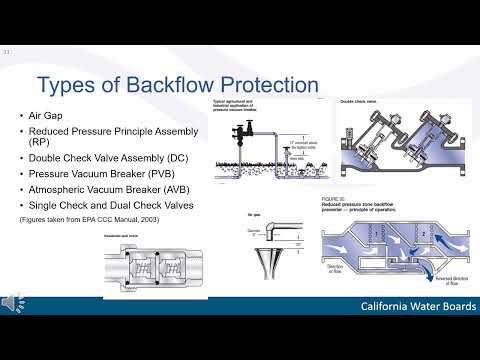
- Backflow prevention assemblies: assemblies must correspond to the identified degree of hazard. Reduced pressure (RP) assemblies are required for health hazards and protection against back pressure and back siphonage; double check (DC) assemblies are limited to low-hazard situations; PVBs and AVBs protect against back siphonage only and are commonly used on irrigation systems. Assemblies that are non-testable should be inspected or replaced regularly. Annual testing of RPs and DCs remains required; testing is also required after installation, repair, relocation, and following seasonal shutdowns. Assemblies failing tests must be repaired or replaced within 30 days unless an alternative timeline is authorized in the system’s plan.
- Fire protection systems: the handbook requires protection of distribution systems from fire systems with at least double-check assemblies for low-hazard fire systems and RP assemblies for high-hazard systems. If an RP or DC cannot be installed, a water system may propose an alternative method or date to the State for review. The presenter described this protection as required within 10 years of the handbook’s effective date (transcript contained differing date references for effective dates; see clarifying details).
- Certifications and certifying organizations: the handbook creates regulatory requirements for tester and specialist certification. Certifying organizations must obtain State Water Board recognition and ANSI accreditation by 07/01/2027; certification programs must include approved training, examinations, and recertification standards. Testers and specialists performing inspections and field testing must be certified.
- Records and tracking: systems must keep records for at least three years for each backflow prevention assembly, air gap and related testing, including assembly type, model, location, test dates, installation dates and repairs, hazard assessments and associated hazards, backflow incident records, and public outreach materials. Systems must describe in the plan how they will track assemblies, air gaps and internal protection devices; the State-provided templates include inventory pages for small and noncommunity systems.
- Incident response and notification: suspected or confirmed backflow incidents must be investigated and documented. Water systems are required to notify their DDW district or LPA office of any known or suspected backflow incident within 24 hours of determination; the State may request a backflow incident report and may direct Tier 1 public notification if warranted.
- Public education and local coordination: the handbook requires systems to implement outreach to inform customers and staff about cross connections, and to coordinate with local entities (building and safety/permitting departments, fire marshals, local health departments and other water agencies) on installation, inspections and incident responses.
The presentation listed resources for systems to use, including the handbook and its accompanying staff report on the State Water Board website, an EPA Cross Connection Control Manual, the California Plumbing Code (available through IAPMO), AWWA M14 guidance, and other manuals. For general handbook questions staff provided the email backflow@waterboards.ca.gov and directed systems with plan-specific questions to their local DDW district or LPA office.
The presentation concluded by reiterating that systems may implement their cross connection control programs prior to formal plan approval, and that plans must be kept current; substantive program changes require plan revision and resubmittal to the local office.