Get Full Government Meeting Transcripts, Videos, & Alerts Forever!
Get email alerts on the Capital Improvement Plan topic
No spam. Unsubscribe anytime.
Council hears 10-year CIP update focused on parks, impact-fee strategy and major infrastructure projects
Summary
City staff presented a 10-year capital improvement program that prioritizes maintenance and phased construction of major projects — including the maintenance and operations center, waterfront and trail grants, and deferred park and street rehab — while flagging constraints on how impact fee and surtax dollars may be used.
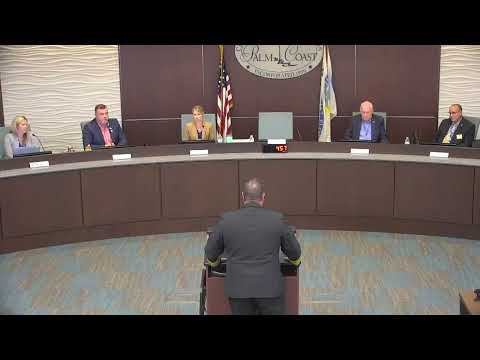
City staff on the Palm Coast City Council workshop presented an updated 10-year capital improvement plan that spans multiple funds and emphasizes maintenance and phased work on the city’s largest projects. Carl Cody, director of stormwater engineering, led the session and walked council through fund-specific restrictions, grant-backed projects and the timing of major work such as the city’s maintenance and operations center and trail and park improvements.
The presentation explained limits on several revenue sources. Cody said the county “small surtax,” a half‑percent of local sales tax collected by Flagler County, is committed to construction and improvement of public facilities and is distributed by a state formula; the city receives roughly half of that revenue. Cody told council the surtax began Jan. 1, 2013, and the revenue is constrained by the county ordinance that created it. He also reviewed multiple impact‑fee funds (recreation, transportation, fire) and said each is restricted to growth‑related capacity projects and cannot be used for existing system deficiencies.
That restriction shapes how staff propose to use fees. For recreation impact fees Cody said the current rate is about $18.28 per unit and that impact fees typically cover roughly 69% of growth‑related project costs with a remaining share required from other funding sources; he said the share may change when the city’s impact‑fee update is completed. Staff said they expect an impact‑fee update to return to council next month and that the study will reflect large cost increases in construction and could change recommended shares and timing.
Cody reviewed grant‑funded park and trail work already in motion, including a $325,000 grant for Long Creek Nature Preserve, a $300,000 grant for additional waterfront‑park access, and other DOT and USTA awards for trail and courts work. He said the Grama Swamp/Grama Trail design received a $615,000 DOT grant and staff are negotiating scope and fee; DOT is expected to move part of the funding from federal to state sources to reduce restrictions. For the waterfront and Long Creek projects, staff listed city match requirements and contingency plans to pursue additional grants.
On transportation and town‑center impact fees, staff told council the town‑center DRI (development of regional impact) contains language tying town‑center impact fees to regionally significant road improvements. Councilors asked whether the trigger language and trip thresholds are met; staff said average daily traffic counts for some segments are approaching but not conclusively over DRI thresholds and that further traffic and stormwater modeling is underway to clarify responsibilities and potential upsize of culverts and bridges.
On fire‑related infrastructure, Cody summarized the fire impact fee fund (current residential fee about $4.34 per dwelling unit) and the ongoing construction of Fire Stations 22 and 26; staff said last year’s general‑fund balance helped cover shortfalls for Station 22 and 26 and that some fund transfers are expected to be repaid as impact fees are collected.
Council questions focused on priorities and sequencing. Several councilors pressed staff for more breakdowns in the five‑year plan — for example how transfers earmarked for the maintenance and operations center (MOC) versus fire and park projects are allocated — and requested a clearer tie between the city’s parks master plan priorities (additional rectangular fields, neighborhood parks, expanded access) and the capital‑funding strategy. Cody said detailed backup worksheets with project‑level funding are in the meeting packet and staff can provide a project‑by‑project breakdown and a five‑year slice when council asks.
Staff last framed next steps: the impact‑fee updates for recreation, transportation and fire are on an adjacent schedule (staff said they hope to take the package to a May 27 workshop), and the council will be asked to adopt a formal five‑year CIP in August. Council members asked staff to return with more detailed worksheets, the history of impact‑fee changes, and a clear list of projects deferred due to prior budget choices so members can weigh catch‑up versus new priorities.
Ending: Staff committed to provide the requested breakdowns in the packet and to return with the impact‑fee study and a prioritized five‑year CIP during the coming budget cycle.