Get Full Government Meeting Transcripts, Videos, & Alerts Forever!
Get email alerts on the Open Meetings Act topic
No spam. Unsubscribe anytime.
Taos City Council holds workshop on Open Meetings, ethics and mayor-manager roles
Summary
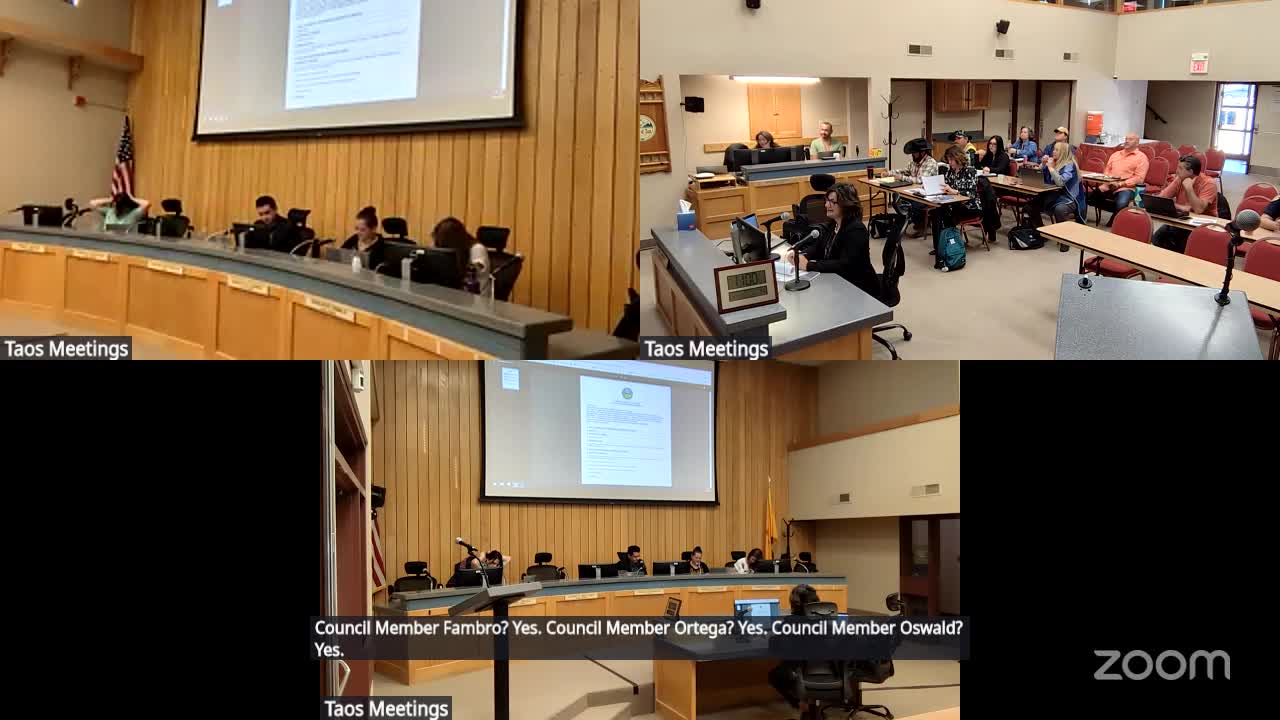
Elena Gallegos of the Walsh Gallegos law firm led a workshop Feb. 24 for the Taos City Council on legal obligations for elected officials and staff, focusing on the Open Meetings Act, public‑records duties and the Governmental Conduct Act.
Elena Gallegos of the Walsh Gallegos law firm led a workshop Feb. 24 for the Taos City Council on legal obligations for elected officials and staff, focusing on the Open Meetings Act, public‑records duties and the Governmental Conduct Act.
The session stressed that Open Meetings Act protections cover deliberations, not only formal votes, and warned against “rolling quorums” formed by serial one‑on‑one communications. Gallegos told the council the public has a right to see the process by which officials form policy, and that informal exchanges that lead to a majority view can violate the statute. “If you’re engaging in it outside of the Sunshine Law, outside of the view of public, it is considered a violation of the Open Meetings Act,” Gallegos said.
Why it matters: The training was aimed at preventing procedural violations that can trigger attorney‑general complaints, IPRA (Inspection of Public Records Act) requests and, in some cases, litigation. Council members and staff raised operational questions about remote participation, executive sessions, minutes and how authority is divided between the mayor and a town manager.
Key points from the presentation
- Rolling quorum and discussions outside public view: Gallegos used a common example — two members talking, then one relaying the discussion to a third — to illustrate how a non‑quorum can become a quorum through serial communications. The presenter recommended discipline and public disclosure when substantive town business is discussed outside a posted meeting.
- Remote participation: The attorney urged that remote attendance be permitted only when it is “difficult or impossible” for a member to attend in person, not for convenience. She said the member must be identifiable, all participants must hear each other simultaneously and the public must be able to hear the remote participant. The council’s technology staff was praised, but speakers noted that repeated or intermittent remote participation can create legal risk.
- Notices, agendas and materials: Gallegos reviewed statutory notice and agenda rules and emphasized that an agenda posted on the town website must be available 72 hours before the meeting (that period includes weekends and holidays). She said the Open Meetings Act requires sufficient specificity for items that the public might reasonably expect to be acted upon and that high‑interest items should be described with clearer language.
- Minutes and records: Draft minutes must be prepared within 10 working days and approved, amended or disapproved at the next meeting with a quorum. Gallegos noted that draft minutes are public records and that livestream recordings may help, but minutes must still capture the substance of proposals and votes.
- Executive sessions: The attorney summarized permissible grounds for closure (for example, limited personnel matters, pending or threatened litigation, and certain real‑property negotiations) and stressed the need to state the statutory exception and a specific description when calling the closed meeting. She reiterated that the vote to close must be taken in open session with each member’s vote recorded and that a report should be made in the next open meeting to state what topics were (and were not) discussed in executive session.
- Emergency meetings: Gallegos clarified that the legal standard for an emergency meeting is a statutory one (unforeseen circumstances that will cause injury, damage or substantial financial loss if not addressed immediately). If a body acts in an emergency, it must report the action and circumstances to the attorney general within 10 days unless the action is covered by a state or national emergency declaration.
- Governmental Conduct Act (ethics): Gallegos described the GCA’s core principles — public service as a public trust, advancing public interest over private benefit, full disclosure of real or potential conflicts, and prohibition on using confidential information for private gain. She emphasized the practical rule: “When in doubt, disclose.” The training covered requirements to disclose outside employment, family interests that may create conflicts, the need for competitive processes where contracts would otherwise benefit an official or an official’s family, and the statute’s one‑year restrictions on certain post‑employment representations.
- Mayor vs. manager roles: Gallegos and municipal counsel reviewed key statutory provisions for the mayor and for a municipal manager where the town’s population qualifies for that structure. The mayor is the municipality’s presiding officer and, under statute, appoints officers and temporarily appoints employees subject to council confirmation; the mayor is counted in a quorum but generally votes only to break a tie. For municipalities with a manager (population threshold noted in statute), the manager serves as chief administrative officer with day‑to‑day supervision and hiring/discharge authority, subject to the governing body and the town’s personnel/merit ordinance.
Council questions and staff comments
Council members asked about how often remote participation should be allowed, whether advisory committees must follow the Open Meetings Act, how to handle minutes for subcommittees and whether local rules or ordinances can and should refine those standards. Municipal attorney “Miss Nixon” (municipal counsel) and Town Manager Martinez said the town’s personnel and governance practices already address many details but that the council could adopt clarifying ordinances or policies where statutes are silent or out of date. Council member Oswald asked for guidance on censure and votes of no confidence; Miss Nixon said the town has used votes of no confidence in the past as a formal resolution and that legal counsel should be consulted on any stronger remedial steps.
Ending and next steps
The workshop ended with a reminder from Gallegos that the OMA and GCA guidance documents published by the attorney general are useful references, and the council signaled interest in reviewing ordinances and internal rules (for example, remote participation policy, committee governance, and conflict‑disclosure forms) to reduce legal risk and improve transparency. No ordinance or formal action was taken during the training portion of the workshop.
Quotes (from the meeting)
“...the public has the right to view you going through that process,” Elena Gallegos said when explaining the Open Meetings Act.
“If you’re engaging in it, outside of the Sunshine Law, outside of the view of public, it is considered a violation of the Open Meetings Act,” she added.
Municipal counsel Miss Nixon noted the town has previously issued votes of no confidence in past administrations and advised the council that any censure or similar action should be carefully structured and supported by legal counsel.