Get Full Government Meeting Transcripts, Videos, & Alerts Forever!
Get email alerts on the Employee Benefits Health Insurance topic
No spam. Unsubscribe anytime.
Butte-Silver Bow hears self-funded health plan renewal; stop-loss change could save about $161,000
Summary
Human Resources presented the proposed 2025–26 self-funded health plan renewal, describing modest premium changes, a switch to a lower-cost stop‑loss carrier and new telemedicine/concierge services; the presentation was placed on file by the council.
Butte-Silver Bow Council of Commissioners Committee of the Whole on April 23 heard a presentation from Human Resources Director Beth Wurm and HR generalist Emily Joan Art on the proposed renewal of the county’s self-funded health insurance for the July 1, 2025–June 30, 2026 plan year. The presentation outlined plan performance, stop‑loss proposals, modest premium changes and new digital services; the council placed the communication on file by a recorded vote.
The plan year-to-date funding level stands at 96.1%, with five large claims driving most high-cost spending, Wurm said. About 160 people are enrolled, and 16 eligible employees currently decline coverage, typically because they are covered on a spouse’s plan. Wurm said the broker remains Marsh McLennan Agency.
A major element of the renewal is stop‑loss insurance. Wurm told commissioners that HMIG quoted a 17.1% decrease versus the current stop‑loss provider; she said the change yields an estimated savings of “over 160,000 to the plan.” Wurm said the stop‑loss carrier change would not affect members’ coverage directly.
The county will keep its three plan designs: a traditional plan (lower deductible), a high‑deductible plan with a $3,300 individual deductible (the IRS-required middle‑tier increase from $3,200 to $3,300 was noted) and a $5,000 high‑deductible option. Wurm said the insurance committee recommended standardizing tier spreads across member/employee tiers to make employer contribution patterns more consistent and to increase the employer share for the employee‑only tier to boost competitiveness.
Wurm and Joan Art described two new member services: MDLive for telemedicine and Rightway (a concierge/billing‑navigation service). Joan Art said MDLive would cost about $0.52 per employee per month and Rightway about $5.50 per employee per month; combined, she said, the change saves roughly $1 per employee per month relative to current arrangements. Joan Art also described existing benefits that will continue, including dental and vision bundled with medical, Mutual of Omaha life insurance and the wellness program.
Wurm noted IRS changes for 2025: HSA contribution limits rose (she cited $4,300 for individual coverage and $8,550 for family coverage) and the middle-tier deductible increase noted above. She walked commissioners through expected premium changes and said the committee was able to hold increases to modest levels (examples discussed included roughly 2% on some plans). Open enrollment is scheduled for May 12–23, with in-person sessions May 5–7.
Commissioners asked about historical deductibles, usage reporting and outreach to raise engagement with the telemedicine/concierge services; Joan Art said utilization reports are available (typically quarterly) and that staff will continue outreach to increase uptake.
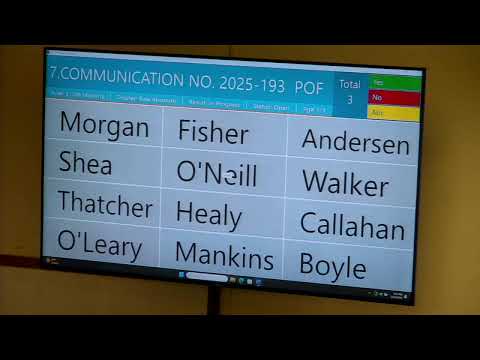
Following the presentation, Commissioner Thatcher moved to place Communication 2025-5190 on file; the motion passed 12–0.
The HR office will proceed with broker and vendor steps and with open enrollment outreach; commissioners will consider any formal plan adoption or other actions in later proceedings.