Get Full Government Meeting Transcripts, Videos, & Alerts Forever!
Get email alerts on the Comprehensive Plan Engagement topic
No spam. Unsubscribe anytime.
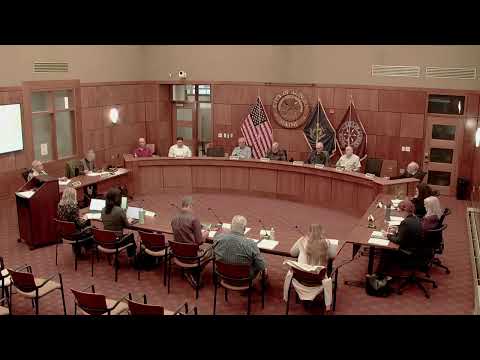
Auburn committee refines community survey, outlines student outreach and subcommittee roles
Summary
The Auburn Comprehensive Plan Committee reviewed a draft community visioning survey, agreed to edits (including separating senior programming), discussed student engagement plans and outreach channels, and formed three subcommittees to review inventory and analysis materials.
The Auburn Comprehensive Plan Committee reviewed and revised a draft community visioning survey, set outreach plans including the Social Pinpoint website, and formed three subcommittees to help with inventory and analysis during its meeting. The committee also approved the minutes from its March 25, 2025 meeting and later adjourned.
Committee Chair John Cleveland opened the agenda item by noting committee members had the draft survey in their packet and inviting the consultants to present. A consultant described the survey’s intent "to collect some broad community feedback across a variety of topics" and to "provide the public's introduction to this process," and recommended keeping the survey low-barrier to encourage participation.
The committee agreed on a handful of substantive survey design points. Members asked the consultant to allow respondents to choose multiple priorities (the committee favored limiting choices to about three or four to encourage prioritization rather than an unlimited selection) and to include an open-ended field for "other" responses. Committee members asked the consultants to separate senior programming from a combined "parks and recreation" option so responses would show whether senior services should be treated distinctly from general recreation offerings. The consultant agreed to make that change across related survey sections.
Members also discussed question wording on jobs and commuting; the committee asked staff to cross-tab a later question that asks whether respondents work in Auburn with other answers so the inventory and analysis can show commuting patterns. On transportation, the committee asked that the survey distinguish local intra-city services from intercity connections such as existing pilot bus service to Portland. On housing and income questions, members suggested aligning income bands with commonly used categories (for example, HUD- and census-aligned bands) while keeping the survey concise.
The committee added a question on public attitudes toward services for people experiencing homelessness and discussed adding a question asking whether respondents would be willing to pay higher property taxes to fund prioritized services; staff said that could be captured by rewording or adding an item in the prioritization matrix.
Student engagement planning was a major topic. Committee member David Hedager described outreach to local school leaders and said the Social Pinpoint site would be used "as our clearing house to gather all the information" and that anonymity would be important for student responses. Suggested tactics for youth participation included: sticky-note activities outside school libraries, small focus groups with student council leaders, a photo contest tied to a high-school photography class, and coordination with Little League and the Boys & Girls Club to reach parents and children. The committee asked staff and consultants to try to complete student outreach before the end of the school year in May.
Consultants reported the Social Pinpoint site had recorded 66 unique visitors and 12 contributors to date. The committee discussed outreach channels to boost participation: social media, articles in the Sun Journal and Auburn Highlights (Turner Publishing), postcards or mailed notices if budget allows, tabling at events, collaboration with the Chamber of Commerce, and use of an electronic downtown billboard.
The committee appointed members to three subcommittees that will review the inventory and analysis and provide targeted input: (1) People and City Services, (2) Natural Environment, and (3) Built Environment. Several members volunteered preferences and staff said absent members would be contacted to complete the rosters.
Members were shown a SharePoint site to store planning documents. Staff acknowledged some participants could not access the site immediately and said IT (Jill) would manage permissions; committee members were instructed to send questions about inventory documents to project staff, who will route them to subject-matter staff when needed.
Procedural actions recorded in the meeting included approval of the March 25, 2025 minutes and a motion to adjourn. The minutes were accepted "as presented" after a recorded two abstentions; the transcript does not specify the names tied to those abstentions. A later motion to adjourn carried unanimously.
The committee scheduled follow-up work on inventory and analysis and confirmed a June meeting date to continue review and engagement planning; staff said the consultants will circulate updated survey wording and an outreach timeline with a planned survey period of about one month leading up to May (exact launch and cutoff dates to be finalized).