Get Full Government Meeting Transcripts, Videos, & Alerts Forever!
Get email alerts on the Event Security Campus Corner topic
No spam. Unsubscribe anytime.
City staff recommends mobile, traffic‑rated barriers instead of fixed bollards for Campus Corner events
Summary
After reviewing permanent bollard options and security ratings, city staff urged a mobile, modular barrier system for Campus Corner and other event zones, citing emergency access, maintenance and utility conflicts with in‑ground bollards.
City Streets staff and public safety officials told the City Council Community Planning and Transportation Committee on April 25 that permanently installed, key‑operated bollards are not the best option for securing Campus Corner during events and football game days.
Joseph Field, streets program manager, briefed the committee on a multi‑year review of a pilot plan for bollards in the Campus Corner footprint. Field and Major Barber (police) said earlier purchased, key‑operated bollards were not traffic‑rated and that traffic‑rated security bollards would require deep foundations, extensive utility relocation and far higher cost. Major Barber noted that bollards that staff had previously ordered were “more aesthetic bollards than they were safety bollards.”
Why it matters: committee members and staff emphasized two priorities that in‑ground bollards would struggle to meet — reliable emergency access and adaptability for different event footprints. Fire and police staff warned that a bollard that fails in the raised position can block emergency vehicles and is difficult to remove quickly, and that key security (many distributed keys in the community) creates control and theft risks.
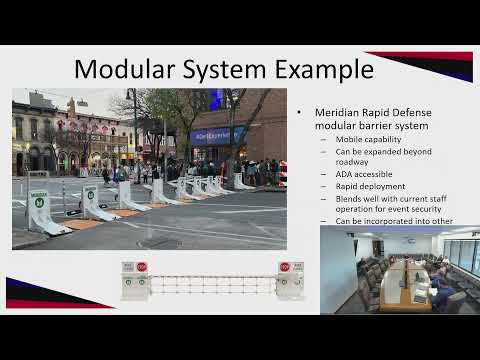
Staff proposal and alternatives: instead of fixed in‑ground bollards, staff recommended pursuing a modular, mobile barrier system that is traffic rated, ADA accessible and rapidly deployable. Staff showed examples of a modular system used at national festivals and suggested the Meridian Rapid Defense System and similar mobile barriers. Those units can be arranged to provide secure vehicle exclusion while maintaining pedestrian flow, include ADA‑compliant walking pads, and are usable in multiple locations across the city (Campus Corner, Main Street, festival footprints).
Maintenance, cost and operations: staff said traffic‑rated in‑ground bollards would cost substantially more (staff cited vendor examples in the thousands of dollars per unit and heavy civil construction) and present high lifecycle maintenance and repair needs. Built, mobile modular systems cost more than the inexpensive aesthetic bollards the city had purchased earlier but avoid heavy permanent civil work and allow rental or phased purchase options; staff said rental availability should be explored for the upcoming football season while procurement and deployment details are finalized.
Merchants and event control: staff noted prior outreach to Campus Corner merchants about earlier bollard proposals and said merchants expressed mixed positions: some want more frequent closures (weekends) but have concerns about who would manage keys and equipment. Committee members and staff said the city will reengage the Campus Corner Merchants Association as staff refines modular options and tests deployments.
Next steps: staff asked for committee direction to pursue modular, transportable, traffic‑rated barriers, to explore rental options for the coming season and to develop a menu of “event‑friendly zones” where pre‑approved closures, equipment and ingress/egress plans could be used. The committee indicated support for the modular approach and asked staff to return with cost and operational details; no formal vote was taken.
Local context: staff said the city will continue to use movable concrete barricades and existing event management tactics in the near term and that earlier inexpensive bollards the city purchased may be repurposed for low‑risk park or pedestrian applications where traffic‑rated protection is not required.