Get Full Government Meeting Transcripts, Videos, & Alerts Forever!
Get email alerts on the Submetering Implementation topic
No spam. Unsubscribe anytime.
PG&E, SCE and SDG&E report partial submetering rollouts; automation, vendor interest remain challenges
Summary
At a CPUC workshop on submetering, program leads from Pacific Gas & Electric, Southern California Edison and San Diego Gas & Electric said they have built billing and enrollment systems but face delays to full automation, limited MDMA vendor interest and cost barriers for residential deployments.
Representatives of California’s three largest investor-owned utilities reported progress and remaining obstacles in implementing the CPUC’s submetering protocol, but said full automation and broad vendor participation are not yet in place.
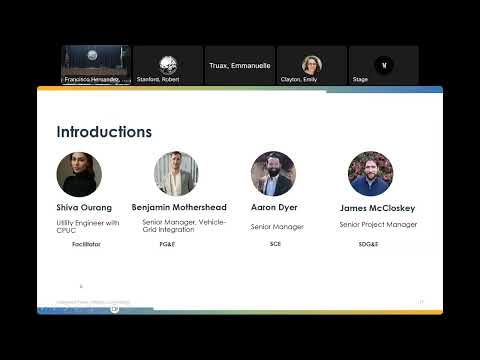
“I'm Ben Motherstead. I am the program lead at PG&E for the submetering program,” said Ben Motherstead, describing PG&E’s direction to have “a fully automated billing system ready by the end of 2024” that was delayed by the utility’s billing modernization work. He said PG&E has implemented a partial automation solution and expects the interim approach to be ready by mid‑year (date not specified). Motherstead emphasized that PG&E views submetering as part of a broader vehicle‑grid integration portfolio and cited pilot results showing load shifting and high customer satisfaction.
Aaron Dyer of Southern California Edison said SCE has an approved equipment Approved Product List (APL) and has been working to qualify Meter Data Management Agents (MDMAs). “We have 1 fully active currently, Grid Tractor. We have 2 that are in the pipeline,” Dyer said, adding that outreach has produced interest from roughly 40–50 potential MDMA candidates but relatively few completed applications. He told the workshop SCE updated its billing systems for a hybrid billing approach and secured an extension for full automation implementation to 2026.
San Diego Gas & Electric said it completed the billed system buildout and enrollment flows on schedule and is ready to onboard MDMA partners. “We've built out our billing system to accept the MDMA data … and we've built out our enrollment process,” said James McCloskey, SDG&E senior project manager. McCloskey said SDG&E had little need to spend manual‑billing or marketing funds because, so far, no MDMA partners have completed integration; enrollments remain automated where customers enroll via a single‑customer (S‑core) flow, while the multiple‑customer (M‑core) scenario still requires manual handling.
Why progress is partial
Utility speakers identified three recurring constraints: (1) high upfront metering costs and differing meter types; (2) limited MDMA interest because vendors find customer enrollment and revenue models uncertain; and (3) integration and internal IT prioritization delays. Motherstead cited Nexant Phase 2 pilot cost estimates (reported in 2018) of roughly $1,500–$3,000 per metering installation as a barrier to residential offerings and urged the CPUC and stakeholders to consider lower‑cost metering alternatives such as smart circuit breakers or CT clamp solutions.
Dyer described an operating challenge inside utilities: vendor integrations are infrequent, so IT teams must “relearn” the integration process for each MDMA candidate, which stretches timelines. McCloskey said SDG&E’s implementation covers the three minimal data flows the utilities expect — enrollment, enrollment response, and meter data — and that SFTP‑based CSV transfers are the baseline that has been implemented.
Who is being targeted
All three IOUs said commercial customers and low‑port‑count commercial deployments are currently the most promising early adopters. SDG&E and SCE noted that many make‑ready and dedicated‑service programs already require separate metering for larger deployments, so submetering is most likely to add value where customers prefer to stay on existing service panels (for example, small commercial sites or multifamily owners with shared parking).
What the utilities say they need
Speakers asked for clearer, standardized device and data requirements and urged stakeholders and the CPUC to consider a path that allows flexibility for emerging metering technologies. Motherstead called for CPUC and industry cooperation to refine goals for submetering so it can be an enabling technology for managed charging and deeper VGI rather than solely a separate billing mechanism.
Ending
Utility project leads said the work completed to date positions the IOUs to onboard customers when MDMA partners do complete integrations, but they urged the CPUC and vendors to address the cost, standardization and MDMA onboarding obstacles that are preventing scalable residential enrollments and broader vendor participation.