Get Full Government Meeting Transcripts, Videos, & Alerts Forever!
Get email alerts on the Textiles topic
No spam. Unsubscribe anytime.
MassDEP reports textile recovery gains since waste ban, urges further outreach and collection access
Summary
MassDEP reviewed textile-recovery work: textiles are a banned disposal item (Nov. 2022), municipalities and recovery vendors report increased tonnage, and MassDEP has used grants and directories to expand collection and reuse.
MassDEP staff told attendees at the midpoint review that textile recovery in Massachusetts has advanced since textiles were added to the state’s waste-ban list in November 2022, and that the agency will continue to use grants, directories and outreach to expand reuse and diversion.
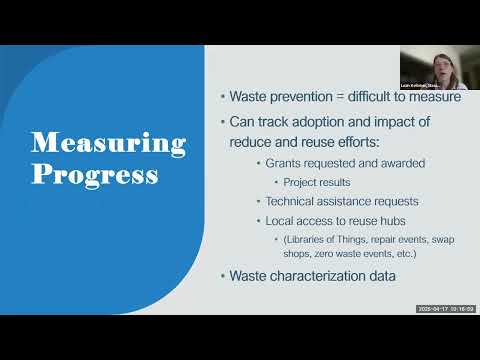
Kathy Mirza and Janice Perret reviewed data intended to measure progress: state waste-characterization studies show more than 5% of municipal trash by weight remains textiles; MassDEP’s goal for textiles is a 50% reduction in disposal relative to a 2018 baseline. Industry partners report that roughly 45% of donated textiles are resold as secondhand apparel, 30% become industrial wiping cloths and about 20% are converted to fiber products; MassDEP staff said roughly 5% of collected material is unusable.
The nut graf: MassDEP combines a range of strategies—education through Recycle Smart Massachusetts, technical assistance via Recycling Works (CET), municipal grants through SMRP/RDP, directories such as Beyond the Bin with more than 2,000 listed textile donation locations, and annual textile summits with recovery organizations—to grow recovery capacity and measure tonnage.
MassDEP cited grant outcomes: the Recycling and Reuse Business Development Grant awarded more than $750,000 to five businesses between 2020 and 2023 for collection and processing infrastructure; microgrants have supported small repair and redistribution programs. The agency said 298 of 352 municipalities reported textile collection programs in 2024, and 190 municipalities earned the textile point in the RDP scoring for that year. MassDEP also noted that many municipalities (approximately 300 annually) participate in the SMRP program.
Participants pressed for more consumer-facing outreach about the waste ban and suggested school-based programs, green-captain networks and clearer municipal web materials. MassDEP staff said it has a mattress and textile-bin toolkit and social-media assets in the Recycle Smart Massachusetts materials and that the agency would work to push those resources more widely.
Ending: MassDEP asked stakeholders to share effective local outreach examples and model policies (donation-bin best practices) that the agency can amplify to further increase textile diversion across the state.