Get Full Government Meeting Transcripts, Videos, & Alerts Forever!
Get email alerts on the Reduce And Reuse Action Plan topic
No spam. Unsubscribe anytime.
MassDEP begins midpoint review of Reduce and Reuse Action Plan, highlights metrics and grants
Summary
Massachusetts Department of Environmental Protection staff reviewed progress three-and-a-half years after publishing the Reduce and Reuse Action Plan, outlined measurement approaches, grant programs, and next steps, and solicited stakeholder feedback on updating strategies.
The Massachusetts Department of Environmental Protection hosted the first of three public midpoint-review meetings Wednesday to assess progress on its December 2021 Reduce and Reuse Action Plan and gather stakeholder feedback on next steps.
The meeting, led by Leah Kelleher of MassDEP’s Reduce and Reuse team, summarized the plan’s origins, the agency’s statutory and programmatic roles, and how MassDEP is measuring progress toward statewide waste reduction goals that were set in the Solid Waste Master Plan. Kelleher said the plan focuses implementation on 1–2 material streams at a time and that the current meeting would examine reusable foodware (single-use packaging), textiles and electronics.
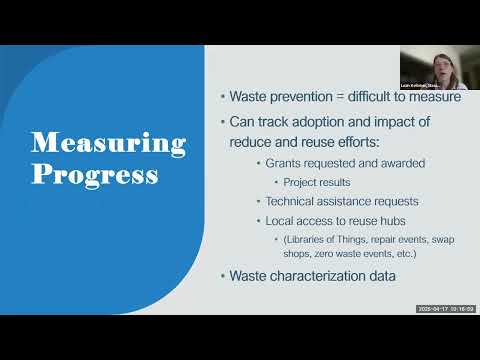
The nut graf: MassDEP framed the midpoint review as a check on what it has accomplished, what remains in progress, and what needs new attention. The agency stressed that measuring reuse is difficult because it describes waste that was never generated; as a result MassDEP tracks activity through proxy metrics such as grants requested and awarded, technical assistance requests, local access to reuse hubs and repair events, and compares those indicators with periodic waste characterization studies.
MassDEP staff outlined the tools they use to support reuse: grant programs (including the Sustainable Materials Recovery Program and the Recycling Dividends Program), technical assistance through the Recycling Works/CET contract, outreach via Recycle Smart Massachusetts, and networking through working groups and listservs. Kelleher and colleagues said MassDEP’s role is to provide grants, technical assistance, and education and to convene stakeholders rather than directly run training programs.
Speakers at the meeting described a mix of accomplishments and unfinished items. MassDEP highlighted increased interest and applications for reuse-focused grants, examples of funded projects (furniture exchanges, reusable foodware pilots, third-party warewashing), and recent guidance: the agency published best management practices (BMPs) for reusable takeout containers in November 2024. MassDEP also reported progress on textiles (see separate article): the agency implemented a textiles waste ban in November 2022 and cited increases in recovered tonnage reported by municipalities and recovery organizations.
Participants asked for more consumer-facing outreach and local materials that municipalities, schools and colleges can reuse. Kelleher and colleagues said many outreach tools exist in the Recycle Smart Massachusetts toolkit and on MassDEP’s social media channels, and that staff will continue to work with the Department of Public Health and municipalities on food code alignment and BMP adoption.
The meeting closed with reminders of open and upcoming grant deadlines (Reduce, Reuse, and Repair microgrant; Sustainable Materials Recovery Program; Reuse and Recycling Business Development Grant) and notice of two follow-up sessions focused on bulky items (May 6) and building materials (May 13). MassDEP solicited ongoing feedback to refine the action plan for the next five-year period.
Ending: MassDEP said it will compile the public feedback collected in this and the two following meetings to recommend updates to the plan’s priorities and tools and to inform grant and outreach priorities for the coming funding cycles.