Get Full Government Meeting Transcripts, Videos, & Alerts Forever!
Get email alerts on the Pensions Teachers topic
No spam. Unsubscribe anytime.
Committee hears testimony on amendment to restore ‘rule of 85’ for post‑2018 school hires; actuarial study, staffing concerns raised
Summary
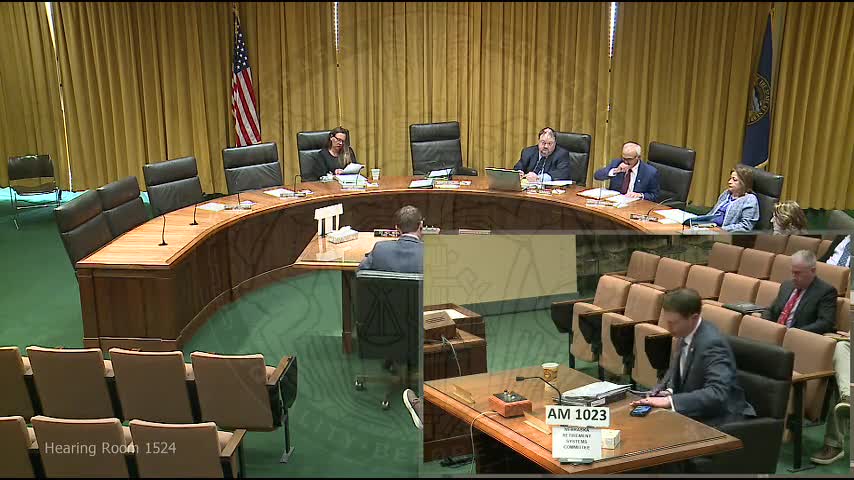
Senator Beau Ballard, chair of the Nebraska Retirement Systems Committee, opened a lunchtime hearing on AM 10-23 to LB 645, an amendment that would restore earlier retirement eligibility under the so‑called “rule of 85” for school employees hired on or after July 1, 2018, and which also includes provisions that alter future state contribution triggers to the school retirement fund.
Senator Beau Ballard, chair of the Nebraska Retirement Systems Committee, opened a lunchtime hearing on AM 10-23 to LB 645, an amendment that would restore earlier retirement eligibility under the so‑called “rule of 85” for school employees hired on or after July 1, 2018, and which also includes provisions that alter future state contribution triggers to the school retirement fund.
The amendment would allow employees hired on or after July 1, 2018, to qualify for an unreduced retirement benefit at age 55 when their age plus service totals 85 — effectively walking back the change adopted in 2018 (LB 415) that required those hires to reach age 60 for unreduced benefits. The amendment also contains a stepped mechanism for reducing the state contribution to the school retirement fund; the committee transcript describes reductions in fiscal years that were discussed during the hearing but the exact numeric schedule as read aloud in committee was not fully specified in the record.
The Nebraska State Education Association testified in favor. Tim Royers, president of the Nebraska State Education Association, told the committee the change would produce a minimal financial impact on required contribution rates. “According to the actuarial study dated April 10, reverting the rule of 85 change would only impact the required contribution rate by 0.25% next year,” Royers said, and he added that the study projects the effect would remain under 1% through 2040. Royers described classroom work that can be physically demanding and urged restoring parity between pre‑2018 and post‑2018 hires so younger educators have the option to retire earlier if needed.
Representatives of school administrators and school boards urged caution. Tim Heruzah, testifying for the Nebraska Council of School Administrators, said the council opposes moving forward without a new actuarial study accounting for the amendment’s combined provisions. “We think we need a new actuarial study before we feel comfortable supporting moving forward with this,” Heruzah said. Colby Coash of the Nebraska Association of School Boards said his organization was comfortable with the current version of LB 645 and preferred the committee not alter the bill at this stage.
Technical staff from the Nebraska Public Employees Retirement Systems attended in a neutral capacity. Tyler Cummings, NPERS interim director, said he was available to answer technical questions from the committee and to follow up where necessary.
Committee members asked a range of questions about process, projected fiscal impacts and workforce implications. Senator Beau Ballard and proponents noted the most recent actuarial work included earlier versions of the proposal and that a revised actuarial review had reduced concerns about abrupt contribution swings; Royers said the newer study increased the probability that reduced contribution rates would be sustainable. Several senators asked for more data on how many educators retire at initial eligibility versus continuing to work and whether restoring eligibility at 55 could worsen teacher shortages by encouraging experienced staff to leave earlier. Royers said many eligible educators currently choose to keep teaching beyond first eligibility and that some retirees in their 50s later return to teach in other districts, a pipeline some districts rely on.
No formal motion or vote occurred during the hearing. Committee members and testifiers repeatedly urged further analysis: proponents asked for the committee to consider the amendment on the merits or to carry it over to secure fuller review; opponents and neutral witnesses pressed for an updated actuarial study reflecting the amendment’s final language and any changes to the timing of state contribution reductions. Chairman Ballard and others noted an actuarial study typically costs on the order of several thousand dollars (one estimate offered by the chair was about $8,000) and that AM 11-08, a clarifying amendment filed subsequently, adjusted timing elements in the step‑down structure.
The hearing concluded with no formal committee action. Ballard closed the session after noting there was one online proponent filed, and the committee recorded the hearing for the bill’s record.