Get Full Government Meeting Transcripts, Videos, & Alerts Forever!
Get email alerts on the Public Assistance Snap topic
No spam. Unsubscribe anytime.
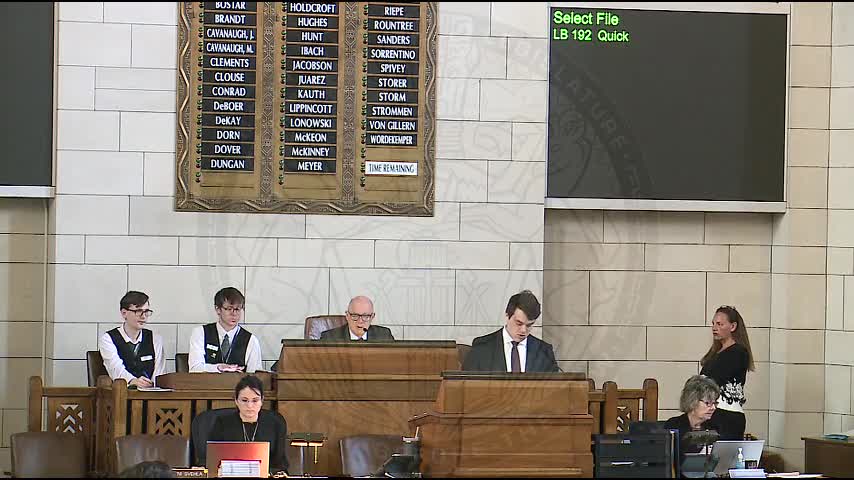
Senators reject Anderson amendment to end statewide SNAP waiver; LB192 advances
Summary
A floor amendment that would have banned the state's blanket waiver of federal SNAP work requirements failed on a roll-call vote; the underlying bill expanding childcare licensure provisions (LB192) advanced later in the day.
Senator Anderson introduced AM 11:31, an amendment to attach his bill to LB192 that would bar the Nebraska Department of Health and Human Services (DHHS) from seeking or renewing a statewide waiver of federal Supplemental Nutrition Assistance Program (SNAP) work requirements and require broader use of the federal Employment & Training (E&T) program. Proponents said the change would restore work expectations and expand help for able-bodied adults without dependents; opponents said the amendment was procedurally hostile to another senator's priority bill and raised unresolved fiscal and rural-tribal impacts.
The amendment was defeated on a roll-call vote (22 yes, 14 no; remaining senators present not voting or absent), and later the underlying LB192 was advanced to enrollment and review on a separate recorded vote.
Why it matters: AM 11:31 sought to remove what the sponsor called a blanket statewide waiver that he said exempted able-bodied SNAP recipients from federal work expectations. Supporters argued that obligating participation in E&T programs will move Nebraskans toward employment and reduce program dependency. Opponents warned the change would have material costs in rural counties and could disproportionately affect tribal communities that have discrete exemptions under federal rules; they also criticized the timing and process of attaching the language to a different senator’s priority bill.
The amendment and debate Senator Anderson (state senator) said the amendment would prohibit the state from renewing broad waivers to SNAP work requirements and would affirm the state's authority to require participation in federal E&T programs. "If you want to take money from your friends and family because you have a hard time and you need some help," Anderson said, "it does mean that you have to give something back. In this case, it's enrollment and working with the education and training." (Senator Anderson, opening on AM 11:31.)
Senators who spoke in favor — including Senator Hansen and Senator Harden — described the E&T programs as proven pathways back to work. Hansen said Nebraska already funds E&T services and that expanding participation would be constructive in a tight labor market. Harden and others described reported participant outcomes and listed services E&T can provide such as bus passes, background checks, childcare, and skills training.
Opponents — including Senator Quick and Senator Dungan — framed AM 11:31 as a procedural takeover of LB192, which they said was another senator's priority bill. Dungan and Conrad raised the fiscal question: earlier fiscal notes on related language had shown multi-million-dollar costs for building E&T capacity across rural counties; Anderson and his supporters said DHHS and the Department of Labor had worked with the sponsor and revised the amendment language and that the agencies' updated assessment reduced the projected state fiscal impact to zero. Several senators — citing the department's fiscal note and rural implementation logistics — urged caution and asked for documented updated fiscal estimates from DHHS before adopting the change.
Concerns about tribal and rural exemptions also dominated debate. Senators noted that the only routine waivers historically sought in Nebraska have been for tribal areas and for counties with documented job scarcity (e.g., Thurston County). Opponents warned that removing discretionary exemptions could harm residents in sparsely populated areas where E&T capacity and transportation options are limited.
Votes and next steps On a roll-call vote in the full body, AM 11:31 failed (22 yes, 14 no; remaining senators present not voting or absent). Later, the underlying LB192 (the bill to which the amendment had been offered) advanced to enrollment and review on a recorded machine vote (LB192 advancement recorded as 29 yes, 9 no). The transcript does not show further amendments to LB192 on the floor that day.
Ending note The debate combined procedural objections with sharply divergent views on the role of work requirements in anti-poverty policy. Supporters framed the measure as a "hand up" to help people re-enter the workforce; critics described it as a potentially costly, rural- and tribal-impacting change that required fuller agency estimates and separate consideration rather than attachment to a different senator's priority bill.