Get Full Government Meeting Transcripts, Videos, & Alerts Forever!
Get email alerts on the Bridges And Roads topic
No spam. Unsubscribe anytime.
Montgomery County residents press commissioners over closed County Road 6200 low-water crossing after engineers recommend full replacement
Summary
Residents told the Montgomery County Board of Commissioners that the closed low-water crossing on County Road 6200 is imposing long detours, safety risks and daily costs, and urged the board to move faster on repairs.
Residents told the Montgomery County Board of Commissioners that the closed low-water crossing on County Road 6200 is imposing long detours, safety risks and daily costs, and urged the board to move faster on repairs. County public-works staff briefed the board on an engineer—s finding that the structure—s slab and subgrade are deteriorated and recommended full replacement, with a preliminary construction estimate of $480,000 and a total estimate of $630,000 including engineering and inspection.
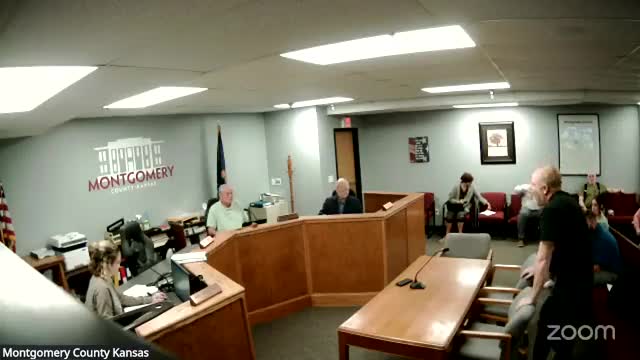
The issue drew sustained public comment at the meeting, where several residents described the crossing as the primary local route and said closure forces roundabout detours of roughly 3.3 miles each way. Robert Peel, a longtime resident, said the closure is costing him and others and questioned the county—s decision to cut the structure: "I thought you were supposed to be working with us or for us instead of slapping us in the face," Peel said.
County public-works staff explained why the road was closed. Brandon, speaking for county engineering/public works, said an inspection tied to nearby Highway 169 projects found a large void under the slab and that "their recommendation was to remove and replace the concrete slab deck and close road to traffic." He said field checks showed only a roughly 6- to 7-inch slab was spanning a washed-out area and that engineers judged the structure beyond repair.
Brandon told the board the replacement design the engineers recommended would lengthen the crossing from about 60 feet to roughly 200 feet because of the terrain. He gave the preliminary cost figures: "It would be 480 for construction. And when you include engineering, inspection, and whatnot, they would get to 630,000 for the total cost." He also told commissioners the county—s bridge crew is understaffed: "We are down to 3 individual bridge crew right now out of 8 positions," and said an in-house rebuild could take many months if attempted with current staffing.
Residents pressed for alternatives and grant options. One commenter asked whether state bridge-replacement grants might be available; county staff said eligibility depends on traffic counts and other criteria and that the county would need up-to-date counts to pursue grant funding. Brandon said past counts had been done but the county would need to review historical data and current usage to determine grant viability.
Commissioners described the trade-offs. A commissioner said rising costs and the county—s backlog mean difficult prioritization decisions: roughly "over 253" bridges and culverts exist countywide, with an estimated 70 to 100 that need replacement or close monitoring. The commissioner also said the board is reluctant to raise taxes to fund the full backlog of repairs and that the county must weigh costs against the number of users served.
The board did not take a formal action to rebuild at the meeting. Instead commissioners said staff should gather more information and the matter will be revisited after the absent commissioner reviews the site. Brandon was asked to check alternative options (shorter spans, corrugated pipe, box culvert, temporary low-water solutions), coordinate with outside bridge contractors if warranted, and report back. The board tabled a final decision pending that follow-up.
Why this matters: residents described medical emergencies where additional driving time mattered; commissioners and staff emphasized safety risks from the void under the slab and the countywide bridge-repair backlog, and staff flagged the cost and staffing limits that constrain an immediate rebuild.
Votes and formal actions: no vote to replace the bridge was taken; the board recorded no final funding or construction action at this meeting. Staff were directed to pursue engineering options and grant eligibility and to bring findings back to the board for a formal decision.
Ending: County staff will obtain any further engineering detail, check grant options and traffic counts, and meet with the absent commissioner on site; the board will schedule a decision after that follow-up.