Get Full Government Meeting Transcripts, Videos, & Alerts Forever!
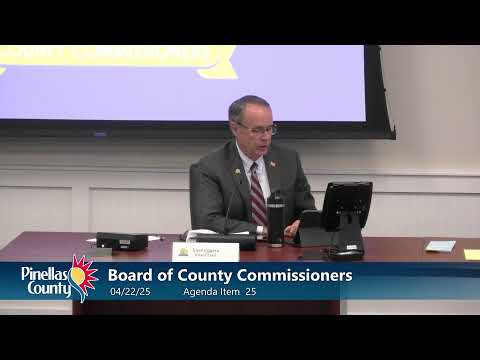
Pinellas commissioners approve withdrawal from Duke Energy subscription program after months of debate
Summary
The Pinellas County Commission on April 22 voted 6–1 to withdraw the county from Duke Energy’s Clean Energy Connection subscription program, pause most public purchases of electric vehicles until the board receives a detailed financial analysis and redirect energy‑program funding toward projects the board deems fiscally prudent.
Commissioners on the Pinellas County Board voted 6–1 Wednesday to adopt a resolution directing staff to withdraw the county from the Duke Energy Clean Energy Connection program and to limit county purchases of electric vehicles pending a formal financial review.
The measure, introduced by Commissioner Nowicki, directs the county administrator to end further county participation in Duke’s subscription program, halt further public funds for electric vehicle procurements until a “comprehensive financial analysis” is presented to the board, and redirects county energy‑program dollars toward projects the resolution called “fiscally sound.” The resolution also repeals two prior county sustainability resolutions (Resolutions 20‑146 and 21‑127) and requires the changes be folded into the county’s sustainability and resiliency planning documents.
Why it matters: Commissioners said they were responding to financial projections showing the county’s subscription payments had outpaced the program credits and to broad uncertainty about the long‑term cost benefits. Supporters framed the move as fiscal stewardship; opponents warned it could limit county leadership on clean‑energy goals.
Board debate and Duke presentation
Commissioner Nowicki read the resolution aloud before opening the floor for discussion and questions from colleagues. Duke Energy representatives gave a short presentation explaining how the subscription program works: Duke built solar generation facilities and customers may subscribe by purchasing blocks (measured in kilowatts) that produce monthly billing credits and renewable energy certificates. Jeff Baker of Duke Energy said the program “was a way for customers…to have more renewable energy” and that the company handles construction and maintenance of the solar sites. Duke account staff noted subscribers receive renewable energy certificates that the county used to meet local sustainability targets.
Duke and county staff acknowledged the program is “upfront loaded” — subscribers pay a fixed monthly subscription and receive a per‑kilowatt credit for generation later. Duke staff said the program’s simple payback point could be on the order of a decade or more; county staff said internal analysis showed the county would not recoup earlier subscription costs until roughly year 12, and full cumulative recovery could…
Already have an account? Log in
Subscribe to keep reading
Unlock the rest of this article — and every article on Citizen Portal.
- Unlimited articles
- AI-powered breakdowns of topics, speakers, decisions, and budgets
- Instant alerts when your location has a new meeting
- Follow topics and more locations
- 1,000 AI Insights / month, plus AI Chat