Get Full Government Meeting Transcripts, Videos, & Alerts Forever!
Get email alerts on the Facilities And Enrollment topic
No spam. Unsubscribe anytime.
Facility study: consultants find room to grow early-childhood and special-education programs as enrollment dips
Summary
Plant Moran RealPoint presented demographic and facilities analysis showing Rochester—s K–12 enrollment down about 872 students since 2018 and projected to decline further; consultants recommended focusing on early-childhood and special-education expansion (9–12 and 8–10 classrooms respectively) rather than school closures.
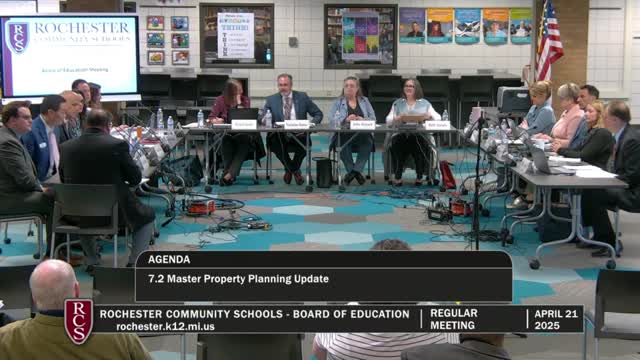
Plant Moran RealPoint presented findings Thursday after a district master property planning process that examined enrollment trends, building utilization and community priorities for Rochester Community Schools.
The consultants told the Board of Education the district—s K–12 headcount has fallen from just over 15,000 in 2018 to about 14,140 in the most recent audited counts, a decline of roughly 872 students. Using SEMCOG and local enrollment models, the consultant team projected further declines over five years and estimated a possible headcount near 13,400 without offsetting changes.
Paul Wills, Partner at Plant Moran RealPoint, and senior consultant John Depew walked trustees through the demographics and classroom utilization figures. Depew said districtwide utilization benchmarks show elementary classrooms at about 88% of a standard target, middle schools at 83%, and high schools at 90% (the treasury—s target cited in the presentation is roughly 85%). Depew said those percentages indicate the district has some spare capacity in parts of the system but is not facing immediate, district-wide overcapacity that would require school closures.
Consultants and administrators identified which buildings had seen the largest elementary declines (Baldwin, Brewster and University Hills) and which secondary sites had the most shrinkage (Hart and Stoney Creek). The advisory committee—s surveys and committee deliberations prioritized three program areas for potential expansion: special education, early childhood, and career-and-technical education. The advisory committee recommended adding roughly 8–10 special-education classrooms and 9–12 early-childhood classrooms over the next five years, with one to two additional CTE spaces at the high-school level if the board chooses to pursue them.
John Depew said the team walked all 22 instructional facilities and counted classrooms, special-purpose rooms, and vacant rooms; the consultants said the district has only two rooms entirely unused, but several rooms used for offices or support services could be repurposed if programming demands required it. The report emphasized that the district—s —capture rate— (the share of local-age cohorts entering RCS) has remained around 7.2 percent even as local live births fell.
Trustees asked detailed questions about how early-childhood and special-education expansions would be implemented, whether multiple-site magnet or CTE programs would require transportation, and if repurposing classrooms would conflict with staffing or collective-bargaining limits. Plant Moran representatives and district staff said those operational implementation issues would be handled in subsequent planning steps and would require more detailed cost and scheduling analysis.
The presentation also summarized community survey results from a 70-person advisory committee: nearly 87 percent favored expanding early-childhood programs; committee members prioritized special education and early childhood as the top two needs, with CTE and magnet programming ranking lower. Consultants recommended the district use the next 1–5 years to align programming with facilities rather than pursuing immediate building closures or redistricting.
Ending: Board members thanked the consultant team and asked administration for a calendar of next steps and likely costs; the consultants said the master plan is a living document and can be updated as enrollment and community priorities change.