Get Full Government Meeting Transcripts, Videos, & Alerts Forever!
Get email alerts on the Land Use Water Capacity topic
No spam. Unsubscribe anytime.
Planned 93-acre Cassie Land Development triggers water-capacity concurrency questions; staff to clarify spreadsheet methodology
Summary
A proposed 93.45-acre Cassie Land Development annexation and zoning request could yield up to 362 houses and produced a negative potable-water concurrency figure in staff materials; utilities staff said the negative number reflects vested prior approvals, not immediate overuse.
City staff reviewed a large-scale future land-use and zoning request from Cassie Land Development covering about 93.45 acres annexed earlier this year in the Old Bartow Road area. The applicant requests neighborhood suburban future land use and multifamily residential low-density (R-3) zoning with an expected build-out scenario that staff estimated could yield up to 362 single-family residential units under the proposed designations.
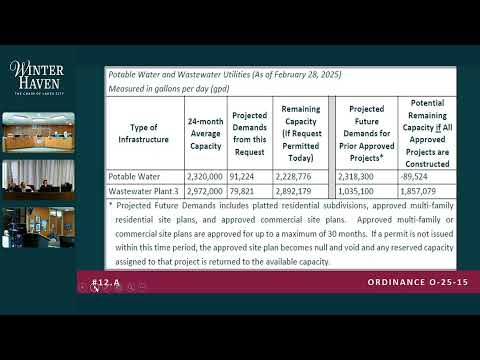
Commissioners and staff focused on a concurrency table in the project fact sheet that showed a remaining potable water capacity “negative 89,524” gallons per day. Eric, a utilities staff member, explained the negative number is a snapshot produced by the city’s concurrency spreadsheets: the city calculates a 24-month rolling average of available permitted capacity, projects demand from the current request (91,224 gallons per day using an adopted level-of-service assumption of 241 gallons per day per house), and then subtracts projected future demands from prior approved and vested site plans and plats. The resulting negative 89,524 gallons per day reflects the sum of current available capacity minus all vested, previously approved projects—not a statement that the city is currently overpumping or out of water.
Eric said the city presently has roughly 2.32 million gallons per day of remaining system capacity when measured on a 24-month rolling average of permitted capacity; the negative concurrency entry arises because the spreadsheet also includes projected demand from prior approved plats and site plans that remain vested. Eric explained that the projected-demand list fluctuates as site plans expire (site plan approvals typically last one year and may receive an extension), and projects that do not proceed are removed from the spreadsheet, which restores available concurrency.
Commissioners discussed longer-term capacity steps, including applying for an increased water-use permit with the Southwest Florida Water Management District (SWFWMD) and participation in the regional water cooperative; staff said the permit application scope will be finalized and submitted soon, with an expected 6–8 months to prepare the submittal, then an unknown period of regulatory review. Staff also said the city could add additional water allocation from the regional cooperative into its concurrency spreadsheets within the three-year window provided by ordinance once allocations are funded and available (staff identified October of the year as a target month to add cooperative capacity). Staff noted water is finite in the state and said they would revisit adopted level-of-service assumptions if actual residential per-house usage trends are materially lower than the plan figures.