Get Full Government Meeting Transcripts, Videos, & Alerts Forever!
Get email alerts on the Land Use Appeal Apollo Gardens topic
No spam. Unsubscribe anytime.
Titusville board upholds Apollo Gardens site development permit after residents’ appeal fails
Summary
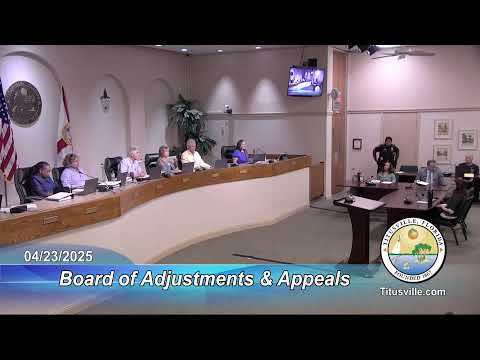
After a lengthy public hearing and discussion April 23, 2025, the Titusville Board of Adjustment and Appeals declined to grant an appeal filed by residents challenging the Apollo Gardens site development permit; the board recorded a 4‑to‑1 vote against the appeal and staff’s approval of the permit stands.
The Titusville Board of Adjustment and Appeals on April 23 reconsidered an appeal of the site development permit for the Apollo Gardens apartment project and voted not to overturn the permit, upholding the administrative interpretation and issuance of the permit (PSDP24‑000205).
Background and procedural history
The Apollo Gardens site development permit, authorizing construction of a multi‑family building, was originally issued November 11, 2024. Appellant Vicki Conklin filed an appeal on December 5, 2024, arguing the project was inconsistent with the Titusville Comprehensive Plan’s locational criteria for high‑density residential development. The board considered standing and procedural issues at multiple prior meetings; in March the board moved to reconsider standing and on April 23 reopened the appeal for full hearing.
What the board heard
Appellant Vicki Conklin argued the project at 2727 Demerit Drive is not “conventional multifamily” and asserted the permit conflicts with Strategy 1.13.11 and Policies 1.14.5 and 1.14.6 of the Comprehensive Plan (relating to locating high‑density uses adjacent to collectors/arterials). Conklin and several neighbors described local street width (Demerit Drive) and access concerns and submitted photos, a traffic/visual presentation, and cited Florida Statute Chapter 163 as the legal basis for requiring adherence to the comprehensive plan.
City staff, led by Community Development staff, presented a written analysis concluding the site plan and permit were consistent with the comprehensive plan and land‑development regulations. Staff explained that the property had been designated high‑density residential by City Council decades earlier and that the cited policies were not applicable in the way the appellant asserted. Brad Parish, the community development director, testified that his written report remained unchanged after hearing appellant’s presentation.
Representatives for the permit holder (identified in the record as counsel Eric Page and representatives from Carfor Supportive Housing) told the board the applicant relied on prior city confirmations of zoning and land‑use compliance, pointed to permit consistency with standards, and cautioned that overturning the permit could raise legal risks including takings or fair‑housing claims. Stephanie Berman, president of Carfor Supportive Housing, addressed public statements made during the campaign opposing the project and disputed assertions that the opposition was solely grounded in land‑use concerns.
Board action
After public comment that included multiple residents on both sides of the question and testimony from experts and counsel, a motion to approve the appeal (that is, to overturn the permit) was called and failed on roll call by a vote of 1 yes, 4 no (Member Green voted yes; Chairman Taylor, Vice Chairwoman Van Diven, Member Beckles and Member Wheelers voted no). By failing to grant the appeal, the board left the administrative site‑development permit in place.
Why this matters: The decision leaves in place a site‑development permit for an 84‑unit multifamily project in Titusville and resolves — at this level of local review — residents’ challenges based on comprehensive‑plan locational criteria. The hearing included detailed legal arguments about standing, comprehensive‑plan interpretation and whether City Council’s prior land‑use designations constrain staff action.