Get Full Government Meeting Transcripts, Videos, & Alerts Forever!
Get email alerts on the Four County Agreement topic
No spam. Unsubscribe anytime.
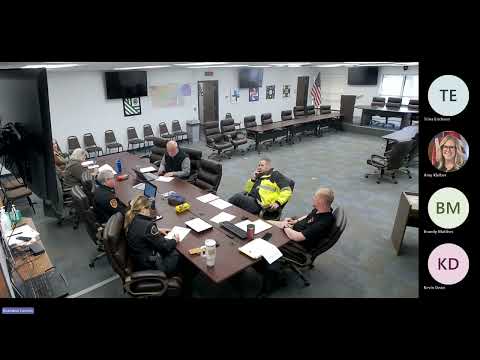
Committee discusses four‑county hazmat agreement terms and the $2,500 annual payment arrangement
Summary
Members debated inserting explicit renewal dates into the four‑county hazmat agreement, reviewed how partner counties’ $2,500 annual payments and grant funds are handled, and authorized the emergency management director to set renewal dates.
The LEPC spent extended time discussing the four‑county hazardous materials agreement that governs Vernon County’s arrangement with three neighboring counties. Committee members expressed concern that the agreement’s lack of explicit renewal dates contributed to a signature delay in January that briefly left a county technically without a designated team.
Emergency Management Director Brandon proposed adding a renewal date (he suggested an example of Aug. 30 or Jan. 1) and said he would meet with partner counties to select a practical date that fits their meeting schedules. He asked for authority to set the date after consulting the partner counties; the committee granted that authority on an oral vote and asked Brandon to return amended language at the next LEPC meeting.
Members also reviewed the financial relationship with partner counties. Brandon explained each partner pays Vernon County $2,500 annually (usually from local levy funds) regardless of how much of that county’s equipment grant is spent; partners also pass their hazmat equipment grant funds to the team when the team buys equipment on their behalf. That pooled grant funding fluctuates each year depending on replacement needs. Brandon said the pooled state equipment grant has allocated approximately $1 million statewide to state teams biennially and that each team receives items according to team type; Vernon County’s type‑3 allocation produced about $8,900 of equipment in 2024 (a meter and a radio).
The committee discussed whether the $2,500 fee could be increased; Brandon reported a statewide survey showed partner payments range widely (some counties pay nothing while others pay up to $8,000 or, in one case, a full fire department charged $54,000 for hazmat coverage). Several members supported adding renewal dates to the agreement to avoid future coverage lapses.