Get email alerts on the System Development Charges topic
No spam. Unsubscribe anytime.
SPU proposes higher system development charges and cost‑sharing to ease costly mainline extensions
Summary
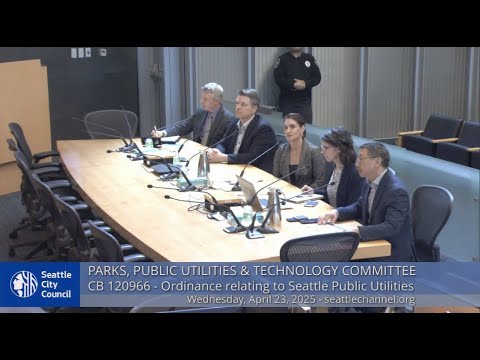
Seattle Public Utilities (SPU) on April 23 presented a three‑ordinance package to the City Council’s Parks, Public Utilities and Technology Committee that would raise and add system development charges (SDCs) for water, wastewater and drainage and create a cost‑sharing and reimbursement program to reduce the upfront cost of new mainline extensions.
Seattle Public Utilities (SPU) on April 23 presented a three‑ordinance package to the City Council’s Parks, Public Utilities and Technology Committee that would raise and add system development charges (SDCs) for water, wastewater and drainage and create a cost‑sharing and reimbursement program to reduce the upfront cost of new mainline extensions.
SPU officials said the package aims to spread expensive infrastructure costs across all development so that individual projects are not priced out. "Everybody pays a little, so nobody pays a lot," Marco Lowe, chief operating officer in the mayor’s office, told the committee.
The package includes: (1) revisions to the water SDC and creation of drainage and wastewater SDCs; (2) authority for SPU to enter latecomer agreements and municipal reimbursement arrangements under state law; and (3) budget and staffing amendments to implement the program. Carrie Burchard Juarez, deputy director at SPU, said the program would begin cost‑sharing on Jan. 1, 2026, if approved.
Why it matters: SPU told the committee roughly 10% of development projects currently must build new mainline extensions, and those projects have borne about 76% of total developer‑paid infrastructure costs in recent years. SPU said developer contributions average about $21 million per year, concentrated on a small share of projects; the proposal would shift more of that responsibility across all development through higher SDCs and reimbursements to make individual projects more feasible.
Key proposal details described by SPU: - New and higher SDCs: SPU proposed raising the water SDC (example: from $2,400 to about $6,900 for a standard three‑quarter‑inch meter) and adding wastewater ($2,600 example) and drainage (example listed as $12.25) charges; SPU estimated the changes would generate new SDC revenue for cost‑sharing (SPU gave an estimate of about $13 million in new revenue for cost sharing in its briefing). These examples were presented as typical, not final project bills. - Developer reimbursement formula: SPU proposed reimbursing developer‑built mainline extensions at a standard rate of $1,500 per linear foot, limited to the first 750 feet of any extension; the developer would build the main and be reimbursed for the portion that benefits future properties rather than the developer’s parcel alone. - Latecomer agreements and repayment: Future properties that connect to the new main would repay SPU ratepayers under latecomer agreements; SPU said those repayments are unpredictable and may take years, so the program will not rely on them for startup viability. - Rate neutrality and monitoring: SPU characterized the package as rate‑neutral for existing utility customers and proposed annual monitoring to reconcile actual development patterns and revenue with projections.
SPU presented hypothetical examples to illustrate impacts: a 150‑unit apartment building that would now pay an estimated $161,500 in SDCs under the proposal versus about $40,800 today; a single‑family lot facing a new service could see a larger SDC if the project requires a new meter, while many ADU additions that use an existing three‑quarter‑inch service likely would not trigger the water or wastewater SDCs but could face a smaller drainage SDC.
Council members pressed SPU on outreach, distributional effects and protections for households on fixed incomes. Council member Teresa Rivera asked who was likely to be "unhappy about this" and sought specifics about outreach and responses; SPU said it notified its customer database by email and engaged developers and industry stakeholders. Rivera also raised the prospect of mitigating impacts on older homeowners and people on fixed incomes; SPU staff said state law does not allow blanket exemptions but allows low‑income deferrals and that the city could broaden the deferral threshold (for example, to 80% of area median income) so repayment could be deferred until property sale.
Council member Alex Strauss and others asked SPU to walk committee members through GIS maps showing where mains are missing and how widespread the need is. SPU staff said roughly 25% of streets lack one or more mains (water, wastewater or drainage) and argued the proposal would help unlock redevelopment on lots that currently cannot afford to pay to extend mains.
SPU emphasized the program would be evaluated annually and that the city would limit initial capital support to cover a shortfall during program rollout. No committee vote was taken on the ordinances during the April 23 briefing; SPU staff said projects expecting the program would still proceed because reimbursement is retrospective.
"We would reimburse that project for the portion in front of the vacant parcel," Carrie Burchard Juarez said of the cost‑share mechanism; she added the program was designed so that "it pays for itself and does not increase utility bills for our customers." SPU also said it had discussed the $1,500 per‑foot reimbursement figure with developers to ground‑truth the estimate.
Next steps: SPU will return for further committee consideration and the committee asked for additional outreach and GIS walkthroughs. Committee members asked SPU and central staff to continue working on deferral options and outreach details before legislation moves to a final vote.
Ending: The committee took no formal action on April 23. SPU acknowledged the need to monitor the program closely and said it would provide follow‑up materials on outreach, technical maps and the low‑income deferral parameters requested by council members.
AI generated
The text on this page is AI generated. Summaries, highlights, analysis, and video transcripts are all produced from the original source material.
AI can make mistakes, so if you spot one, and we will fix it for everyone.
Note: the source content is unaltered by us. Any content source we link to, be it a video, an audio recording, or a document, is presented exactly as its publisher released it. That publisher is usually a government body, sometimes an individual official or another organisation.