Get Full Government Meeting Transcripts, Videos, & Alerts Forever!
Get email alerts on the Watershed Management topic
No spam. Unsubscribe anytime.
Watershed council outlines flood-reduction projects, warns of funding squeeze
Summary
At a Vernon County Flood Mitigation Alliance meeting, the watershed coordinator described growing interest and participation in local conservation practices, several on‑the‑ground projects and events, and concerns about declining grant funding that could slow work such as cover‑crop and tree‑planting programs.
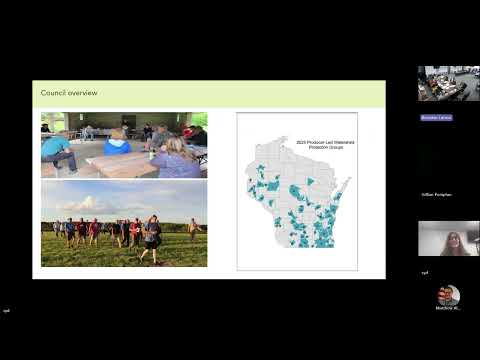
Sydney, the watershed coordinator for a local community watershed council, gave a presentation at a Vernon County Flood Mitigation Alliance meeting describing the group's work to reduce flooding and support agricultural resilience across the Kickapoo-area watershed. She said the council is farmer-led, community-driven and “entirely grant funded,” and summarized recent projects, outreach and funding pressures.
The council covers roughly 90,000 acres of mixed forest and agricultural land in the Kickapoo/River valley area and focuses on conservation cost‑share, demonstrations and watershed planning. Sydney said recent on‑the‑ground projects include a water‑diversion installation at the Valley Conservation Club, purchase of a mobile four‑pad nutrient scale for farmers, support for tree planting and expanded cover‑crop funding, and efforts to build a farm demonstration corridor linking four nearby farms with diverse operations.
Why it matters: local conservation practices such as contouring, terraces, cover crops and managed grazing can reduce runoff and sedimentation that fuel flooding. The council said those practices are known to reduce flood peaks and improve water quality, but adoption depends on outreach, peer demonstration and available funding.
Council activities and outlook Sydney described three core program areas: conservation cost‑share grants, demonstration/education events, and development of a watershed plan aligned with the EPA’s nine‑element watershed framework to help open additional funding pathways. She highlighted a recent cover‑cropping push: although the program received less money in 2024, the council funded more total acres and enrolled more participants by stretching available funds.
The council is pursuing a federal grant for a farm demonstration network — a roughly 350‑acre conservation corridor connecting four farms across a significant elevation change intended to showcase a mix of practices (stream restoration, grazing rotations, roadside rehabilitation and perennial plantings). The group also plans public events: a Kickapoo Confluence on May 3 (community event with demonstrations and outreach), a council meeting on June 6 featuring a historian speaking about PL‑566 watershed history and a free field trip to Northeast Iowa on June 5 to visit projects supported by the Iowa Flood Center.
Equipment, services and membership Sydney said the council helps make some farm equipment and tools available to producers. The council helped acquire a mobile nutrient scale (used to measure manure and nutrient loads prior to field application) and maintains a no‑till drill and roller‑crimper that can be rented; the council is developing a web checkout system and a rental agreement. On scales, Sydney said three functioning scales exist in the county (La Crosse, Galesville and one other), and additional capacity would help farmers and crop consultants perform on‑site nutrient testing.
Funding pressures and partnerships Council leaders and meeting participants repeatedly raised concern about a drop in program funding tied to pauses and rebranding of several federal programs. Sydney and board members said state funding has sustained much of the council’s work to date, but federal programs and private partners that previously provided substantial support have tightened. One county staff member reported the council received roughly 10% of the funding it saw the prior year from some federal sources (i.e., “we got about 10% of what we got last year” for some programs), and the council is exploring philanthropic partnerships, fee‑based events (ticketed “Confluence” tables) and local collaborations to diversify revenue.
Speakers at the meeting urged more outreach to producers, stronger partnerships with county services and universities, and creative local fundraising to maintain momentum. Several farmers and residents described repeated flooding on low‑lying parcels and urged the council and county to continue combining on‑the‑ground conservation with public engagement.
Ending: The council asked alliance members to publicize upcoming events and to consider how county partners can support equipment sharing, outreach and a watershed plan. Participants agreed to continue coordinating on demonstrations, equipment rental logistics and potential university partnerships.