Get Full Government Meeting Transcripts, Videos, & Alerts Forever!
Get email alerts on the Land Use Rezoning topic
No spam. Unsubscribe anytime.
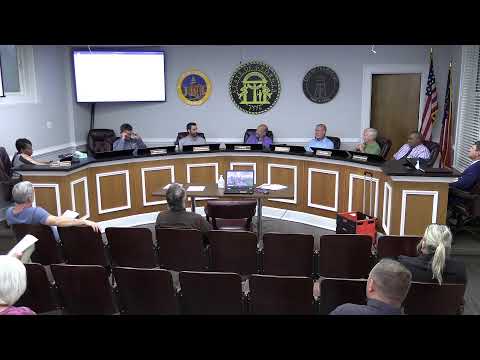
Upson County commissioners deny rezoning for Serenity Lake development after contested public hearing
Summary
After hours of testimony, the Upson County Board of Commissioners voted to deny a request to rezone roughly 266 acres for a mixed planned development called Serenity Lake. The planning staff recommended approval but the planning commission had recommended denial; residents raised concerns about water, traffic and tree clearing.
The Upson County Board of Commissioners on April 22 denied a request to rezone roughly 266 acres north of Spurlock Bluff for a planned mixed-use development called Serenity Lake, rejecting the applicant’s proposal to change the property from AR (Agricultural-Residential) to PM (Planned Mixed).
The development applicant, 10 Acres Lake LLC (represented at the hearing by Dan Springhetti and engineer Larry French), sought approval of a development plan the county planner described as a proposal to create single-family lots, an amenity area and limited neighborhood commercial uses. Staff recommended approval; the county planning commission had unanimously recommended denial on April 14, 2025, citing inconsistency with the county’s comprehensive plan and the forestry/low-density character the commission said applies to the corridor.
The planning staff, represented by Doug Currier, told commissioners the plan was intended to preserve natural amenities such as Reeves Creek and floodplain areas, and that the PM zoning would allow design flexibility and conditions tied to a development plan. Currier said the submittal in the county packet identifies a development concept and a schedule; he noted the planning commission had continued the matter several times before recommending denial. The staff report also described a proposed minimum house size (about 2,500 square feet) and cited the applicant’s stated price points in the $650,000-to-$1.5-million range.
Applicant representatives emphasized the site’s wooded character and topography and said the proposal would preserve most of the land as open area. Dan Springhetti said the project is “one of a kind” and described clubhouse and amenity plans, while engineer Larry French described preliminary studies on soils, wetlands and water supply and said the team would follow state erosion- and stormwater-control requirements.
Residents who testified opposed the rezoning for a range of reasons. Opponents said the proposal would change the area’s rural character, raised concerns about the adequacy of wells and septic systems, cited traffic and safety on Old Alabama Road, and said timbering and a controlled burn earlier in the development process had reduced tree buffers. Public commenters who spoke against the rezoning included Matt Bricker, Jessica Myers, Sheila Michael, Tammy Boyle and others; supporters included Doug Peck and Chris Young. Several speakers cited differing lot counts in materials and testimony — applicants and some staff repeatedly described the submission as a 24-lot project, while other materials and witnesses referenced 124 lots and opponents said numbers in packet materials changed over time. The transcript records both figures and that discrepancy was a recurring point in public comment and in commissioners’ questions.
County Attorney and applicant counsel highlighted procedural details: under Upson County rules the board evaluates the rezoning request against the comprehensive plan, zoning standards and the submitted development plan and schedule. Commissioners questioned water availability after a hydrology memo was discussed in the hearing (the memo recommended further testing and in some areas advised community wells may be required). Several speakers and staff said final determinations about wells and septic permitting rest with state and local health officials and a well driller’s follow-up testing.
After discussion the board heard a motion to deny the rezoning. Commissioner James Ellington moved to deny; Commissioner Jones seconded. The roll call recorded Chairman Bruce voting No, Commissioners Ellington, Jones, Biggs and Watson voting Yes; the motion to deny carried, and the rezoning was not approved.
The planning commission’s written recommendation, the staff report and multiple written public comments were available to the board in the meeting packet, and the applicant said they would consider additional study and adjustments to address the concerns raised.
Why it matters: The board’s decision preserves the property’s existing AR zoning and leaves future development options under AR or a modified submission; residents who said they moved to the area for its rural character told commissioners they viewed the denial as a protective outcome. The record shows unresolved technical questions — particularly about water supplies and the exact number and layout of lots — that would need to be addressed if the applicant re-files or pursues a different plan.
The board’s denial closes the matter for now; the applicant may revise and return, or pursue appeals available under state law.