Get Full Government Meeting Transcripts, Videos, & Alerts Forever!
Get email alerts on the Governance And Ethics topic
No spam. Unsubscribe anytime.
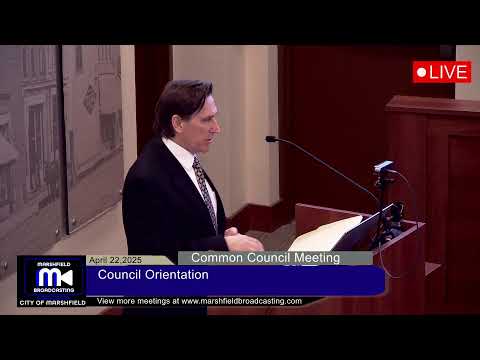
City attorney briefs Marshfield council on legal duties, open meetings and ethics
Summary
At a special April 20 meeting, the city attorney delivered an orientation for the Marshfield Common Council covering the city attorney's role, Robert's Rules of Order, open meetings restrictions, public records responsibilities and conflict-of-interest rules; the meeting ended with a brief adjournment vote.
The city attorney delivered an orientation to the Marshfield Common Council at a special meeting on April 20, covering the office's legal duties, rules for meetings and public-records and ethics responsibilities for elected officials.
The orientation explained why the city operates as a corporate entity and described the city attorney's duty to provide legal advice to council members in their official capacity. The attorney said, "We're a municipality. But that's also a municipal corporation," and emphasized the obligation to protect the municipality's interests when legal or ethical issues arise.
The attorney summarized how Robert's Rules of Order are used in the council's code and urged members to avoid so-called negative motions and to follow standard motion-then-discussion procedure except where the agenda explicitly allows informal discussion. The attorney told the council: "If a matter is in front of the body... before discussion starts up about that ordinance, it should be moved, seconded, and then the discussion takes place."
Open-meetings rules and walking-quorum risks were a central topic. The attorney warned that informal gatherings, chained emails or text exchanges can create a "walking quorum" or a "negative quorum" if enough council members discuss an issue that will appear before the body. He noted that such exchanges can expose the city to claims of violating open-meetings law, and described text messages, email and phone chains as potential traps.
On public comment and agenda control, the attorney said council members must avoid responding substantively during the public-comment period because the open-meetings law limits discussion to items noticed on the agenda. He also described a procedure for "items for future agenda" that allows members to request items and gives the full body the forum to decide whether an item should be scheduled.
The attorney reviewed public-records obligations for officials, including that communications used to make decisions become public records even if stored on personal devices or social media pages. He said members who use social media in an official capacity should preserve records, and reminded members that open-records requests can target individual members' records.
On ethics and conflicts of interest, the attorney pointed council members to the city's ethics policy (policy 3.34 in the human-resources policies) and described statutory limits, including a criminal statute the attorney said can apply when a contract or financial interest reaches a threshold. He cited an annual-threshold example from the discussion: "$15,000," and said that reaching that level can trigger legal concerns even if a member does not participate in decision-making.
The attorney also warned against individual council members directing staff to take significant actions or research without broader council direction, saying such requests place staff in a difficult position and can create expectations that the council did or will approve the change.
After a brief public exchange during which a judge in the audience asked a question about walking quorums, Alderman Wortman moved to adjourn and Alderman Tompkins seconded. The roll call included a recorded affirmative from Mr. Varshall and an "Aye" recorded for Bridal; the chair declared the meeting adjourned.
The orientation covered procedural and legal ground intended to reduce future open-records and open-meetings risk and to clarify how council members should interact with staff, the public and each other.