Get Full Government Meeting Transcripts, Videos, & Alerts Forever!
Get email alerts on the Vg I Pilots And Programs topic
No spam. Unsubscribe anytime.
California IOUs and CEC report many VGI pilots; utilities say most activity remains short‑term research
Summary
PG&E, SCE, SDG&E and the California Energy Commission said California has many VGI pilots but most activity remains research‑focused; panelists urged translating pilot learnings into enduring programs and clearer value metrics.
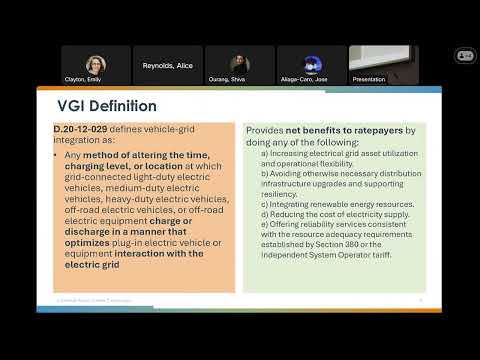
Representatives of California's three investor‑owned utilities and the California Energy Commission told the CPUC VGI forum that the state has a large, active set of vehicle‑grid integration demonstrations but that most work is in pilots or R&D rather than long‑running customer programs.
Mike Delaney, Vice President of Utility Partnerships and Innovation at PG&E, said the utility serves over 700,000 electric vehicles in its territory and has an ambition to reach 3,000,000 EVs by 2030 (as stated at the forum). "As part of that, we have an ambition to have 550 megawatts of vehicle grid integration," Delaney said. He added PG&E currently reports about 55 megawatts of flexible load on its system and that VGI can both increase EV value to customers and provide grid flexibility that lowers rates.
Brian Chen, who moderated the IOU panel for PG&E, told attendees that much IOU activity remains time‑bound pilot work, with the notable exceptions of existing time‑of‑use rates and emergency load reduction programs. "Pilots are time bound and short lived, as they should be. But the unfortunate result of that is when you actually need something more enduring...the most expedient regulatory path is to spin up another pilot," he said, adding that the sector needs clearer mechanisms to translate pilot learnings into enduring program offerings.
Peter Chen of the California Energy Commission outlined the CEC's role in technology funding (EPIC, REDWIDs and other grant programs), analysis and reporting (AB 2127 statewide charging assessment, IPER reports), and standard support such as the V2G equipment list and the recently announced Chargeyard initiative to support interoperability testing. He flagged new statutory authority from SB 59 to require bidirectional capability on vehicles if a sufficiently beneficial use case is demonstrated.
Southern California Edison and San Diego Gas & Electric panelists described similar work: pilots across campuses, school‑bus V2G demonstrations, customer‑facing managed charging trials, and partnerships with CCAs and automakers. SCE's Aaron Dyer said the state is "further ahead on the customer vehicle side" in terms of device and third‑party capability, but that integration into system planning remains challenging. SDG&E's Nick Fiore said some customer segments (for example, school districts and commercial fleets) show clearer site‑level value for V2G, while residential managed charging still needs clearer compensation mechanisms to scale.
Why it matters: forum participants emphasized three recurring barriers to scaling pilots into programs — establishing a trusted, measurable value for distribution and generation benefits; improving interoperability and lowering capital/installation costs for bidirectional hardware; and designing durable scaling mechanisms (rates, programs or non‑rate funding) that align utility operations, third‑party providers and customer experience.
The utilities and CEC urged continued cross‑sector coordination so EPIC and other R&D investments feed into commission rulemakings on demand flexibility, interconnection and retail rates.