Get Full Government Meeting Transcripts, Videos, & Alerts Forever!
Get email alerts on the Transportation Electrification topic
No spam. Unsubscribe anytime.
CPUC president: scale vehicle‑grid integration to cut EV costs and avoid grid upgrades
Summary
Alice Reynolds, president of the California Public Utilities Commission, opened the VGI forum urging faster scaling of vehicle‑grid integration pilots into durable programs and stressing dynamic rates, pilots (V1G/V2G), and interagency coordination to keep EV fueling affordable and limit grid upgrades.
Alice Reynolds, president of the California Public Utilities Commission, opened the commission's second annual Vehicle‑Grid Integration (VGI) forum urging stakeholders to move from isolated pilots toward scalable programs that keep electric‑vehicle fueling affordable.
"I'm Alice Run, president of the California Public Utilities Commission. And I'm the assigned commissioner for the transportation electrification proceeding," Reynolds said at the forum, noting the commission's role in coordinating VGI work across multiple proceedings.
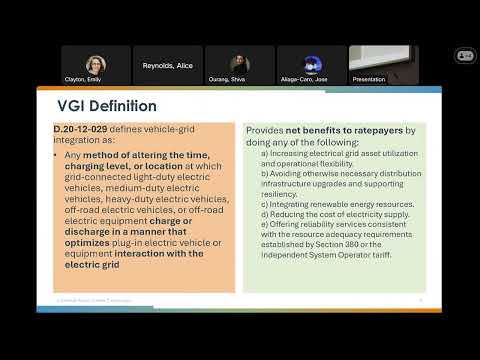
Reynolds said California is "really establishing cutting edge technologies" and highlighted pilots for both unidirectional and bidirectional charging (V1G and V2G) already underway. "We are particularly focused on how VGI can help keep costs down by maximizing the use of existing grid infrastructure and really minimizing upgrades where possible," she said, adding that properly designed managed charging and dynamic rates can make EV ownership more accessible.
Why it matters: the CPUC is trying to align multiple regulatory tracks so learnings from demonstrations feed into rates, interconnection and planning. Reynolds urged stakeholders to provide practical input at the forum so the commission can consider those lessons in related proceedings on demand flexibility, distributed energy resources, interconnection and transportation electrification.
The president also noted the commission's objective to focus on rates and demand flexibility, technology enablement, and using common planning inputs so VGI deployment does not lead to unnecessary infrastructure overbuild. "We are always looking for ways to keep costs down, especially in direct ways because we know that any cost that's borne by rate payers makes EV fueling more expensive," Reynolds said.
Reynolds said she could not stay the whole day but that CPUC staff and her adviser would collect notes from the forum. She called the pilots underway "critical for shaping what's next in California" and thanked IOUs, the California Energy Commission and other participants for their work advancing VGI demonstrations.
Reynolds concluded by encouraging a broad set of stakeholders to collaborate on turning pilot learnings into practical programs and rate designs that convey the value of flexible EV load without shifting unfair costs to other utility customers.