Get Full Government Meeting Transcripts, Videos, & Alerts Forever!
Get email alerts on the Alaska Lng topic
No spam. Unsubscribe anytime.
AGDC updates House committee on Alaska LNG: private developer to fund FEED, state retains 25% rights
Summary
Alaska Gas Line Development Corporation told the House Resources Committee that private developer Glenfarn will fund front-end engineering work toward a final investment decision, the state retains a 25% perpetual stake in 8 Star Alaska, and legislators should expect near-term choices about whether to buy equity in the subprojects.
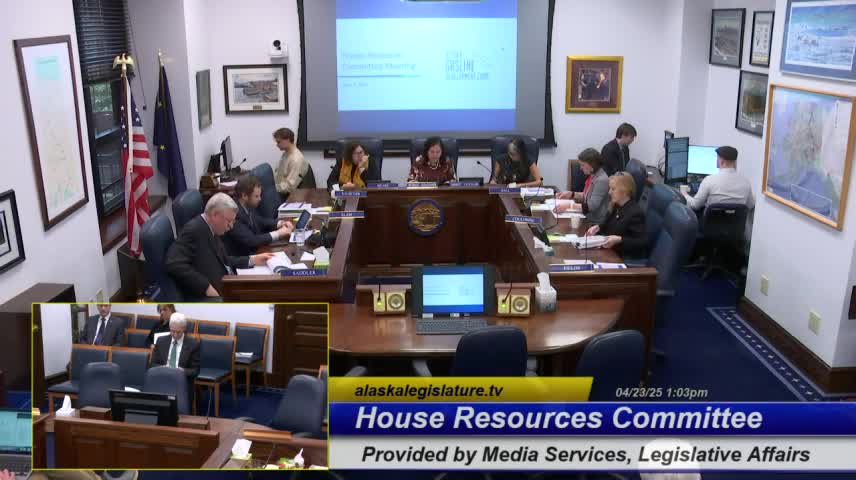
The Alaska Gas Line Development Corporation told the Alaska House Resources Committee on April 23 that a private lead developer will carry most pre‑FID costs for the Alaska LNG project and that the state retains a 25% ownership stake in the project developer entity.
For the record, Frank Richards, president of the Alaska Gas Line Development Corporation, said the private developer Glenfarn "has made the decision to suspend discussions about the ADA backstop" and will proceed with funding development work. Matt Kissinger, Venture Development Manager for AGDC, told the committee FEED (front end engineering and design) and other pre‑FID activities are roughly "$50,000,000 per element" — meaning about $50 million each for the gas treatment plant, the pipeline, and the liquefaction facility as an initial estimate.
The matter matters because those pre‑FID steps and any decisions to invest state funds would determine both the timeline and Alaska's financial exposure. AGDC and the developer described a multi‑step path to a final investment decision (FID) that requires FEED, permits, offtake and gas sale agreements, EPC contracts, and debt financing. Kissinger said these elements, taken together, are what lenders use to underwrite project finance and make a FID possible.
AGDC emphasized the state already holds a perpetual 25% stake in 8 Star Alaska LLC, the top‑level project company. "That doesn't end at FID," Kissinger said, adding the 25% ownership of 8 Star yields a revenue stream AGDC described as "developer economics" that would flow to the state in perpetuity. Richards and Kissinger also described a separate option for the state to invest up to 25% equity in each subproject at the subproject FID; AGDC said that investment would be an appropriation decision for the legislature.
Committee members asked detailed budget and timeline questions. Kissinger said finance modeling assumed a 12% rate of return for a well‑contracted project. Richards and Kissinger provided a high‑level project cost breakdown cited by AGDC: a total project estimate of about $44 billion, with roughly $14 billion for the pipeline (about $11 billion attributable to the phase‑1 pipeline), $10 billion for an Arctic carbon capture facility, and $18 billion for the liquefaction terminal. Using an illustrative $10 billion pipeline example, Richards said a 75% debt / 25% equity split would imply about $2.5 billion of equity for the pipeline and a roughly $625 million state share if Alaska elected to take a full 25% equity stake in that subproject.
On the role of the legislature, Kissinger and Richards told members the legislature would not revisit the earlier delegation that allowed AGDC to engage a lead developer; AGDC's definitive agreements with Glenfarn are executed and AGDC said it was created by statute to represent state interests. Richards said the legislature will, however, be "intimately involved" in any later decision where the state would commit appropriations or otherwise invest equity in a subproject.
Members sought milestone dates that would show when FEED entry or FID might occur. Kissinger said FEED entry milestones for the pipeline, gas treatment plant and liquefaction facility are the primary schedule triggers but that specific dates are subject to confidentiality. AGDC said an accelerated path could produce a pipeline FID sooner than the conservative chart provided; the committee was told a possible earliest FID on the pipeline could be by the end of the current year if many conditions align, while the public schedule showed financing activity in 2026 and potential first gas in the early 2030s.
The committee also discussed the Fairbanks spur (a lateral to serve Fairbanks). Richards said the mainline and the Fairbanks lateral are distinct projects: AGDC has previously done FEED and a class‑3 cost estimate for the Fairbanks lateral and has a memorandum of understanding with an Alaska pipeline company that may update the FEED and cost estimate in parallel with phase‑1 work. Richards said off‑take responsibilities, tariff decisions and utility hookups will be a matter for the local utilities and the Regulatory Commission of Alaska.
Workforce and training were raised repeatedly. Warren Christian, AGDC board chair, said the federal Alaska Natural Gas Pipeline Act contains a $20 million training provision (not yet appropriated) and asked the committee and federal delegation to support funds to scale training in Alaska. Christian said the Fairbanks Pipeline Training Center exists but that Alaska will need many regional training centers and an earlier start on specialty craft training to avoid relying on out‑of‑state labor.
On revenue projections, Commissioner Adam Crum of the Department of Revenue told the committee his office is preparing an updated revenue analysis based on the current developer arrangement and new market conditions; he committed to providing more detailed material in writing to committee staff. Crum said a March 2023 analysis underlies the chart members were reviewing and that the department is preparing updated detail, including breakdowns of property tax, royalties and corporate tax timing.
No formal votes or committee actions were taken at the hearing. Committee members requested written milestones and the Department of Revenue's updated revenue analysis, and commissioners and AGDC staff agreed to follow up in writing.
"We were created as a state corporation with this specific mission to represent all of Alaska," Richards said, describing AGDC's oversight role as the project advances and developers execute FEED and commercial agreements. The House Resources Committee concluded the session by instructing staff to collect the written materials and continue oversight work as milestones and financing decisions approach.