Get Full Government Meeting Transcripts, Videos, & Alerts Forever!
Get email alerts on the Geologic Carbon Sequestration topic
No spam. Unsubscribe anytime.
State agencies outline plan to test geologic carbon sequestration on state lands
Summary
DOGAMI and the Department of State Lands described a proposed subsurface test well on state-owned parcels in the Columbia River Basalt, and a governor’s budget request of up to $10 million from a land-revolving account to support initial work; agencies said the research would inform regulatory design and potential private investment.
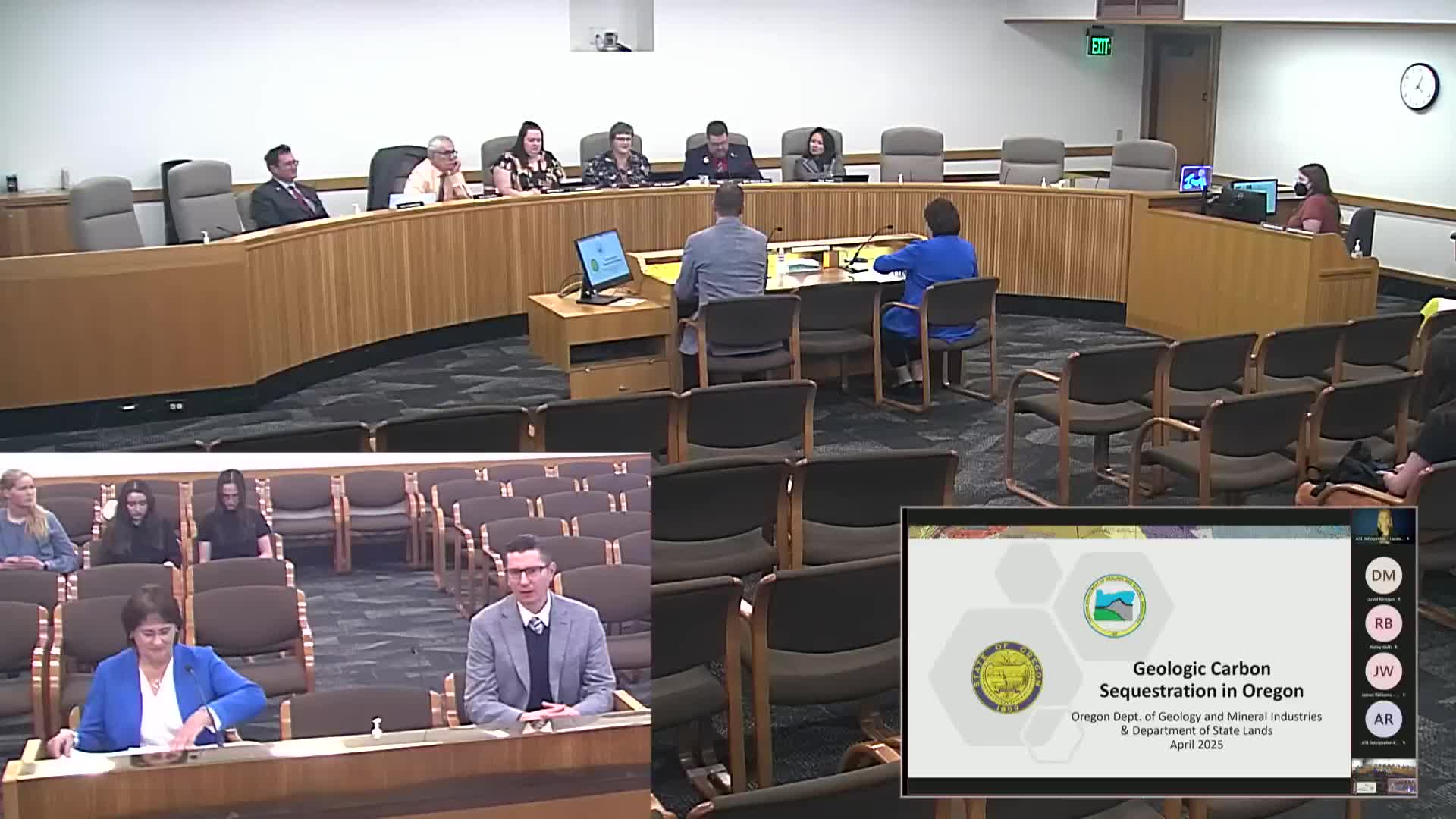
The Oregon Department of Geology and Mineral Industries (DOGAMI) and the Department of State Lands briefed the Senate Committee on Energy and Environment on April 23 about a proposed geologic carbon sequestration test well program on state lands in northeast Oregon.
DOGAMI director Rory de Stierrot described the technical opportunity in the Columbia River Basalt and said peer projects (notably Carbfix in Iceland) have shown basalt mineralization can fix carbon in solid minerals on relatively short time scales. "Everything that I'm gonna present today has been either featured on 60 Minutes, is in National Geographic, or is buried in a much more scientific press," de Stierrot said, introducing the science and mapping work the agency has done.
State Lands funding request and objectives - Vicki Walker, director of the Department of State Lands, said the Governor and State Land Board included a proposal in the governor’s budget (policy option package 217) asking for limitations to allow up to $10,000,000 from the Common School Fund Land Revolving Account to support initial work. "The Governor, with the support of the State Land Board, has recommended in her budget a project... policy option package 217. And it requests limitation for the project... up to $10,000,000," Walker said. - Walker said the Land Revolving Account currently holds about $46 million and that revenues from state lands support the Common School Fund; the Department prefers sites where it controls both surface and subsurface rights so it can collect fees and manage leases comprehensively.
Technical potential and next steps - DOGAMI showed maps indicating widespread Columbia River Basalt of sufficient depth (testimony referenced a depth contour exceeding about 2,600 feet) in parts of northeast Oregon and southeast Washington; Pacific Northwest National Lab work cited in testimony estimated up to 40 gigatons of CO2 storage potential in the full Columbia River Basalt formation (national estimate; Oregon’s share is smaller). - DOGAMI said its immediate work would be to drill an informational test well to evaluate porosity and other subsurface properties; if promising, the agencies said they would return to the legislature to advance regulatory structures and to support private investment.
Regulation, monitoring, and costs - Witnesses noted that injection projects in the U.S. are regulated under EPA’s Underground Injection Control (UIC) Class VI framework and that the regulatory bar is high because of drinking-water protections. DOGAMI said mineralization in basalt reduces long-term monitoring needs compared with saline-sandstone sequestration because CO2 reacts with rock to form stable minerals. - Senators asked about costs and scale. Testimony acknowledged wide cost ranges depending on capture method: point-source capture with existing tax incentives may have lower per-ton costs than direct air capture paired with mineralization. DOGAMI agreed to follow up with more specific cost ranges for committee consideration.
What did not happen - The hearing was informational; no procurement, lease, permit, or appropriation was approved at the session. The budget request remains subject to the State Land Board, investment council consultation, and the legislative budget process.
Ending note - Agencies emphasized the research value of a state-led test well: data would inform DEQ, Water Resources, and other agencies, shape regulation, and help Oregon decide whether and how to host commercial sequestration projects.