Get Full Government Meeting Transcripts, Videos, & Alerts Forever!
Get email alerts on the Wind Siting Threshold topic
No spam. Unsubscribe anytime.
Panel hears bill to let counties site larger wind farms, adds decommissioning requirement
Summary
House Bill 3,874 would increase the county siting threshold for wind facilities from 50 megawatts to 100 megawatts and the dash-1 would require a county review to include a decommissioning plan and financial security; county officials and renewable groups supported the change while proponents said it aligns with evolving turbine technology.
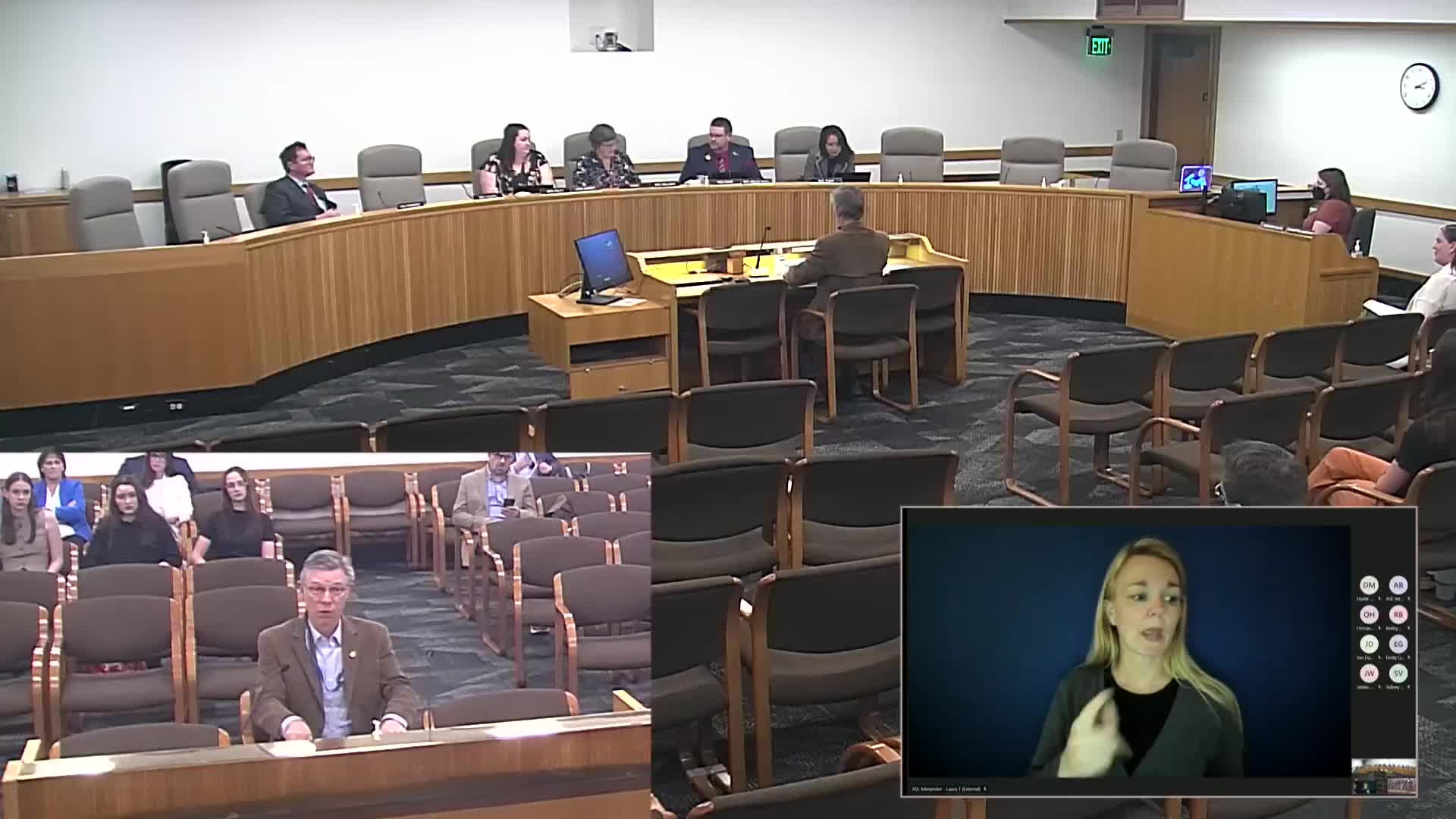
The Senate Committee on Energy and Environment received testimony April 23 on House Bill 3,874, which would let counties review and permit wind energy facilities with average electric generating capacity up to 100 megawatts rather than the current 50 megawatts threshold that generally triggers review by the Energy Facility Siting Council (EFSC).
Sponsor and supporters said the change reflects advances in turbine technology that put more megawatts on each tower and can reduce project footprints. "The new power heads and some of the towers are capable of 4 and a half or so as I understand it," Representative Ken Helm told the committee, adding that permitting more projects at the county level preserves developer choice and can allow smaller local developers to pursue projects under county processes.
Dash-1 amendment: decommissioning plan - Paige Pruitt, chief of staff for Rep. Pam Marsh, read written comments supporting a dash-1 amendment that would require applicants to submit a decommissioning plan and financial security (bonding or similar) for facilities with generating capacity of at least 50 but less than 100 megawatts. "Proposed dash 1 amendment simply requires the submission of a decommissioning plan, including bonding or other financial security to ensure the plan can be executed when it is needed," Pruitt said; testimony said the language parallels existing solar decommissioning requirements.
Local government experience and economic benefits - Joe Debulskis, Sherman County judge and chair of the Community Renewable Energy Association (CREA), urged approval and described Sherman County’s multi‑decade experience hosting wind projects. He told the committee, "We have a total of 12 projects in Sherman County wind turbines. There's 612 is turbines out there... Our last project came online 3 years ago this month." Debulskis said the county distributes about $590 per household annually from wind project revenues and that local planning staffs have experience handling siting reviews. - Brandon Persinger of the Association of Oregon Counties said the bill “would give additional local authority to the siting of renewable energy on the county level” and noted it parallels prior legislature changes that increased local permitting authority for solar.
Support from clean-energy groups and industry - Renewable Northwest, represented by Emily Griffiths, and the Northwest and Intermountain Power Producers Coalition (NIPC), represented by Sydney Villanueva, testified in support, saying the change would give developers flexibility to choose county or state permitting and could help projects move forward more efficiently.
Context and trade-offs - Supporters framed the bill as consistent with previous legislative actions that raised acreage thresholds for solar permitting at the county level (testimony referenced House Bill 2,329 (2019) and House Bill 3,179 (2023) as prior changes for solar). The bill does not remove the option for developers to go to EFSC; it increases the megawatt threshold at which counties may provide the local siting path.
What did not happen - The committee took testimony and closed the hearing; no committee vote was taken during this session.
Ending note - Several supporters asked that the committee advance the bill so counties with experience can continue to be an option for siting projects, while testimony indicated EFSC remains the pathway for the largest, more complex projects.