Get Full Government Meeting Transcripts, Videos, & Alerts Forever!
Get email alerts on the 30 30 30 Initiative Education topic
No spam. Unsubscribe anytime.
OHSU reports early gains on 30‑30‑30 education initiative; cites scholarships and simulation expansion
Summary
OHSU told lawmakers it has begun meeting its 30‑30‑30 targets — increasing graduates and student diversity — while expanding scholarships, simulation and clinical placements to boost the health workforce across Oregon.
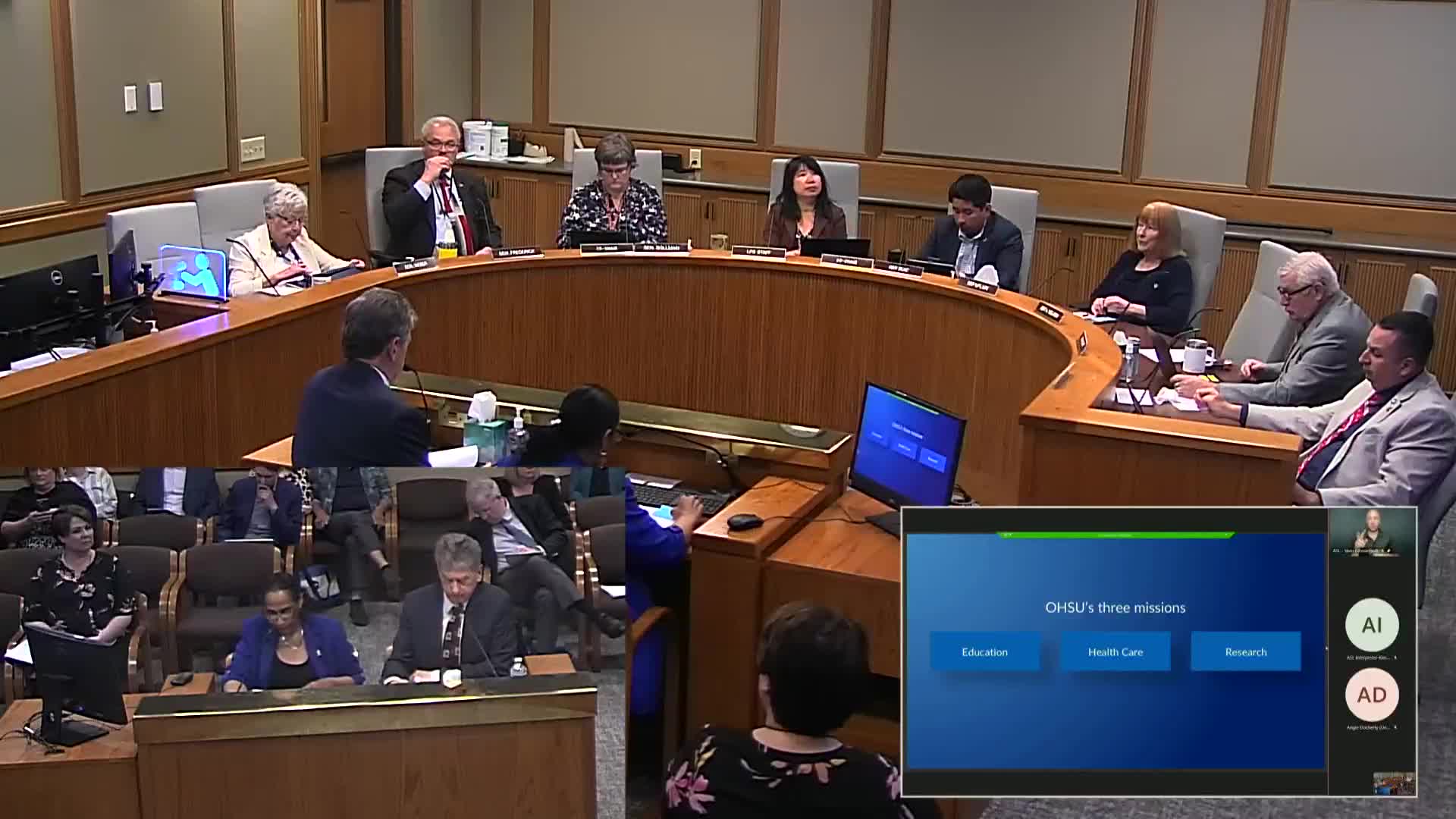
Oregon Health & Science University officials told the Joint Committee on Ways and Means Subcommittee on Education on April 23 that investments tied to the institution’s 30‑30‑30 initiative are producing early gains in graduate counts and student diversity.
“Right now, we have approximately 5,100 students, residents, fellows, and postdocs,” said Marie Chisholm Burns, provost at OHSU, introducing the education portion of the presentation. “The OHSU 30‑30‑30 initiative … will increase the number of graduates in certain health care programs by at least 30 percent, and we will increase student body diversity to at least 30 percent by 2030.”
Chisholm Burns told lawmakers that programs participating in the initiative had a baseline of 553 graduates and that in 2023–24 the programs produced more than 600 graduates, an increase the university characterized as greater than 9 percent. She said student‑body diversity rose from a baseline of 22 percent in fall 2022 to 31 percent in fall 2023 and 30.5 percent in fall 2024.
OHSU reported scholarship activity tied to the initiative and to other sources: about 300 students have been awarded roughly $6,500,000 in scholarships tied to 30‑30‑30, with students receiving awards for the full length of their programs. Chisholm Burns said “more than 60 nursing students have been awarded greater than $4,500,000 in scholarships.” The university said scholarship and other supports help with recruitment, persistence and completion.
Officials also described investments that increase student support and clinical capacity: an expanded academic success center that cut wait times for learning‑support appointments from about six weeks to less than a week; new simulation equipment and faculty; reduced full‑time nursing faculty vacancy rates from about 10 percent in 2022 to less than 4 percent; an accelerated baccalaureate nursing site in Bend operated in collaboration with St. Charles Health System and Central Oregon Community College; and hiring enrollment professionals to boost recruitment and retention.
Dr. Angie Docherty, campus associate dean for the OHSU School of Nursing at the Monmouth campus, told the committee the Monmouth campus has used 30‑30‑30 funding to increase enrollment by 25 percent over two years and plans a further 25 percent increase. “This funding is directly supporting a significant increase in our student enrollment,” she said, adding that 95 percent of the campus’s graduates are employed in Oregon.
OHSU officials also highlighted degree production across schools: 286 students in the Doctor of Dental Medicine program (68 DMD degrees awarded in 2023–24), more than 1,100 students in the School of Nursing across five campuses, and 554 MD students in the School of Medicine. The provost said OHSU awarded 1,295 degrees and certificates in 2023–24 and that the university’s total awards have exceeded a 1,000‑degree target in recent years.
Committee members asked how the university balances diversity goals with admissions standards. Chisholm Burns said admissions remain holistic and program‑specific (for example, medical applicants use MCATs and the dental school uses DATs) and that the university’s definition of diversity is broad and includes geography, socioeconomics, veterans, first‑generation college students and other factors.
The presentation and follow‑up testimony tied OHSU’s education investments to the institution’s $173 million appropriation request and to the Legislature’s decision on how to support statewide workforce development.