Get Full Government Meeting Transcripts, Videos, & Alerts Forever!
Get email alerts on the Ohsu Budget Appropriation topic
No spam. Unsubscribe anytime.
OHSU asks Legislature for $173 million biennial appropriation, flags grant losses and rising costs
Summary
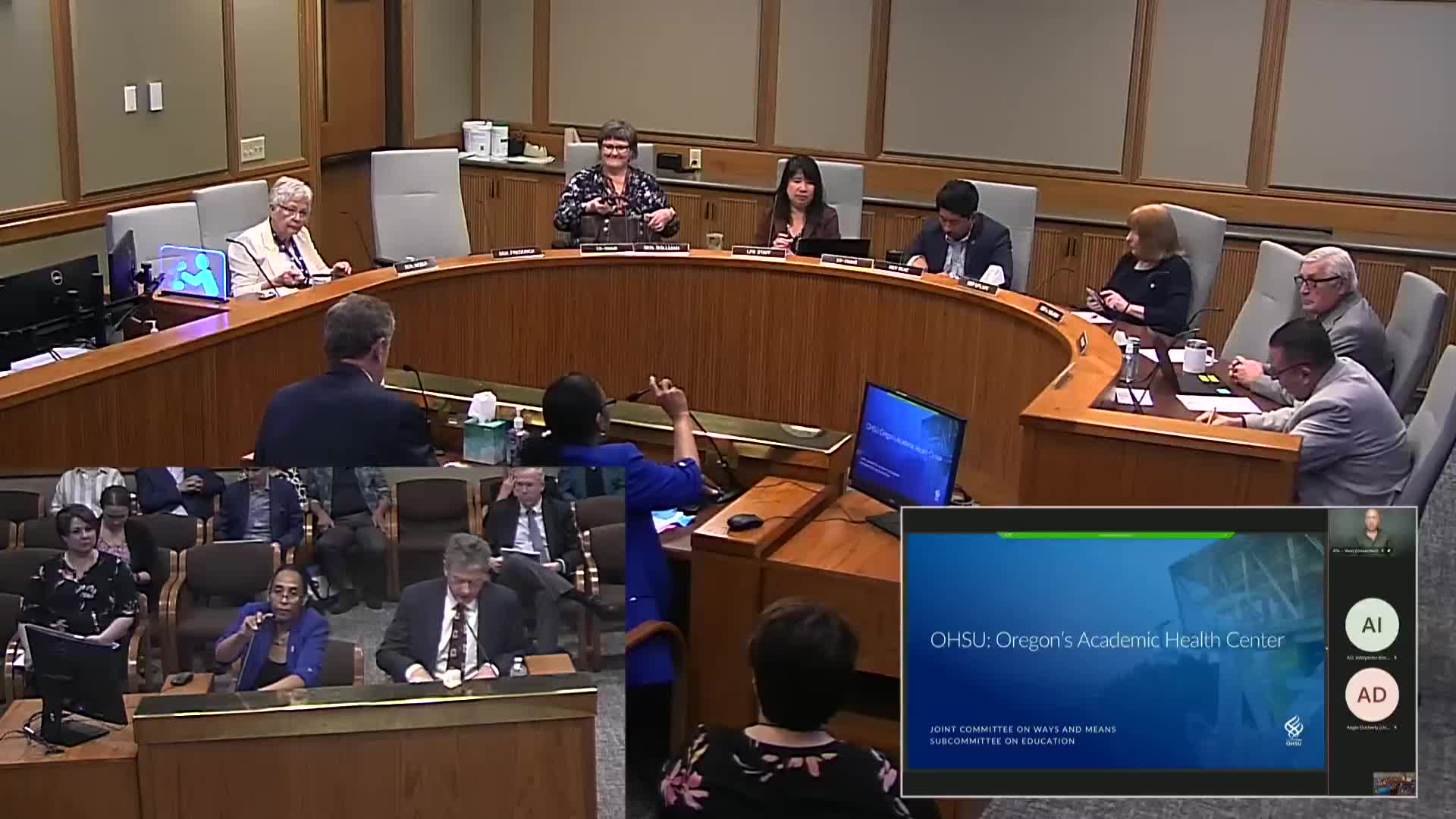
Oregon Health & Science University told the Joint Committee on Ways and Means Subcommittee on Education on April 23 that it is seeking a current service‑level appropriation of just over $173,000,000 for the biennium and warned lawmakers that federal grant cancellations and rising labor costs are tightening the university’s budget.
Oregon Health & Science University told the Joint Committee on Ways and Means Subcommittee on Education on April 23 that it is seeking a current service‑level appropriation of just over $173,000,000 for the coming biennium and warned lawmakers that federal grant cancellations and rising labor costs are tightening the university’s budget.
“For the record, my name is Steve Statham. I serve as interim president at OHSU,” said Steve Statham, interim president at Oregon Health & Science University, during the informational presentation. “OHSU state appropriation is a small but very vital part of supporting the university.”
The request matters to the state because the appropriation leverages larger federal and private dollars and supports programs statewide, presenters told the committee. OHSU described itself as Oregon’s only academic health center, combining patient care, biomedical research and professional education.
Lawrence Fernstall, OHSU’s executive vice president and chief financial officer, told legislators that OHSU’s operating expenses for the current fiscal year are about $5.48 billion and operating revenues about $5.46 billion. Salaries and benefits are the largest expense, making up roughly 62 percent of operating costs; tuition and fees account for about 2 percent of revenue and the state general fund appropriation about 1.5 percent of OHSU’s overall budget in the current fiscal year. Fernstall said the state appropriation makes up over 47 percent of the School of Nursing’s budget and about 40.5 percent of the Poison Center’s budget.
Statham and other presenters listed financial pressures: implementation of state laws such as nurse staffing ratios, tariffs and inflation driving up costs, and a reported $5,500,000 in canceled grants and subgrants tied to federal funding changes. Statham said OHSU’s labor costs have risen from 57.9 percent of the budget in FY19 to more than 62 percent currently. The university also reported $584,400,000 in sponsored research awards in FY24 and said it ranked 36th out of 2,838 NIH‑funded institutions that year.
OHSU emphasized how a relatively small state investment supports programs that would be harder to sustain otherwise. Fernstall noted the institution’s bond‑issuing authority granted when OHSU became a public corporation in 1995; OHSU currently holds a Standard & Poor’s A+ rating with a stable outlook. He said the university’s operating revenue has increased roughly tenfold since 1995 and that OHSU now employs thousands of people across Oregon.
Committee members asked about details behind the canceled grants and how state support helps stabilize tuition and workforce training. Statham said he would follow up with specifics on the grants. After the informational presentation the committee opened a public hearing on Senate Bill 5525 and received testimony from OHSU‑affiliated witnesses and partners.
The presentation and public hearing provided lawmakers with financial figures and program dependencies as they consider the governor’s and agency budget proposals. OHSU officials said continued state support helps maintain statewide clinical training, rural placements, the Poison Center and other programs that they said would be difficult to sustain without the appropriation.
Next steps: the university submitted additional materials for the record and told legislators it would follow up with requested grant details and other supporting documentation.